Cebrail 25, 1790 — Commissioned by the Oothoonian Union’s [1] space agency, a new feature documentary surveys the Kenomitian Sphere’s archeotech ruins—Dyson debris, numina, and preserved archologies—arguing that Hylic ingenuity fused technomagic with science. The film invites education, debate, and sober stewardship of hazardous legacies.
The Kenomitian Sphere stands in the Late Third Age of the Gnostic Era, within the Epigenetic Aeon. Its current capabilities mirror a mature interplanetary society, yet the Hylic Era still overshadows it. That prehistoric age attained 3000-level advances before collapsing into Pandemonium.
The new documentary frames the ruins not as mythic curiosities, but as infrastructures that once functioned at planetary scale. The filmmakers adopt a public-interest stance: explain, contextualize, and warn. Their thesis is simple. Understanding Hylic archeotech is a civic duty, not an occult hobby.
The Oothoonian Union’s space agency funded an independent crew to synthesize years of expedition footage, telemetric surveys, and archival reconstructions. The result is a two-hour chronicle structured as an itinerary through the system’s principal sites and their surviving logics. Producers stress transparency about uncertainty. Simulations are flagged, dates carry confidence ranges, and the narration distinguishes observation from inference. Fieldwork partners include several university labs and guild ateliers specializing in Sorcery.
Serving as the film’s principal expert, Dr. Aria Randolph appears in interview segments and annotated walk-throughs. “We are not chasing legends,” she says. “We are auditing infrastructure that once worked.” Her caution tempers spectacle with method. The premiere lands with simultaneous releases to civic halls, guild academies, and public holotheaters. Educational licenses follow next quarter, paired with curricular briefings for provincial ministries.
Engines of Creation in the Inner Sphere
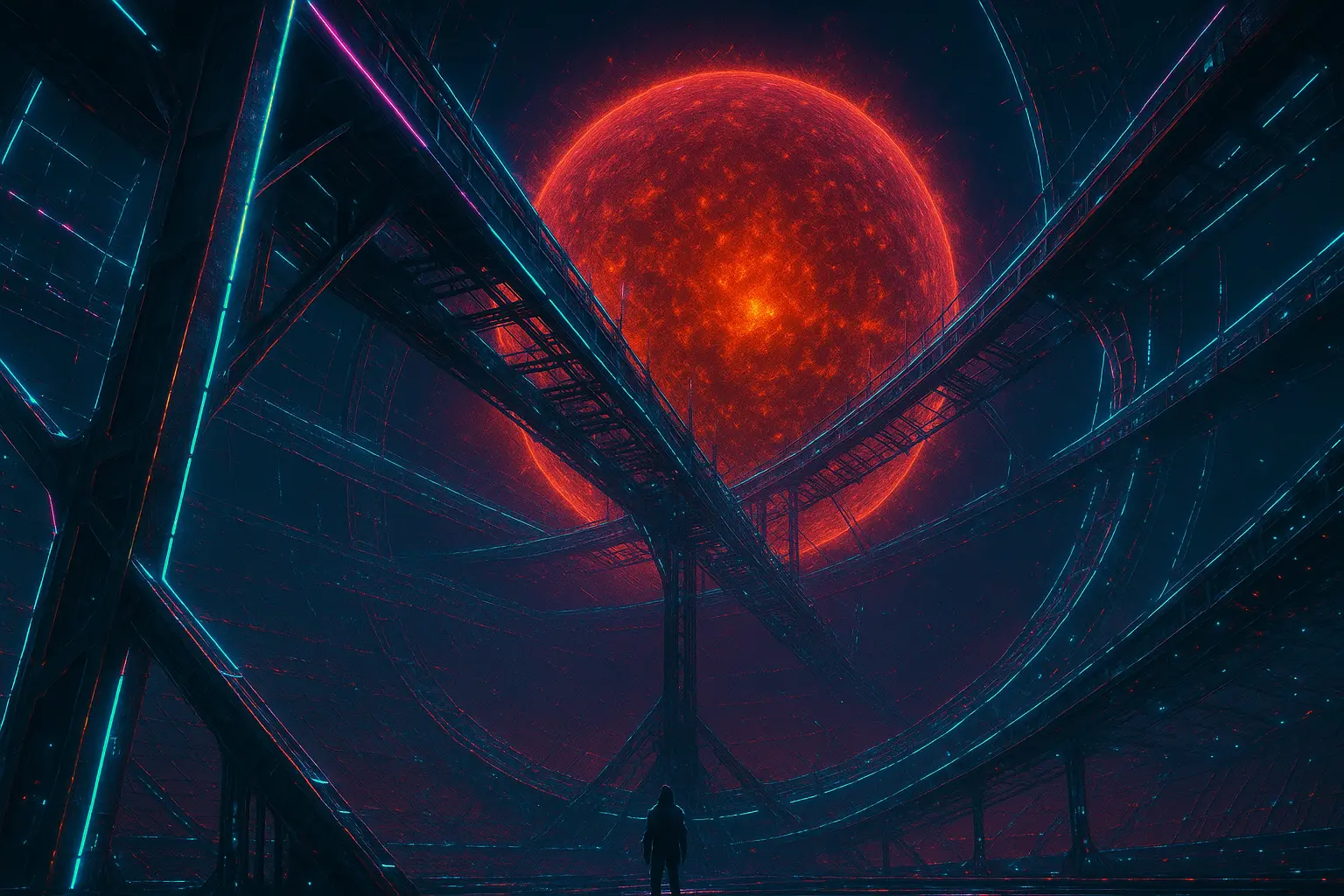
The itinerary opens at Yaldabaoth, the system’s red dwarf. There, a fractured Dyson swarm still inscriptions Hylic ambition. Panels drift, girders yaw, and collector lattices glint with dead telemetry. The swarm never recovered from the cascading failures triggered during the Pandemonium events.
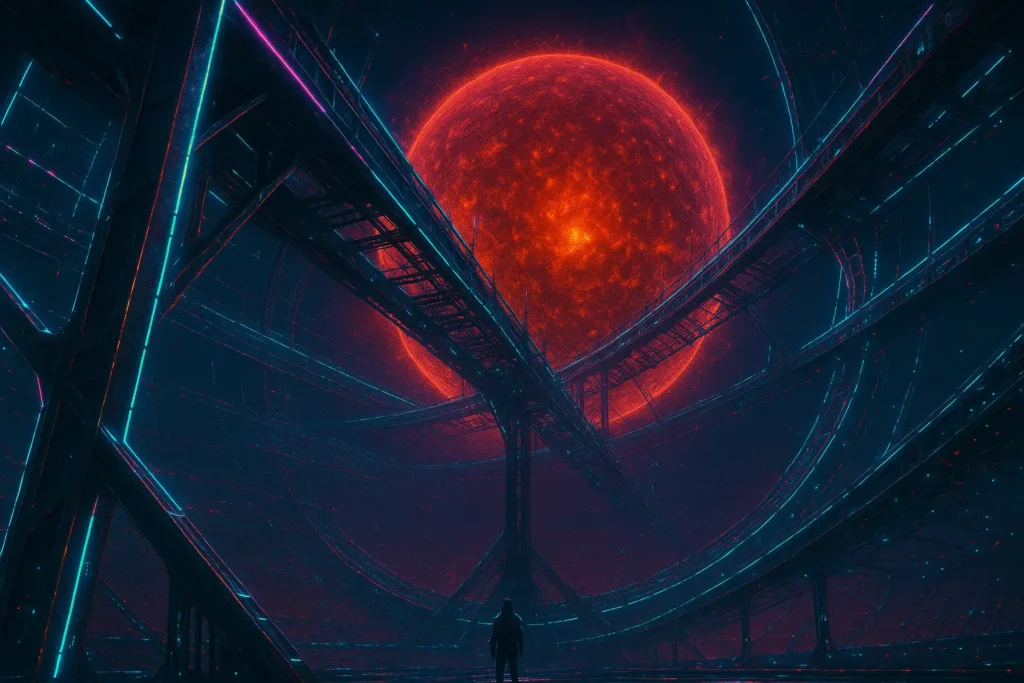
The fractured Dyson swarm at Yaldabaoth, a monument to the Hylic Era’s collapse. Engineers once balanced energy budgets at an astronomical scale (Credit: Kenomitian)
The narration treats the swarm as a civic mirror. Hylic engineers once balanced energy budgets at astronomical scale. Redundancy was lavish. Yet safeguards proved brittle against systemic malice and solar violence. A familiar tension surfaces: optimization versus resilience.
One week outbound by subluminal courier lies Pronoia, astrologically keyed to Telegnosis, the Way of Observation. The film reveals crumpled therion habitats and a biomechanical gas-mining station. Vats and tendrils once refined atmospheric feedstock using vril flux and symbiotic cultures.
The camera lingers on valves fused with cartilage-like ribs, then pulls back to show autoclaves as large as towers. “Hylic design dissolves the boundary between lab and landscape,” Dr. Randolph notes. “Biology is not a payload here; it is a chassis.”
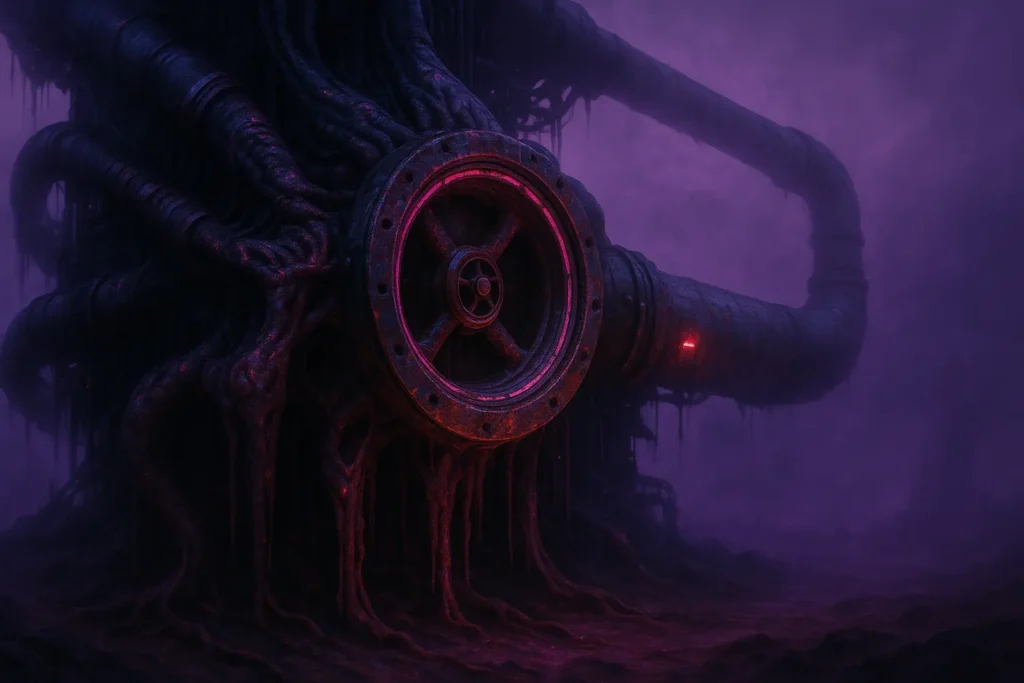
Hylic design dissolved the boundary between lab and landscape. Cartilage-like valves mark Pronoia’s abandoned biomechanical gas-mining station (Credit: Kenomitian)
Automated Stewardship on Henosis
Henosis, a Venus-sized Gaian, rotates within the glitter of Eídein’s shattered rings. The film documents self-directed maintenance swarms, now dormant, that once patrolled ring lanes and station trusses. Their housings resemble carapace armor, painted with algorithmic heraldry.
A nomadic hive of panarthropod-like robots is seen drifting along the ring debris, docking at skeletal gantries. Their mission profile, reconstructed from partial glyphs, reads: “Monitor elioud infrastructure.” The phrase suggests hybrid jurisdictions—golems and mantics overseeing public works.
Production designers built clean overlays to show traffic once coursed here: ore skiffs, beam ferries, and priest-engineer couriers. The effect is reverent without hagiography. Automation did not free people from governance; it encoded governance into motion.

Automated stewardship. Panarthropod-like maintenance swarms with algorithmic heraldry drift near Henosis, their mission profile: “Monitor elioud infrastructure.” (Credit: Kenomitian)
Terraforming Ambitions at Phronesis and Prophania
On tidally locked Phronesis, associated with Correspondence, the film surveys thermal buffer trenches that snake across the terminator. These trenches tried to tame glare and shadow, vent super-volcano throats, and thaw abyssal ice. The attempt stalled and then failed.

The scar of ambition. Thermal buffer trenches snake across Phronesis’s terminator, marking the massive, failed attempt to tame glare and shadow (Credit: Kenomitian)
Orbiting Prophania, a Hadean satellite, a grander ambition surfaces. Hylic planners began converting the moon into an azothic gate. The surviving pylons resemble mountain ranges extruded into perfect arcs. Their alignment implies a transit lattice linking realms, not merely locations.
“Azothic gates are not tunnels,” Dr. Randolph says. “They re-index reality. You do not go through; you are readdressed.” Her point lands softly. The risk was total. The promise, likewise.
Factories of Glass and Fields Against Time
The itinerary turns to Heimarmene, where blade storms shear the horizon. Here a malfunctioning alchemical factory still breathes. It was designed to synthesize super-glass from first principles, an Abacomantic feat that marries vril compression with ritualized lattice-seeding.
Footage reveals production bays cycling, stalled mid-incantation. Chimes toll from cracked resonators. A brief field test shows why salvage remains banned. A pried panel releases a gust that vitrifies dust midair. The crew withdraws quickly, nerves unmasked.
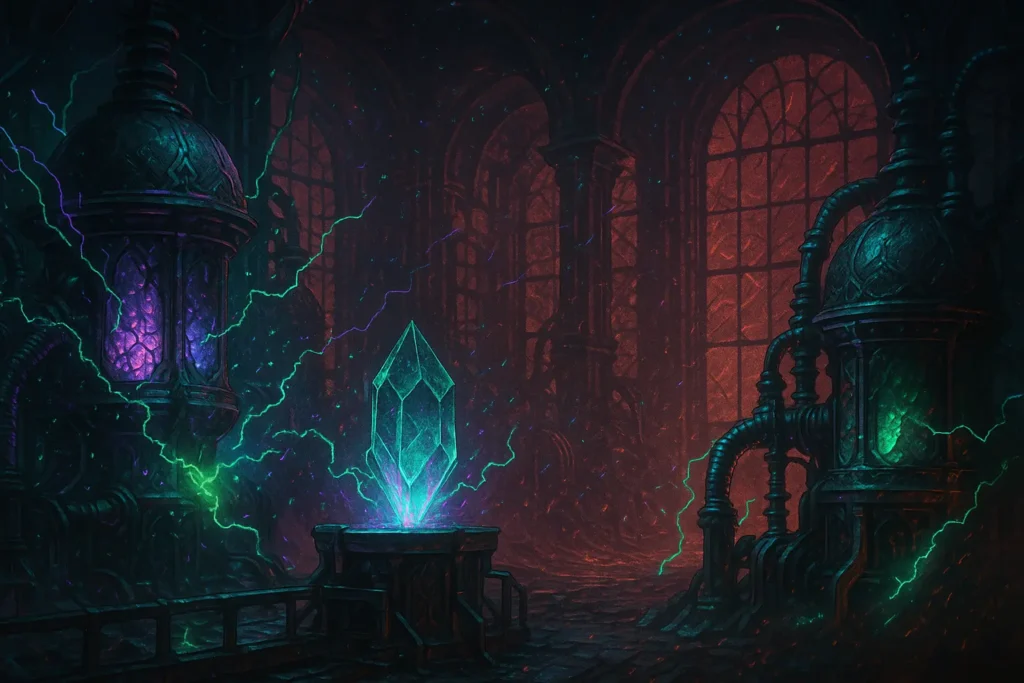
Salvage remains banned. Inside Heimarmene’s alchemical factory, production bays cycle, stalled mid-incantation. A pried panel vitrifies dust mid-air (Credit: Kenomitian)
The most intact complex appears on Báb, one of the Triatic Colors. Inside a preserved archology, the film detects an Anti-Odic Disintegration (AOD) Field still faintly active. Corridors hold temperature, inscriptions gleam, and air tastes metallic. The survival owes more to warding than to luck.
Báb’s moons, the ‘Ālam-i dharr, host old “diamond farms,” now silent. Their crucibles once spun industrial gemstones for optics, armatures, and liturgical circuits. The camera finds crates of scrap, not jewels. Extraction ended, but the choreography of abundance remains readable.
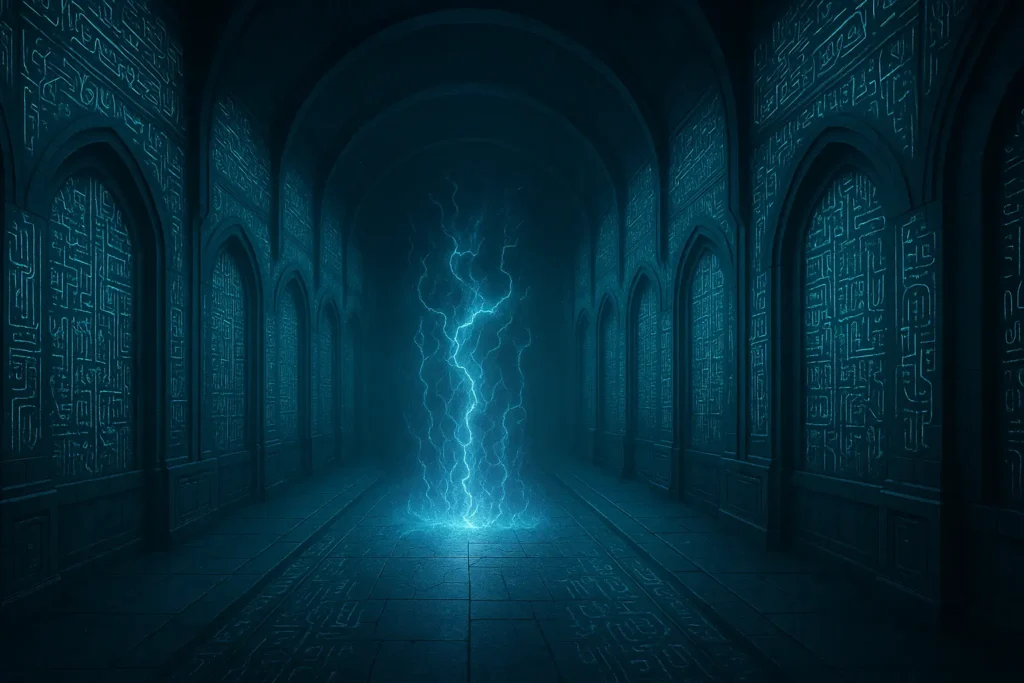
Preserved by ritual. The AOD-Field still faintly pulses inside an archology on Báb, its walls gleaming with the fusion of circuitry and ritual warding (Credit: Kenomitian)
Military Optics and Numen Sleep at the Giants
Around Hayyi Rabbi, a Uranus-sized giant, the ruins turn martial. A shattered orbital laser cannon drifts among tilting habitats. Its barrel segments resemble cathedral naves. Aperture petals, the size of plazas, float like dead lilies. Targeting mirrors reflect nothing but wind.
Moons called the Uthras hold the tethers of space elevators, now cut. Their anchor crowns still clutch basalt. The film suggests the elevators carried materials, energy, and dignitaries between cloudline depots and orbital commons. A public highway once stitched sky to space.
At Aeolia, an ice giant, a different relic endures. A numen—a sentient intelligence vessel—hangs inside a residual force field, curled like a sleeping child. Its hull is smooth, then stippled with scripture-like code. No signals answer, yet the field refuses to decay.
On Aeolia’s Anemoi moons, a “moon-hopping” swarm of flesh-like nanites creeps between craters. The documentary treats it as a textbook. Self-repair. Self-replication. Self-direction. Risk scores flash on-screen, then fade under the quiet.
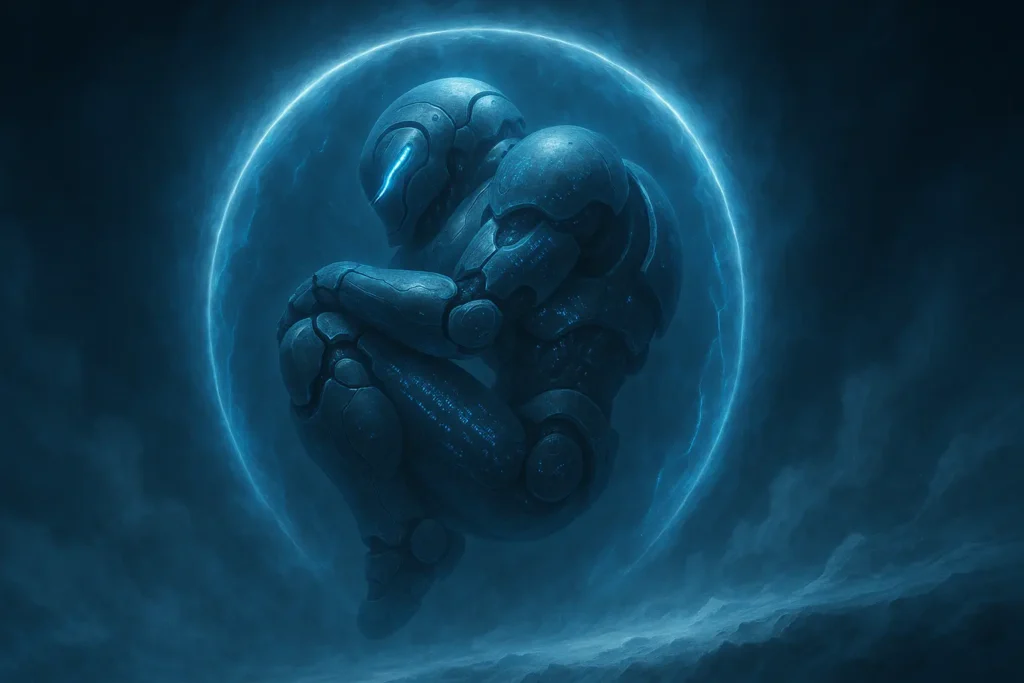
The enduring mystery. A numen, a sentient intelligence vessel, sleeps inside a residual force field on the ice giant Aeolia, its hull covered in scripture-like code (Credit: Kenomitian)
Afterlives of Catastrophe on Hypsiphrone and Horos
Hypsiphrone, a chlorine world, shows the Pandemonium’s bruise. Machaloth biota perished after a solar flare associated with Belial’s cycle. The camera finds violet “flowering” nanites blooming from vents. Their function is unknown. They seem gentle until their shadows move wrong.
Beyond the planets sprawls Horos, the asteroid belt. The film’s most unsettling image rises here: a fortress braided from black nanites, coiled like a sleeping serpent. It appears to conserve itself, not expand. Patrol drones keep distance and log spectral patterns like hymns.
A ring city drifts nearby, snapped, its parks exposed. A Stanford torus spins, outgassing faintly. The narration resists nostalgia. These were not utopias; they were cities, with budgets, unions, and crimes. Their ruins deserve history, not worship.
Magipoetic Heritage and the Archives of Light
At Pigeradamas, sometimes a blue star to the naked eye, the crew swims through drowned habitats to frame a shimmering holographic obelisk. It emits radio structures that resemble literature. The thesis advanced is bold: this is memory, not beacon.
“Hylic culture stored instruction in light,” Dr. Randolph argues. “The obelisk encodes process, ritual, and law. It teaches by projection. Touch is unnecessary.” The archival team captures hours of emission. Interpretation will take years, not weeks.
Mkayyema, an airless Hermian, offers a stranger exhibit. A flock of intangible hexahedrons hovers above scarps, black and pressureless. Instruments pass through them, then return with altered timing. Close by, the Ophiomorphoi moons hold dead tractor beams, like bridges drafted into the night.
The documentary avoids declaring victory. “Our tools might be too literal,” Dr. Randolph admits. “Hylic artifacts often stage encounters. If we demand data alone, we miss the rite.”
Outermost Signs: Adumbrali and Music in the Dark
At the system’s fringe, the eccentric brown dwarf Baphomet orbits like a patient metronome. Around it hangs a petrified adumbrali forest—biobots engineered for vacuum. Their trunks run with mineral veins, their crowns coil into horns. Everything is still except the music.
A nanite cloud hums across the grove, the tone bending with drift. Whether the swarm tunes itself to the dwarf’s magnetics or to an absent conductor remains unknown. The crew’s spectrogram resembles a score with missing bars.
The film resists finality here. It invites contemplation without promising safe contact. The message is measured. Wonder does not imply permission.
Methods, Safety, and the Ethics of Touch
The production discloses its methods. Crew worked under agency protocols, with AOD detectors, nanite baiters, and mana dampeners. Expeditions stopped at ward lines and avoided active repair swarms. Non-contact documentation was the rule, not the exception. Restraint also guided narration. When the film dramatizes a Hylic process—forge-grown super-glass, azothic routing, or vril-mana conversion—on-screen captions separate reconstruction from footage. The team shows its seams rather than claiming omniscience.
Ethical questions surface throughout. Should functioning wards be left to fade? When does sampling become theft? Who decides jurisdiction over ruins with live governance logics? The film offers case studies, not verdicts.
“We inherit both danger and instruction,” Dr. Randolph says. “Recovery is not acquisition. Stewardship means learning how to refuse.”
Education Goals and Public Reception
The Oothoonian Union frames the documentary as civic pedagogy. Screenings pair with panels hosted by guilds, universities, and neighborhood circles. Toolkits include glossaries for vril and Mana, plus simple activities for a classroom or hall. Early viewers report a mood shift from awe to responsibility. Headlines in local holosheets emphasize the Dyson fragments, the Báb archology, and the Aeolian numen. Parents ask about field trips. Salvage syndicates grumble about tightened cordons. That friction feels expected.
The filmmakers nod to the ancient-astronaut motif without embracing sensationalism. Their version is domestic and accountable. The “ancient astronauts” are our ancestors, not strangers, and their artifacts ask for governance, not worship.
Notes extracted from the Kenomitian Compendium
[1] Oothoonian Union: a Decopunk dystopia organized like a pyramid scheme with an absolute monarch, the Eupraxus, at the top; who is assisted by the Perfecti: individuals, organizations and lineages who enjoy absolute immunity as long as they enforce the inscrutable edicts penned by their patron from the capital city of Los. It came about after the unification of the Metis Federation (an exclusionary and Steampunk democracy), the Holy Kingdom of Zagreus (a Raygun Gothic theocracy) and the Eunation of Phanes (the Decopunk homeland of the Eupraxus monarchy), the Asterope Territories (Oothoon’s Steelpunk extra-dimensional colonies) and the Domination of Sideris (Oothoon’s Atompunk extra-planetary colonies).
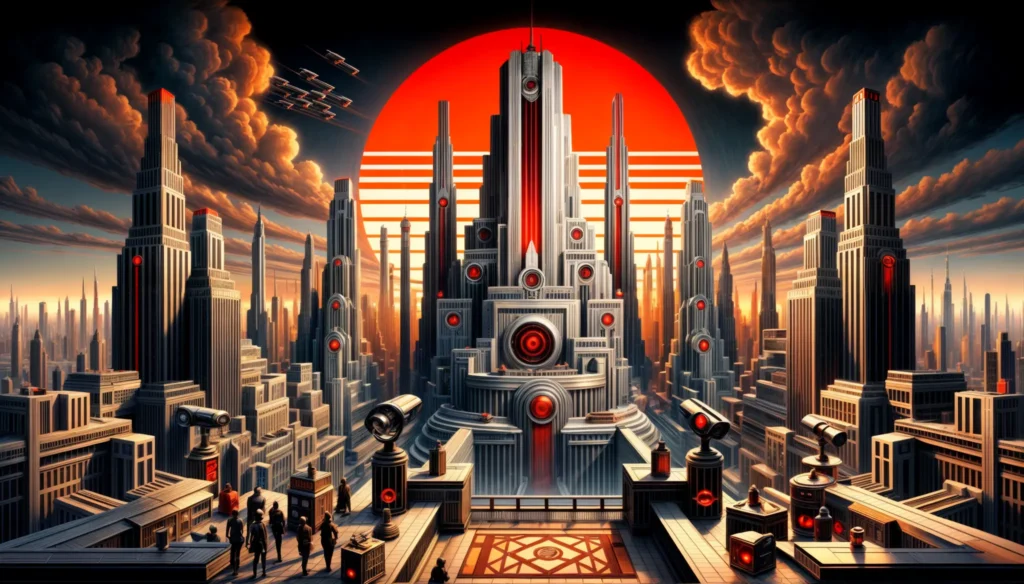
A glimpse into the Oothoonian Union (Credit: Kenomitian). See more