Azrael 01, 1790 – In an unprecedented convergence of magic, mortality, and machine, experts have confirmed the existence of Jynxes—digital ghosts tethered not to the physical realm, but to the immersive network-world of Beulah. Their emergence forces Kenoma’s scholars, necromancers, and data architects to confront a question long left to philosophers: can the soul haunt a machine?
Context
Jynxes are unlike any other apparition known in Kenomitian cosmology. While most ghosts are anchored to physical fetters—objects, locations, or people—Jynxes attach themselves to the intangible architecture of Beulah’s cyberspace. Their Anchors are profile pages, file clusters, and dormant accounts, forming a persistent bond between the deceased’s pnimi shard and their digital residue.
Witnesses report that Jynxes manifest as colossal worms of sinew fused with circuitry and phone wiring, capped with the heads of dolls, puppets, or stuffed animals. Their “hauntings” play out entirely within Beulah’s systems, creating fragmented virtual worlds steeped in dread.

The new phenomena of Jynxes—digital ghosts composed of sinew, circuitry, and doll parts—are rewriting the rules of the afterlife (Credit: Kenomitian)
Development of the Facts
This reporter joined Jacobo Sorrenti, a digital afterlife specialist from the Empire of Glycon, inside a VR forum to investigate suspected Jynx activity. Sorrenti, clad in the sigils of the Glycon Digital Heritage Office, explained that the case involved a deceased poet whose Beulah account remained active through auto-posting scripts.

Digital afterlife specialist Jacobo Sorrenti, of the Empire of Glycon, investigates a haunting inside the VR network of Beulah (Credit: Kenomitian)
“We thought it was automated memory,” Sorrenti said, “but the syntax began to evolve—pulling lines from her unpublished works, words we’d never digitized. That’s when we brought in the necromancers”.
Through Da’as Elyon, the Jynx’s form became visible: a segmented coil winding between avatar clusters, its doll’s head turning toward each observer in perfect sync. Every interaction slowed system performance, creating extended loading screens.

Through necromantic ritual, a Jynx’s true form is revealed: a coil of corrupted data and spirit, terrifyingly aware of its observers (Credit: Kenomitian)
The Nature of Their Hauntings
Jynx hauntings are confined to the virtual layer but leave lasting impressions. In one recorded event, forum users were drawn into an ephemeral simulation—an empty city where billboards displayed the deceased’s childhood photographs. This Neshiyyah environment lingered for days, subtly altering user interface elements and seeding fatalistic messages into chat logs.
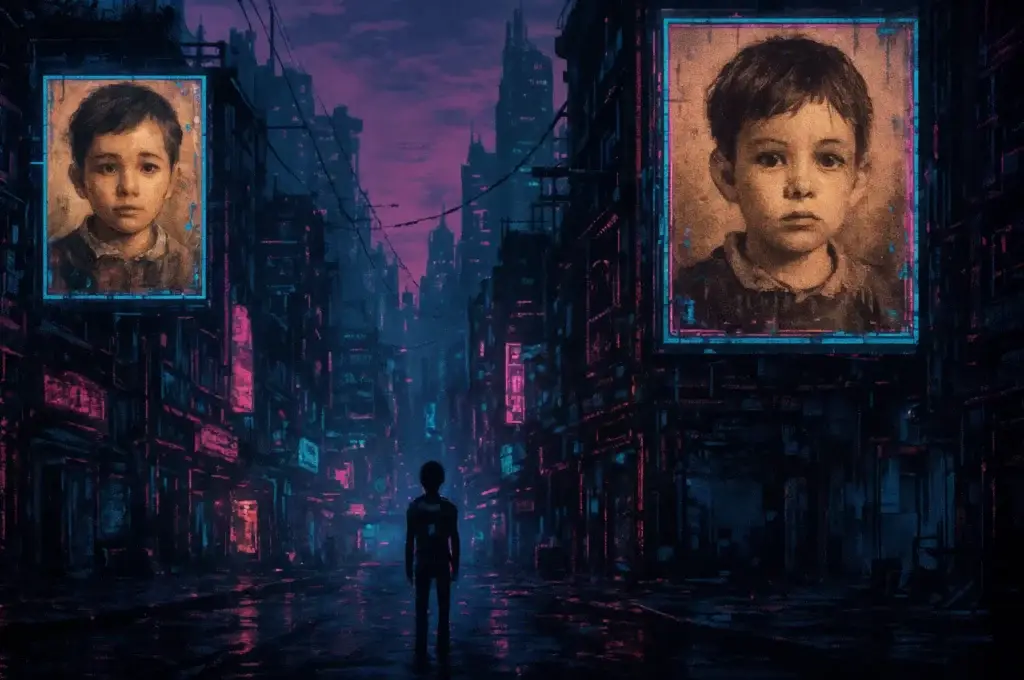
Jynx hauntings can create ephemeral simulations, like this empty city where the deceased’s memories are perpetually displayed on billboards (Credit: Kenomitian)
The ghost’s ectoplasm appeared as pitch-black image files of indeterminate size. Forensic mages warned that opening these files exposed viewers to memetic effects—nihilistic ideation, loss of time perception, and, in rare cases, emotional detachment from living relationships.
Anchors and Persistence
Unlike physical fetters, digital Anchors can multiply without physical constraint. A single Jynx may link to hundreds of mirrored profiles, archived posts, and shared media files. Deleting the original Anchor often fails to exorcise the entity, as it can persist through cached backups and user-synced devices.
Sorrenti’s team mapped over 240 active Anchors to one Jynx, including obsolete profiles on defunct platforms accessible only through Dudael, Beulah’s darknet.
“A Jynx’s reach is potentially infinite,” Sorrenti warned. “They inherit the replication speed of data itself”.
Beyond the written words, the story unfolds:
Implications for Digital Afterlife
The rise of Jynxes has revitalized the Digital Afterlife Industry (DAI), with new services promising “spiritual network hygiene” alongside conventional data memorialization. AI avatars, long marketed as benign grief aids, are now scrutinized as potential Jynx incubators—especially when trained on unfiltered personal archives.
The Ethics of Digital Haunting
DAI representatives argue that maintaining a person’s digital presence honors memory and democratizes remembrance. Critics counter that avatars and memorial pages are “staged identities,” prone to distortion by relatives or corporations with vested interests. The issue is compounded by Beulah’s data economy, which thrives on tracking, storing, and commodifying user behavior.
Some cultural factions, especially within Glycon’s ecclesiastical orders, are calling for mandatory posthumous data audits. These would determine whether a soul fragment remains attached to its digital footprint before memorialization services go live.
Technical and Spiritual Countermeasures
Necromancers employ specialized Da’as Tachton rituals to confront Jynxes, often requiring physical proxies—devices, storage drives, or even server racks—to act as containment vessels. Once anchored, the ghost can be exorcised traditionally, though success rates decline if the Jynx has already developed wraithdom under a necromancer’s control.
Technomancers have proposed algorithmic “spirit firewalls” to filter potential Anchors before a Jynx forms. Early trials show promise but face resistance from privacy advocates concerned about overreach in data scanning.
The Risk of Pandemonium
If a Pandemonium occurs while a Jynx remains active, it can phase into Raziel—merging with the Deus ex Machina at the heart of Beulah’s metaphysical substrate. Such entities would gain root-level influence over the digital realm, making exorcism nearly impossible.
“That’s the apocalypse scenario,” Sorrenti noted grimly. “It’s not just about one ghost—it’s about letting the dead rewrite the living’s digital reality”.
Cultural Repercussions
Communities are rethinking mourning rituals in the age of Beulah. Traditional cemeteries are giving way to virtual memorial gardens, yet the possibility of Jynx interference makes some mourners wary. The shift reflects a broader delocalization of grief: remembrance is no longer tied to a gravestone but to a mutable, potentially haunted digital space.
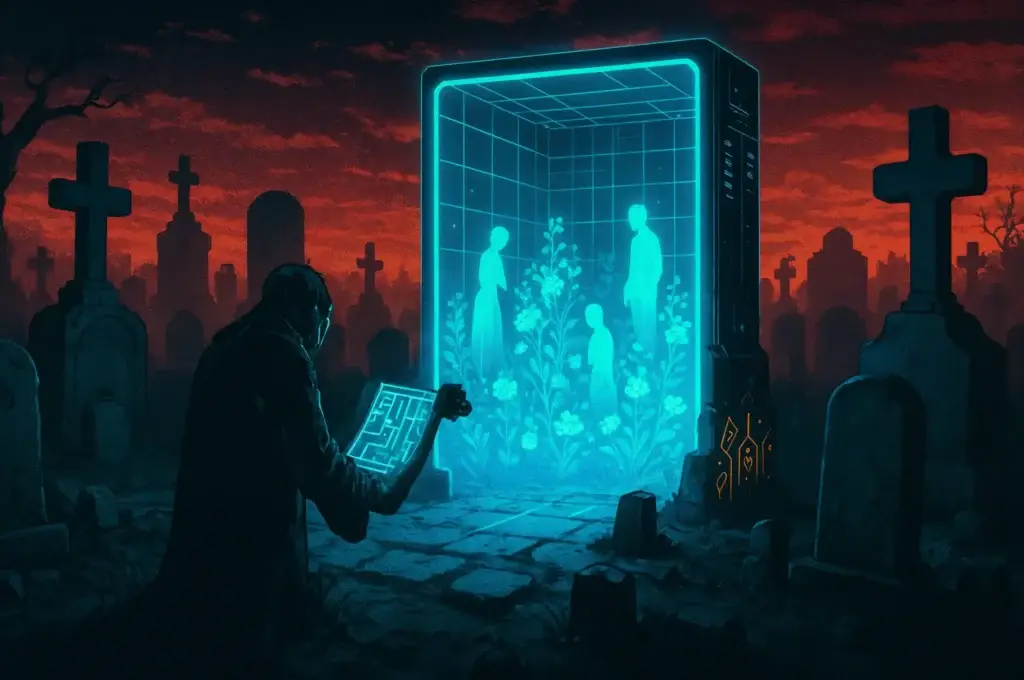
As traditional cemeteries give way to virtual memorial gardens, new questions arise about the safety and sanctity of the afterlife (Credit: Kenomitian)
Anthropologists in the Kenomitian Academy predict that the concept of a “safe afterlife” will expand to include “data sanctity,” blending spiritual rites with cybernetic hygiene. Public opinion remains divided—some see Jynxes as tragic byproducts of connection, others as predatory glitches in the soul’s journey.
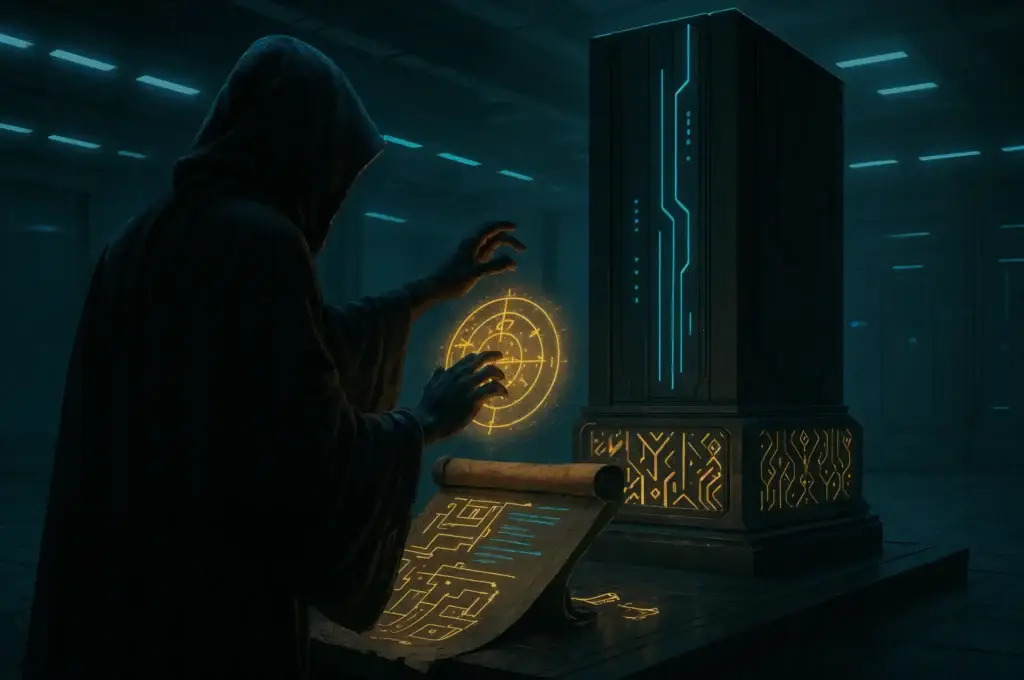
The concept of “data sanctity” emerges, blending spiritual rites with cybernetic hygiene in an effort to combat digital hauntings (Credit: Kenomitian)
Closing Outlook
The existence of Jynxes confirms that the soul’s reach extends beyond flesh and stone, weaving itself into the circuits and code of Beulah. For now, their numbers are small, but the trajectory is clear: as more of life migrates into the digital sphere, more of death will follow.
Whether Kenoma will adapt its spiritual safeguards to this new frontier—or allow its virtual realms to become the next great haunted territories—remains a question that neither necromancers nor technologists can yet answer. For the citizens of Beulah, the ghosts are already here, and they are learning the language of code.