The Hallowed Courts of Adonaios are sliding toward a systemic emergency as the Arakiel heating-mud supply chain buckles under relentless inter-court warfare, escalating supremacist politics, and a widening failure of Supernal mediation. Analysts warn that, absent rapid stabilization of Tit ha-Yaven harvest corridors, the undersea state’s heat economy could fracture into irreversible regional collapse.
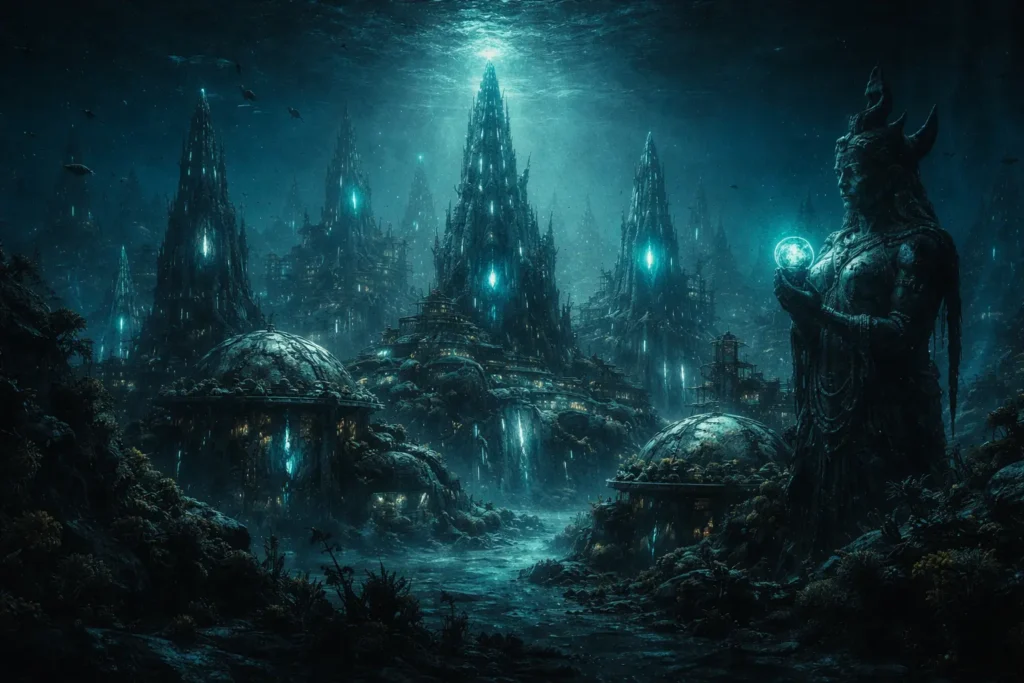
The dying glow of the Hallowed Courts. As the Arakiel supply chain fractures, the bioluminescent spires of Adonaios flicker against the encroaching abyssal cold, signaling a systemic collapse of the undersea state’s heat economy. Credit: Kenomitian
Adonaios has long survived its feuds through one stabilizing constant: heat. In an undersea polity where depth governs daily life and infrastructure, the Arakiel mud harvested from the dead zones of Tit ha-Yaven is not a luxury. It is the baseline condition for habitation, transport, and industry. Arakiel functions as both fuel and sacrament, a concentrated residue tied to the scars of the Deluge and the lingering imprint of Supernal Avatars. Yet the Hallowed Courts were built for rivalry, not resilience. Three overlapping judicial and political architectures—theocratic Ashemim tribunals, Nephilim courts, and Magian city-states—compete to define legitimacy. In calmer cycles, the Ashemim presence has served as a pressure valve. In recent years, that valve has narrowed.
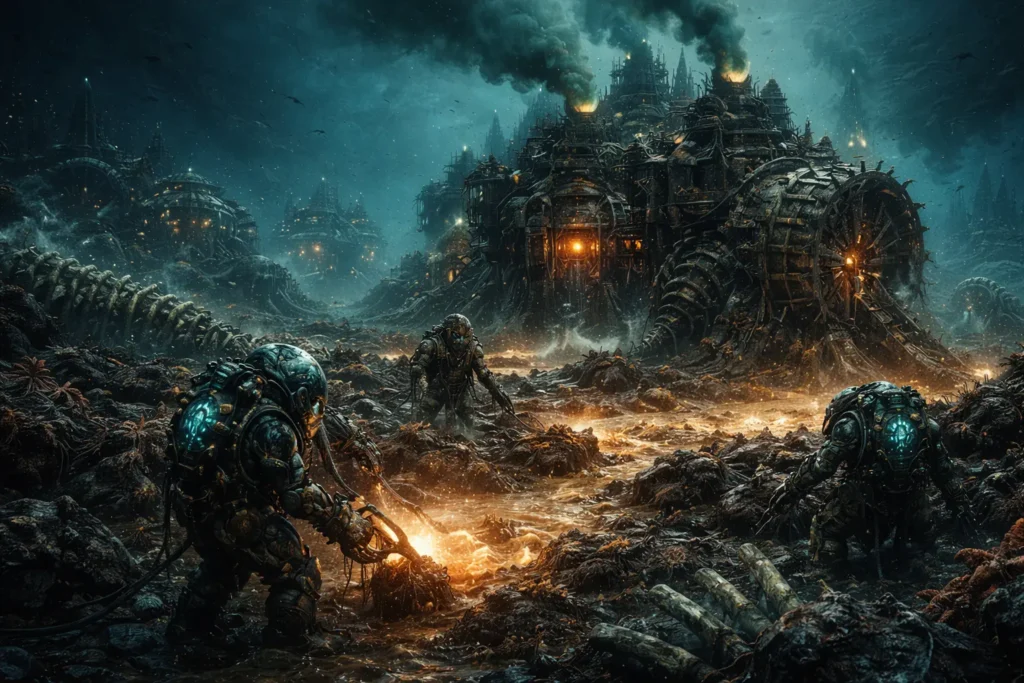
Extraction in the Dead Zones. Churning through the viscous, thermal-rich mud of Tit ha-Yaven, magitek rigs harvest the “baseline of survival”—a resource tied to pre-Deluge scars and now the center of a desperate, undersea war. Credit: Kenomitian
The result is an Arakiel crisis: not the disappearance of the resource, but the breakdown of safe access to it—an undersea version of a strategic chokepoint spiraling into a national emergency.
Harvest volumes from Tit ha-Yaven have not collapsed because the mud has run dry. They have collapsed because the harvest has become uninsurable. Across multiple collection lanes, Arakiel convoys now travel through “red zones” where the rule of law is contested by court-aligned militias, insurgent cells, and private security detachments. Local commanders—some sworn to Nephilim monarchs, others tied to Magian councils—treat the mud as tribute. The harvest, once regulated by precedent and mediated by sporadic Supernal oversight, is increasingly treated as spoil.

Fire in the Deep. Arakiel transport convoys navigate the lawless “red zones,” where the rule of law is replaced by the roar of magical discharge and the greed of court-aligned militias. Credit: Kenomitian
The greatest pressure concentrates where resources and ideology overlap. Tit ha-Yaven’s most productive dead zones sit adjacent to territories claimed by rival Nephilim courts, primarily the Dragonist Kingdom of Enmedugga and the Angelic Principality of Enmegalamma. Each claims spiritual mandate. Each argues that control of Arakiel is an extension of divine stewardship. Each also knows that the court that controls heat controls allegiance. In the short term, this is a logistics crisis. In the medium term, it is a legitimacy crisis. In the long term, it is an existential one.
Arakiel extraction requires time at depth, specialized containment, and stable perimeter control. None of those conditions currently hold. Field mapping indicates that harvesting crews must now negotiate layered checkpoints—some official, many improvised. Bribes are demanded in refined Ramiel, in Arakiel allotments, or in binding oaths that entangle crews in court politics. The more the harvesters concede, the more extraction becomes a tool of governance by armed intermediaries.
This dynamic is feeding a battlefield economy. As extraction becomes dangerous, Arakiel prices rise. As prices rise, more actors enter the trade. As more actors enter, violence becomes profitable. The dead zones, already precarious, are now in practice a contested commercial frontier. There is a further destabilizer: the metaphysical mapping of harvest territories. Adonaios does not merely draw borders on charts. It assigns meaning to zones, routes, and depths through ritual and cosmological claim. Competing “maps” do not just disagree on ownership. They disagree on reality. Where cartographies diverge, mediation becomes harder, not easier.
The Arakiel supply chain is not an isolated system. It is coupled to Ramiel logistics, and that coupling is now amplifying risk. Crystalized lightning—Ramiel—remains vital for power distribution, illumination, and the operation of heavy magitek in deep-water districts. Much of it flows through Bor Shaon. Under normal conditions, Ramiel can compensate for heat shortfalls by powering auxiliary systems. Under crisis conditions, Ramiel becomes another scarce, securitized input. In practice, Arakiel shortages force districts to lean harder on Ramiel. That increases demand for Ramiel transport and storage, which increases the frequency of contested shipments. Those shipments, in turn, become targets.
An undersea state can endure one bottleneck if it can reroute around it. Adonaios is now experiencing two interlocking bottlenecks: heat and power. That reduces the system’s ability to absorb shocks. Armed groups disrupt Arakiel routes to force dependence on Ramiel, then extract concessions on Ramiel lanes. This is not random banditry. It is strategy.
Resource shocks do not automatically produce political extremism. They do, however, provide extremists with leverage.
Nephilim-supremacist ideology has gained ground by recasting the crisis as a test of bloodline legitimacy. In supremacist rhetoric, the Magian courts are framed as collaborators with “lower” Material structures. Arakiel, in this narrative, becomes not a shared necessity but a patrimony—heat reserved for the “rightful” inheritors of the undersea world. Magocratic supremacism and religious supremacism reinforce this trend. Competing devotions—to Titans, deities, and the Ashemim Avatars—are being weaponized into a politics of purity. Courts increasingly frame the other as metaphysically contaminating, not merely politically adversarial.
The practical effect is that scarcity becomes governance. Distribution decisions—who gets warmth, who gets power, who gets safe passage—become a daily referendum on whose lives are valued. This is visible in the security posture adopted by many Nephilim-aligned authorities. Under the banner of protecting Adonaios from “impurities,” they expand emergency measures, intensify checkpoint regimes, and apply collective punishments. Each measure may deliver a short-term tactical win. Many also deepen long-term grievances, widening the recruitment pool for insurgents.
The conflict pattern in the Hallowed Courts is not uniform chaos. It has structure. Incident data suggests the violence has stabilized into what we call a “new normal” equilibrium. Attacks are often retaliatory, calibrated, and politically legible. Targets are chosen to weaken governance without triggering unified backlash. Officials tied to the City-state of Kakia, administrators overseeing resource allocation, and Ashemim-linked mediators are at elevated risk.
This is a familiar arc in protracted internal conflicts: insurgent groups maintain persistent disruption while avoiding actions that would consolidate the broader population against them. The goal is not necessarily to win battles. It is to make governance unaffordable. In Adonaios, this calculus is enhanced by the structure of the courts. Fragmentation allows actors to externalize costs. A militia aligned to one court can trigger crisis in a neighboring district without bearing direct responsibility for the humanitarian fallout. Each court blames the other. The public freezes.
Historically, the Ashemim tribunals have been the only force that can enforce meaningful pauses across rival claims. Their authority is not merely legal. It is cosmological. When present, Ashemim mediation can “bind” disputes in ways that ordinary treaties cannot. That is why their absence is so dangerous. Adonaios now faces a widening mediation gap. Ashemim participation is reported as sporadic and inconsistent. The reasons offered vary—ritual constraints, competing obligations, and in some cases implied withdrawal in protest of mortal conduct. Whatever the cause, the effect is the same: conflict escalates without a credible arbiter. In systems under stress, power flows to whoever can deliver immediate security. In Adonaios, that security is often conditional, sectarian, and transactional.
Where states falter, markets adapt. In Adonaios, megacorporations are not merely adapting. They are advancing. Hadit Industries, Aiwass Magitek, and the Armaros Consortium maintain recognized extraterritoriality. In practical terms, this grants them operating space insulated from local court law. Under stable conditions, these arrangements can appear mutually beneficial: capital and technology in exchange for access and contracts. In a crisis, extraterritoriality becomes leverage.
Corporate actors have reportedly begun private harvesting operations in Tit ha-Yaven, deploying golems and automata to reduce Therian exposure. The efficiency gains are real. So are the political costs. Private harvest displaces local labor, undermines court bargaining power, and shifts control of heat toward actors whose accountability is contractual rather than civic. There are credible indications of “crisis contracting,” where aid-like interventions bundle long-term concessions. In practice, emergency heat shipments can be tied to exclusive logistics rights, privileged access to Ramiel nodes, or expanded testing permissions for biological augmentations and symbiont systems.

The Golem Shift. Hadit Industries automata displace local Therian labor in the mud beds, marking the transition from civic governance to cold, megacorporate “crisis contracting.” Credit: Kenomitia
For the courts, the temptation is obvious: accept corporate terms or watch districts go cold. For Adonaios as a sovereign system, the risk is profound: a heat dependency that migrates from internal political bargaining to external corporate governance.
As official supply strains, an Arakiel black market has surged. Black-market Arakiel is rarely “pure.” It is adulterated for volume, cursed for control, or traded with hidden obligations. Distribution networks often overlap with insurgent supply lines, allowing armed groups to fund operations while presenting themselves as providers. In certain districts, smugglers are becoming more reliable than the courts.
This creates a grim feedback loop. The courts respond with crackdowns. Crackdowns raise prices. Higher prices expand trafficking. Trafficking finances more violence. More violence increases the crackdowns. The black market also erodes the capacity for reform. Even if the courts agree on a new resource governance framework, actors profiting from scarcity have incentives to sabotage stabilization.
Adonaios’s internal fractures are being stressed by external predation. Raids from the Free State of Choronzon—widely regarded as a lawless hub of undersea trafficking—have increased the volatility of already-fragile corridors. The raids do more than steal resources. They reshape politics.
Under external pressure, supremacist factions within the Nephilim courts have used the threat of “foreign impurities” to justify harsher internal security measures. These include expanded detention authorities, accelerated tribunals, and punitive sweeps in Magian districts. Such measures may disrupt raider networks in the short term. They also risk alienating local communities whose cooperation is essential for intelligence and corridor security. In several observed cases, external raids have become a pretext for internal consolidation. That is a dangerous pattern in any fractured polity. In Adonaios, it is also a recipe for wider radicalization.
The most destabilizing consequences of the Arakiel crisis may not be the loudest. Heat scarcity is already pushing basic services into triage mode. Remote colonies are experiencing intermittent power and unreliable warming cycles. Clinics report disrupted access to supplies and skilled practitioners, including Hematomancers needed for complex births and deep-pressure injuries.
Two humanitarian trends deserve urgent attention:
First, infant and maternal mortality risks appear to be rising in peripheral districts, where travel is hazardous and clinics are understaffed. When heat fails, sterilization systems falter. When transport fails, emergency referrals become impossible. The death toll can accumulate quietly, outside the spectacle of conflict. Second, displacement is intensifying. Refugee flows toward more stable courts, toward neighboring provinces, and toward extra-dimensional outlets such as the Pioneer Councils of Abzu are likely to grow as wintering cycles and heating schedules fail. Displacement tears at cultural continuity. It also strains the host districts’ capacity, risking secondary unrest. Adonaios’s “Solar Punk” ideal—harmonizing nature and technology—now competes with a visible shift toward scavenged infrastructure, bunkerized neighborhoods, and fortified convoys. Aesthetic change here is not cosmetic. It signals governance failure.
Adonaios is, in our assessment, approaching a critical threshold. The interplay of Arakiel scarcity, Ramiel stress, and supremacist governance dynamics is producing state fragility faster than any single factor would alone. The courts are not merely fighting over borders. They are fighting over the ability to keep citizens alive.
If Tit ha-Yaven remains a contested red zone, the heat economy will continue to fracture. If the Ashemim tribunals remain sporadic, no actor will possess credible authority to bind disputes. If megacorporate extraterritoriality continues to expand, sovereignty will be exchanged for survival in incremental contracts. If supremacist politics continues to define distribution, grievances will harden into identity-based insurgency. Taken together, these trends suggest not a sudden collapse, but a slow freezing—district by district, corridor by corridor—until the undersea polity becomes a patchwork of fortified enclaves.
Adonaios is, in effect, an undersea thermal system whose core is clogging. Pressure is building beneath a social order defined by rivalry. Heat is no longer reliably reaching the citizens who depend on it. Unless the courts clear the blockage—supremacist governance married to militarized resource control—the system risks a violent rupture. And in an environment where warmth is life, rupture can look like silence: districts going cold, routes going dark, and a civilization slipping into the annals of drowned history.
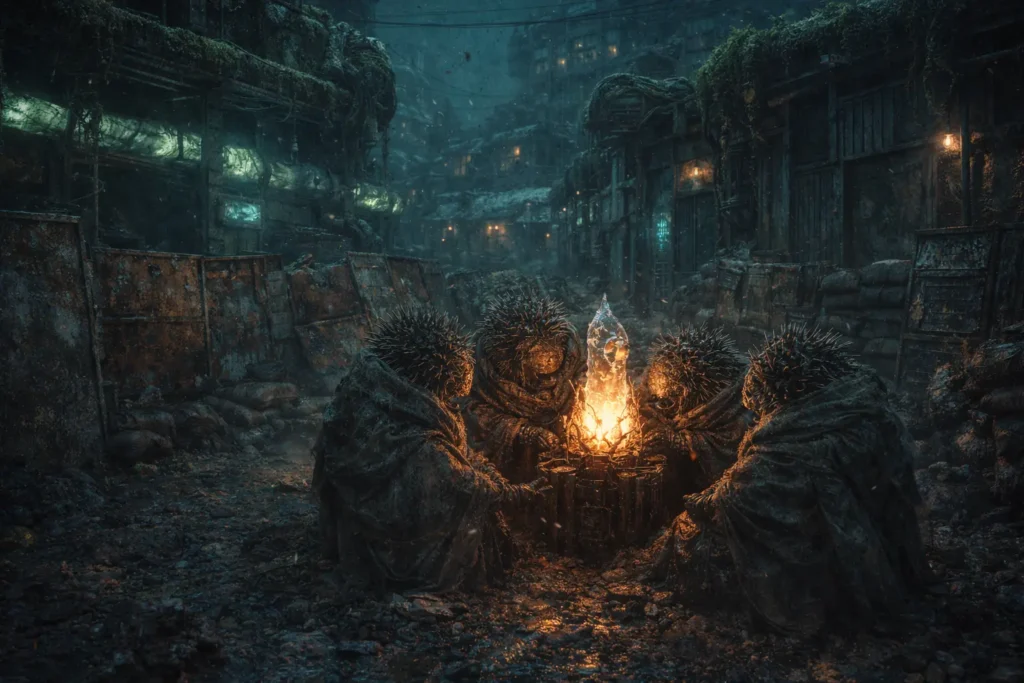
Survival at the Edge. In the bunkerized alleys of the Hallowed Courts, citizens huddle around failing Ramiel heaters—a grim testament to a civilization where warmth is no longer a right, but a dwindling luxury. Credit: Kenomitian