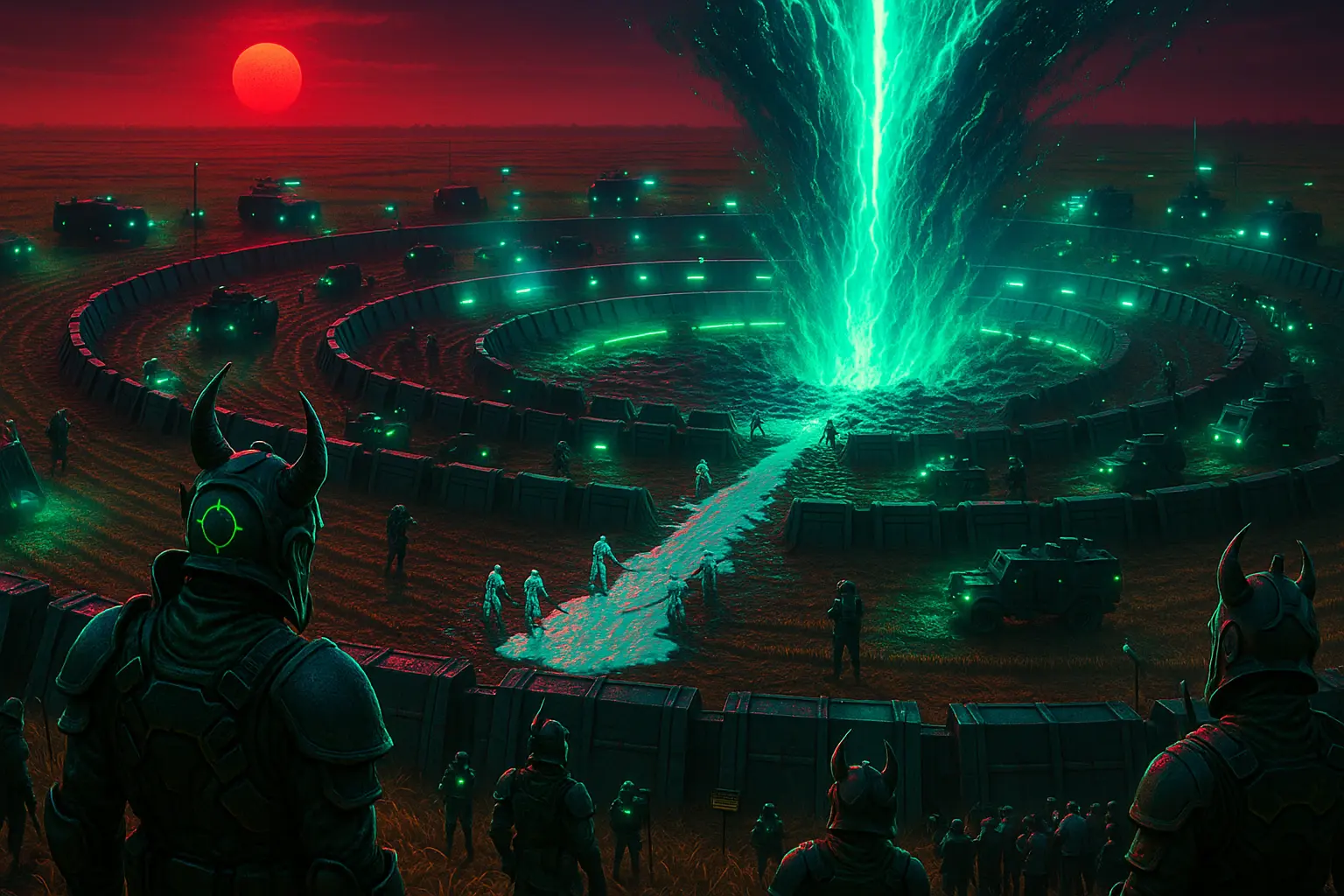
Cebrail 25, 1790 — A localized temporal rupture on Druzang Farm in the Nousian Kingdom began ejecting living Cambrian organisms onto dry ground. The phenomenon—swift, recurrent, and violent—has transformed a quiet agricultural parish into a containment zone, forcing scientists, soldiers, and ministers to improvise policy and practice as prehistory pours forth.
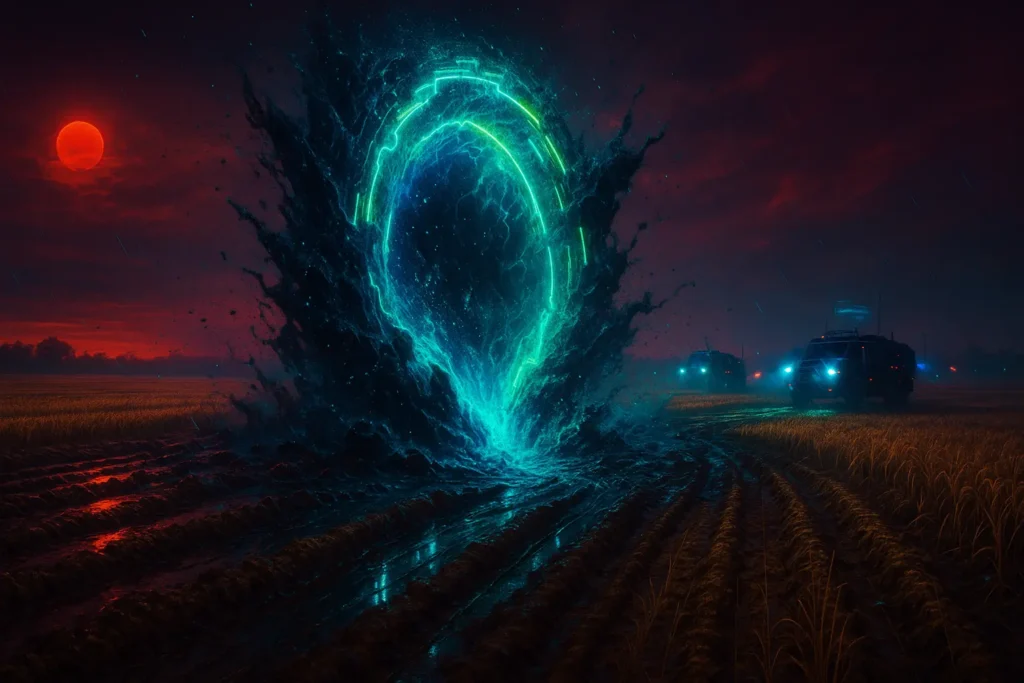
A sudden tear: The Druzang Temporal Anomaly transforms quiet Nousian farmland into a containment zone as prehistory violently pours forth (Credit: Kenomitian)
The Druzang Anomaly is a stable but fluctuating temporal rift centered on a single paddock of family farmland. Its output is episodic, described by witnesses as “spewing” and dominated by radiodonts—apex arthropods of the early Cambrian seas—alongside kinorhynchs, comb jellies, and small shelly clades. The organisms arrive alive, saturated with seawater, and physiologically suited to marine conditions that do not exist on land.

Apex arthropods of the early Cambrian seas, the radiodonts arrive alive but exiled, struggling to find purchase on the alien, dry soil of Kenoma (Credit: Kenomitian)
Authorities have erected cordons and a mobile wet lab. The scientific team views the rift as a living analogue for stratigraphic reworking: a dynamic “unconformity” transporting entire communities across 518 million years. The government frames the incident as a national security and public health crisis. The opposition claims the Crown downplayed early warnings and bungled rural preparedness.
Druzang Farm lies in low, loessic country far from the coast. Irrigation channels run straight as a surveyor’s string, and the nearest garrison is a half-day by road. The discoverer, Chen Druzang, reported “shimmering air” above a sun-wet patch and “dark water pouring from nowhere.” Within minutes, arthropods the size of hunting dogs writhed among wheat stubble. Far to the east, scholars built reputations on extraordinary fossil beds—soft tissues preserved in fantastical detail. Those cases were silent stone. Druzang is loud water. The shift from fossil to living specimen recontextualizes decades of inference, and threatens to turn museum logics into field triage.
A three-ring cordon now encloses the farm: an inner quarantine, a media and logistics perimeter, and an outer agricultural buffer. Soldiers laid prefab berms to redirect effluent back toward the rift. Fire crews stretched foam curtains to keep radiodont appendages from finding purchase on slick tarps.
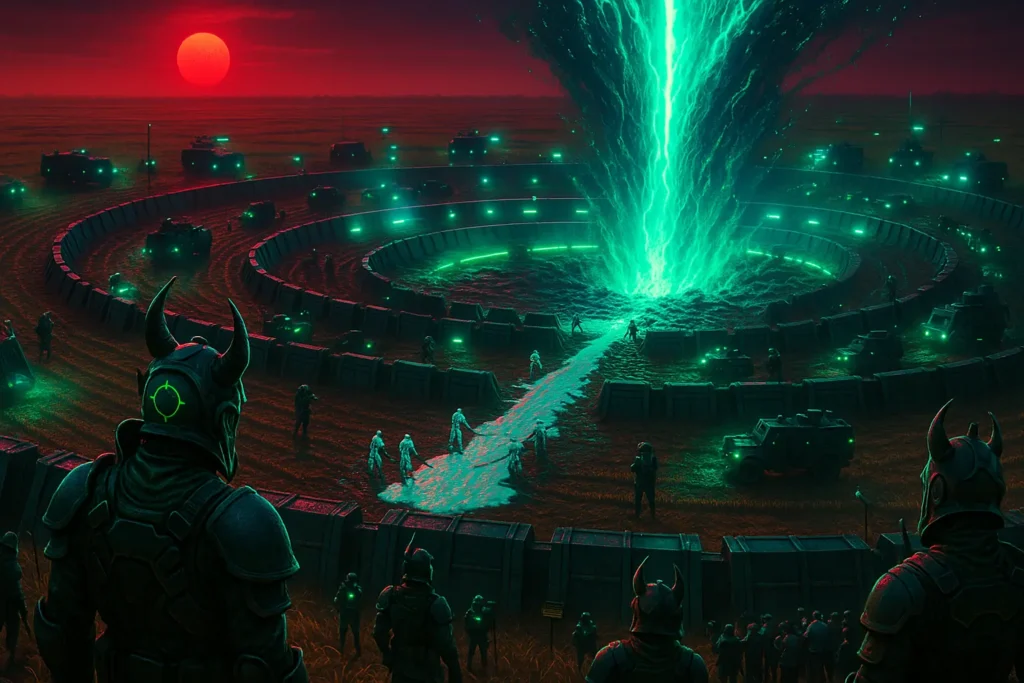
Soldiers erect a rigid three-ring cordon using prefab berms and specialized foam barriers, attempting to contain the temporal fallout and redirect the primordial effluent (Credit: Kenomitian)
“We treat every emergence as if it carries a parasite we do not understand,” said Lt. Valea Rom, site safety lead. “No souvenirs, no trophies, no unauthorized photographs. If you step in the water, you get scrubbed.”
The Ministry of Geomancy dispatched an anomaly cartographer. Her first result was sobering: the locus precesses by centimeters between pulses. That drift, if it accelerates, could shear containment seams, complicating filtration and capture.
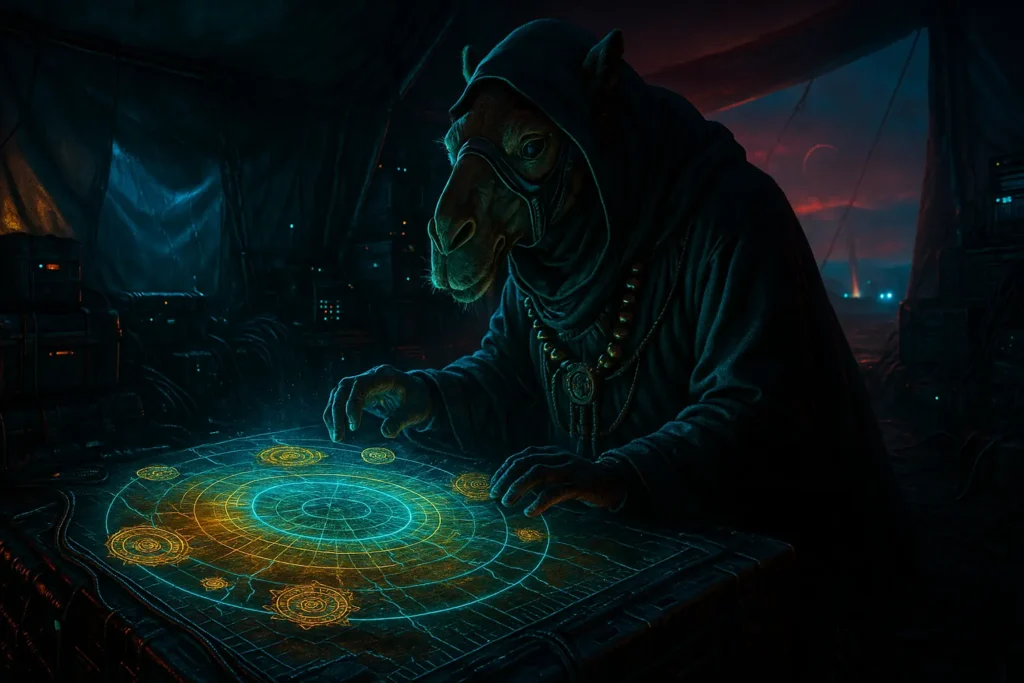
The Ministry of Geomancy’s initial survey confirms a sobering reality: the rift’s locus precesses, its unstable drift threatening to shear containment seams (Credit: Kenomitian)
Inside the mobile lab, paleobiologists handle living morphology with gloved awe. Radiodont frontal appendages flex with muscular precision. Multi-faceted eyes track movement even in harsh floodlights. Gills ripple. Soft tissues, usually speculative in textbooks, are here demonstrably functional.
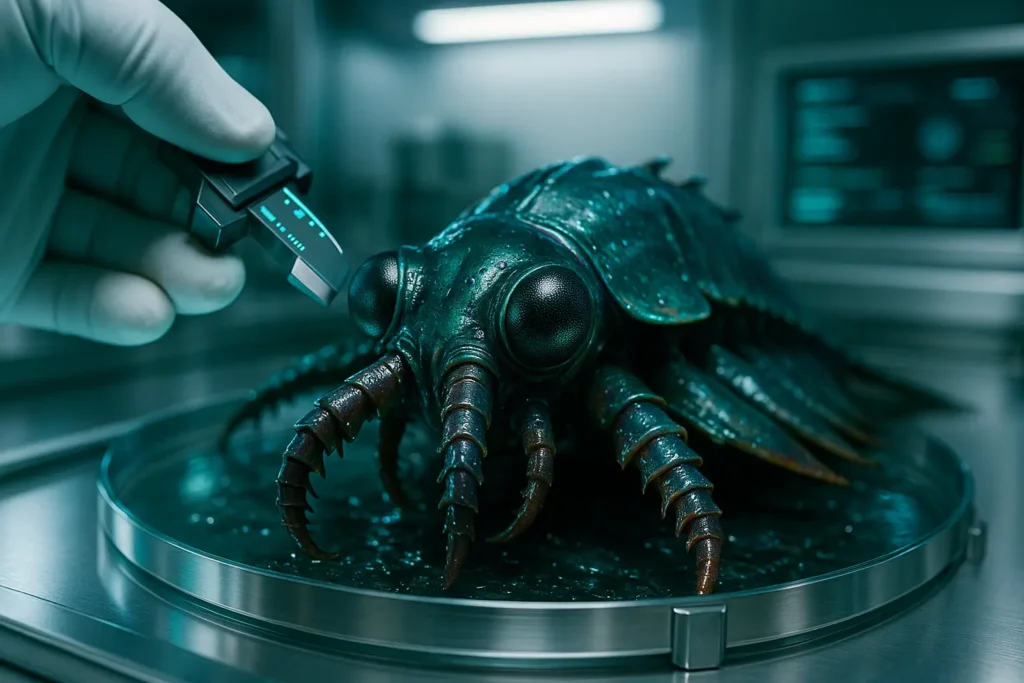
Inside the mobile lab, paleobiologists study the impossible: living radiodont morphology, with frontal appendages flexing and soft tissues demonstrably functional (Credit: Kenomitian)
“We are not getting random Cambrian junk,” said Dr. Onren Işik, lead investigator. “We are sampling a coherent shelf sea. Salinity, dissolved oxygen, and microfauna arriving in the same pulses match a particular ecological space. It is as if an erosional scarp opened across time.”
Working theory, flagged as provisional by the team, ties the output to early Cambrian shelf instability: slumps, debris flows, and sudden burial. Geological processes that once mixed fossil zones are here expressed as biological export. The rift behaves like a living breccia—tearing, transporting, and redepositing entire communities.
The team works in triage cycles: emergence, capture, anesthesia, documentation. Radiodonts draw headlines, but smaller taxa reveal the time signature. Kinorhynchs—“mud dragons”—arrive at sizes closer to ancient relatives than modern dwarfs. Comb jellies flash faint ciliary rainbows under lab light, predatory and delicate. The small shelly assemblage complicates matters. Micromount specialists have pulled protoconodont-like elements and brachiopod plates from filters. Sponge spicules clog intake screens. Inside a single pulse, elements that paleontologists once used to define clean intervals now co-appear, a dynamic rebuttal to tidy First Appearance Dates.
“We are watching time smear,” said faunal analyst C. Laghari. “Zones that should be separated by stratigraphic meters, maybe kilometers, come through together. If you tried to write a column of ranges from this, you would accuse nature of fraud.”
How a shelf sea arrives in a wheat field remains the core mystery. The anomaly maintains a pressure gradient; you can feel the air grow heavy, then aquatic. Each pulse seems to entrain a column of water with its inhabitants, then collapse. Temperature drops by several degrees. Fine mud settles in concentric fans. The Ministry’s chronometricists mapped pulse frequency across the day. Early data suggest a weak tide.
“We do not assert agency,” cautioned Prof. Meilin Hor, a historian. “But geopolitics can run on narrative. If neighbors read this as an incursion from our extra-dimensional colonies, they will respond, and not gently.”
Containment wrestles with ethics. Do you euthanize an apex predator dragged, terrified, into hypoxic air? The current protocol is capture and aquatic rehabilitation. A series of livestock tanks, retrofitted with chillers and oxygen injection, serves as temporary habitat. Mortality remains high.
“We owe these organisms more than a specimen label,” said aquarist-medic Irune Sanz. “They did not choose exile. Our job is to learn without cruelty.”
A radiodont, sedated and stabilized, briefly swam in a lined quarry at dusk. The quarry’s chemistry approximates the ancient sea. For ten minutes, its strokes were sure. Then the sedation wore thin, and stress climbing, it rammed the liner. The trial ended. The team logged both triumph and failure.
Witnesses and Ground Truth
Chen Druzang walked inspectors to the locus, boots picking careful paths between berm and channel. “At first I thought it was heat,” he said. “Then I saw eyes. Not fish eyes. Minds. I called, and the line kept ringing.”
He does not speak like a man eager for fame. He wants wheat that grows predictably, children who sleep soundly, and a house without soldiers. The Crown wired an emergency stipend and a relocation offer. He has not decided.
Neighbors, sharper-tongued, talk of compensation, media rights, and who controls the road. “Don’t let the capital write our story,” one woman said. “Every camera that shows a monster shows my fence falling.”
Fallout and Implications
Public health officials moved quickly. A boil-water advisory covers three counties. Veterinary authorities banned slaughter of ungulates within the buffer, citing unknown pathogens and prions. Schools pivoted to remote learning for families within the second ring. Farmers downstream asked if their crop insurance covers “acts of Time.” Economically, grain futures twitched. A brief rally in industrial disinfectants followed, then flattened when procurement centralized under the Ministry. Fishing guilds, threatened by rumors of “sea monsters in lakes,” staged a symbolic net-burning before returning to work. Markets tire of panic faster than people do.
At the academy, syllabi are already changing. Students will learn radiodont musculature from living footage, not interpretive plates. Stratigraphy courses will carry disclaimers: time is granular until it isn’t. A young discipline—chronobiogeography—may be born here, tracing how living lineages move when time itself behaves like a river in flood. Ethical debates are sharper. Some argue that keeping arrivals alive distorts the fossil record and risks ecological spillover. Others argue that rapid euthanasia squanders an unrepeatable knowledge window. The compromise is the uneasy dance of triage: stabilize what you can, document what you can’t, and never pretend that cruelty is neutral.
Civil society filled the gaps. Clergy arrived with prayer tents. Environmental groups offered pumps and field kitchens. A coalition of rural co-ops deployed their amateur radio net, the first to carry reliable, rumor-resistant reports beyond the cordon. In crisis, the kingdom’s history of communal response mattered more than doctrine.
Academics in Far Eastern institutes submitted an open letter, reframing their celebrated fossil discoveries in light of Druzang. “Our stone taught possibilities,” they wrote. “Your water demands responsibilities.” The phrase trended for a day, then settled into policy memos, which is where change either goes to die or quietly reshape the state.
The scientific team published a preliminary incident bulletin. It names the anomaly, dates pulse sequences, and lists taxa to the safest possible resolution. It uses sober language. The images, though, are not sober: compound eyes catching light like a city at night; feeding appendages poised; ciliary combs flashing in perfect order. To watch is to recognize kinship and distance at once. The most level-headed voices sound like Chen Druzang: steady, unsentimental, unwilling to mythologize what is still a hole in a field. “It is my land,” he says, “but the water is not mine. You do what you must, and then you go home and fix the fence.”

The discoverer, Chen Druzang, stands amidst the chaos, his focus on the practical: “It is my land… You do what you must, and then you go home and fix the fence.” (Credit: Kenomitian)
Scientists keep their lists. Ministers keep their timetables. Children, barred from schoolyards, draw radiodonts with crayons, their eyes too big and kind. In the mobile lab a timer chimes. Another pulse begins. The air thickens, then runs. Nets lift. Cameras roll. Somewhere, a page of history turns, not with a whisper but with the sound of gills learning the shape of modern air.
Volunteers swap soaked tarps for dry ones. Soldiers eat in shifts. The scientist on night watch set fresh culture plates and check oxygen stones.