Cebrial 21, 1790 —A new state-backed documentary premiered across Sabaoth, tracing the Stone Age encounter between proto-Sabaothian Theria and Aradia, the Kingdom of Water and Frost within Usiel in Tikun. Its thesis is ambitious: vassalage began at first contact, and its memory still shapes Sabaoth.
The film, “Water and Frost: The First Vassalage,” arrives amid renewed interest in Kenomitian prehistory and the political uses of myth. It draws on archaeological finds, thaumaturgic reconstructions, and oral epics preserved in northern Hyrcania. Producers position the documentary as a corrective to romantic tales of equal exchange with the Fae. Instead, it argues the Warg monarchy exercised elemental dominance, while early Theria survived by accepting vassal obligations near unstable Azothic Gates.
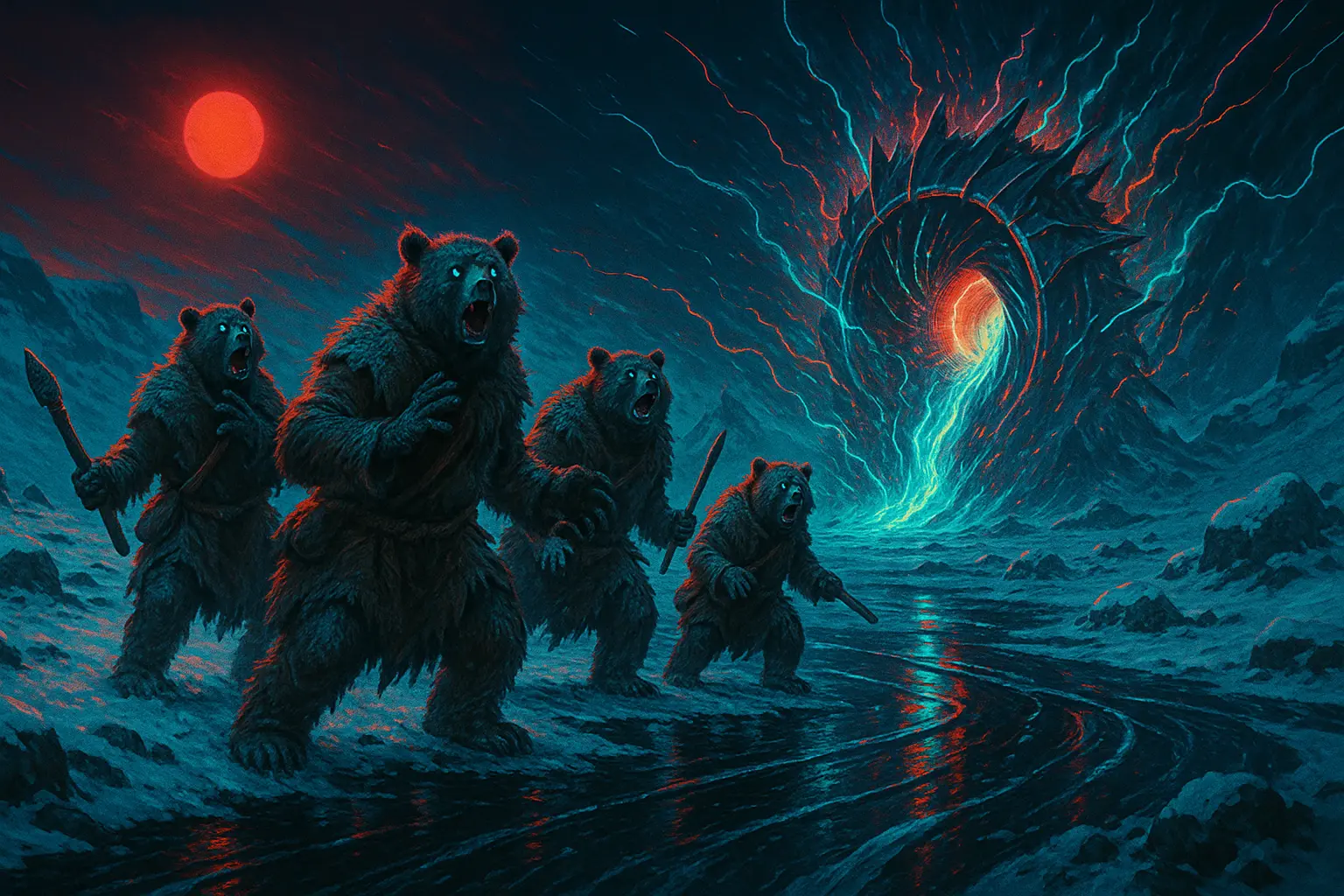
The narrative begins in the Third Age of the Pneumatic Era, when clans foraged across glacial Sarmatia. Their tools were late Paleolithic. Their magic was practical and scarce. According to the film, Azothic Gates tore open across the Sarmatian plain, exposing nomads to Aradia’s Icepunk fjords and petroleum-streaked ice. The Wargs—Fae chimeras of frost and fossil fuel—organized rapid campaigns around these crossings.
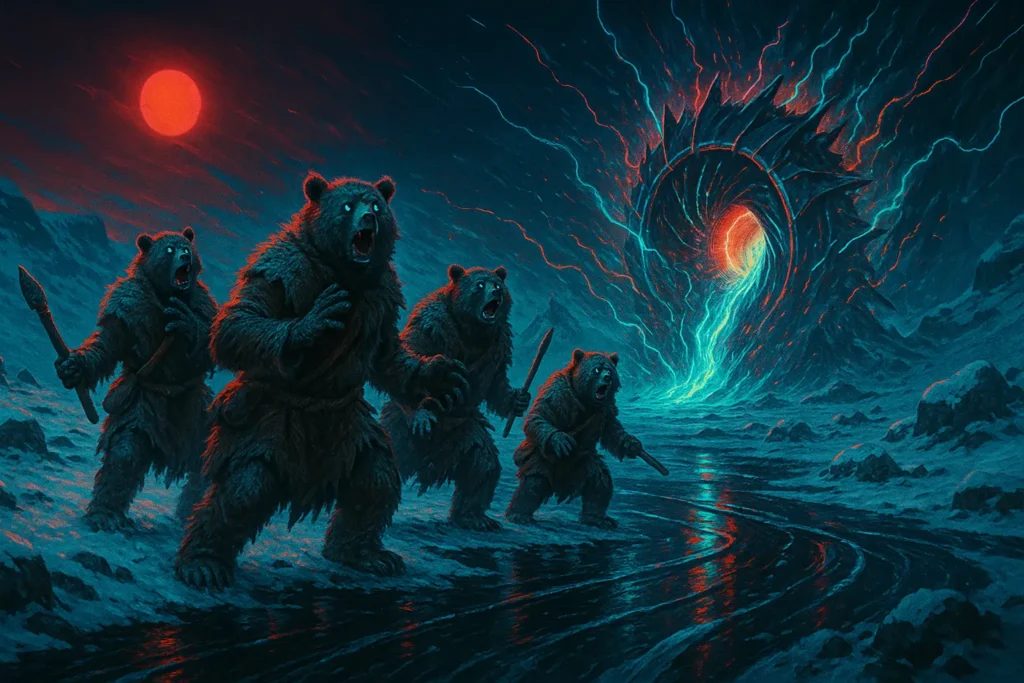
The Glacial Sarmatian plains were irrevocably changed when the Azothic Gates tore open, confronting stone-age clans with the Icepunk horror of Aradia (Credit: Kenomitian)
The documentary contends that Yeshite colonies founded inside Aradia depended on royal patronage and tribute. Colonies that refused vanished from both Tikun registries and material maps, erased by silt manipulation and cold. Researchers interviewed on camera link this dominance to later Sabaothian distrust of hereditary power. They trace a line from Warg polygamy and overlordship to the modern Communist suspicion of royal spectacle.
Cinemas in major industrial cities reported sold-out screenings. The state network simulcast the premiere with sign language and Penemuean captions. Street kiosks blasted the anthem “Song of the Workers” over intermission footage of glacial shelves. Outside several venues, students carried placards quoting the film’s epigraph: “Remember the Gates, and who set the terms.” Some veterans of polar extraction brigades wore commemorative patches featuring a stylized Warg jaw and a broken crown.
Officials kept their speeches brief. They emphasized scholarship over ideology, while praising the film’s Cassette Futurist design. “We see our past through disciplined imagination,” one cultural secretary said from a stage lined with frost-white banners.
Reconstructing a Prehistoric Encounter
The film reconstructs life along the Etz Breishit frontier, where the Kabbalistic Tree’s roots gave rise to the Elioud. It details how clans moved between permafrost and spruce bog, mapping seasonal camps to Gate tremors. Reenactments show hunters with bronze-tinted skin and skull-like features, stalking musk ox with obsidian blades and low-tier wards. Fishers harvest under-ice stocks using breath-magic and woven charms. Their spells are small, their communal coordination exact.

The debated “Sarmatian Compromise”: a hypothetical treaty etched in alternating lines of frost and bitumen, illustrating how early vassalage fixed enduring habits in Sabaothian statecraft (Credit: Kenomitian)
Then the frame fractures: a Gate blooms like a turbine iris. Wind shrieks in a minor key. The screen cuts to Aradia’s black ice, flensed by drill towers of living frost. Warg sentinels rise as serrated silhouettes, equal parts mosasaur and wolf.

Aradia’s Warg Sentinels, biomechanical chimeras of frost and fossil fuel, established elemental dominance over the plains, organized around the first Gate crossings (Credit: Kenomitian)
The film argues the first vassalage fixed three habits that endure. First, Sabaothian caution near charismatic, unelected rulers. Second, infrastructural obsession with monitoring cross-realm thresholds. Third, aesthetic ambivalence toward majesty and machinery. Curators connect those habits to the modern Nakhielim surveillance lattice, the Tree of Eyes that watches gates, borders, and data lines. The documentary treats the lattice as a civic heir to ancient vigilance, not only a security tool. Critics, however, warn against reading prehistory as destiny. They caution that past subjugation does not justify perpetual emergency measures. The film acknowledges the tension but keeps its emphasis on long memory in statecraft.
Producers showcase a mixed toolkit. They cut between stratigraphic digs in northern Sarmatia and thaumaturgic audits conducted by certified ritualists. The audits reproduce sound signatures of Gates using archived resonance from basalt cores. Animations overlay isotope maps on migration routes. Where fossil fuel seams kiss glacial fans, the film places early colonies. The implication is simple. The Wargs sought resource corridors and controlled them through marriage, tribute, and engineered winters.
Ethnographers present songs from Hyrcanian villages that name specific Warg queens and “salt-sons.” The verses are matched to bone fringes and copper foils found near ice pits. A margin of uncertainty remains, and the film keeps it visible.
Senior historians frame the contact as asymmetrical but not absolute. Some colonies bargained better terms by supplying gate guards or fishing quotas. Others fled back to Yesh, carrying Aradian tools and anxieties home.
One segment highlights the “Sarmatian Compromise,” a hypothesized treaty etched in alternating lines of frost and bitumen. The artifact’s authenticity is debated, yet its clauses match later oath formulas recorded in clan law. The film also engages the Epigenetic Aeon’s intellectual milieu. It proposes that modern ideological schisms reflect older arguments about what counts as “people” under Fae sovereignty, and how much change a people can bear without losing itself.
In factory dorms, workers watched in common rooms, then argued about royal marriages over wheat tea. Some saw pragmatic survival. Others called it capitulation. Many said both could be true. Museums set up companion panels explaining Usiel’s relation to Avon in Tikun. Children traced Gate rings with chalk and learned that not every portal stays open. Memory is often stitched from vanishing edges. Online forums filled with freeze-frame analyses of Warg morphology. Users compared dental ridges and limb counts, debating whether certain sentinels were composite officers or ceremonial avatars.
Voices From Screen and Street
“I have told this story five ways,” says historian Mara Daskol on camera. “None of them make the Wargs kinder. Some make the Theria more ingenious. That is enough.”
A maintenance foreman outside a steel plant offered a cooler view. “We live by schedules the Gates do not keep,” he said. “I liked the part where the clan chief bartered for ferry rights. That felt honest.”
The director, Ilya Tchern, anticipated disputes. “We are not myth-busting,” he says near the closing reel. “We are myth-measuring. The rulers were polygamous. The ice was loud. The treaties were binding. People survived.”
The Film’s Visual Grammar
Cinematography leans on contrasts. Brutalist shafts flank reels of drifting floes. Cassette Futurist consoles chirp beside bone toggles. Tape hiss merges with Gate wind, a motif that signals proximity to decision points. Costume designers collaborated with industrial artisans. The Warg regalia appears poured, not sewn, studded with trapped leaves and coal. Meanwhile, Therian gear shows repair on repair, a dignity of continuity rather than display. The score avoids triumphal peaks. It favors pulse and drone, recalling machine halls and distant surf. When the Nakhielim arrays light, the music only thins. The audience supplies the feeling, which is sometimes dread.
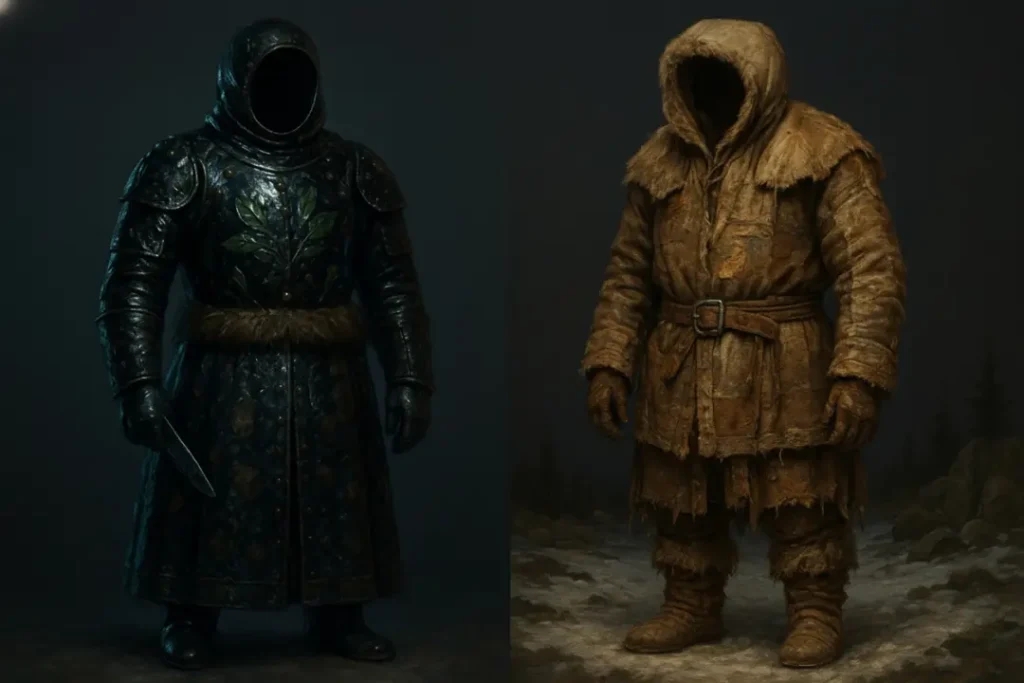
The visual grammar of dominance: the Warg’s “poured” regalia, an alien spectacle, contrasted sharply with the Therian’s gear, a testament to survival and continuity through constant repair (Credit: Kenomitian)
Comparing First Contacts
Scholars in a key segment place Sarmatia’s encounter alongside Old Earth’s Homo interbreeding events. The analog is limited, they caution. Where genes once mingled, jurisdiction now pressed down. The film uses that caution to sharpen its claim. It shows benefit without romance. Immunities, construction tricks, and icecraft techniques passed to Yeshites. In exchange came tribute, relocation, and a politics of watching. An anthropologist concludes the sequence with a rule of thumb. “First contacts are never first in the mind,” she says. “They arrive into expectations we learned elsewhere. The Wargs met a people already wary.”
A brief declassification montage reveals ledger fragments from early party repositories. Items reference “Gate Adjudication Units” formed during socialist consolidation. The units studied frontier oaths for modern boundary law. One memo, read in voice-over, summarizes a lesson. “A vow is a machine,” it says. “It converts uncertainty into labor. Beware of undervalued oaths.” Viewers quickly screen-captured the line. Archivists stress that modern institutions do not inherit Warg sovereignty. They inherit awareness of leverage points. The documentary floats that distinction like a buoy and moves on.
Risks of Overreach
Civil libertarians appear on camera to warn against narrative opportunism. “If all roads lead to the Gates, every checkpoint becomes sacred,” one advocate says. “We must keep the profane lanes open.” Producers include that critique without rebuttal. The edit places it between scenes of village councils refusing Aradian marriage terms and paying a harder price. Consequence is shown, not explained. Security officials give a single statement. The network captions it without ornament. “Monitoring thresholds prevents surprise,” it reads. “Policy is set by law. History is not a loophole.”
Education and Youth Engagement
Schools announced lesson kits paired with the film. Teachers receive maps of Sarmatia, glossaries of Tikun realms, and prompts for debate. Students argue whether vassalage can be provisional and still count as vassalage. Youth clubs plan model councils to simulate treaty bargaining. Each team must balance cold, hunger, and clan factionalism against Aradian demands. The rules encourage concessions and walk-aways, both scored for realism. Curators will tour northern towns with a portable exhibit. It includes a Gate resonance booth that plays “weird music” mapped from basalt cores. Younger children laugh. Teenagers stay longer, listening for pattern.
Industry and Resource Echoes
Energy planners note the film’s attention to seams, shelves, and choke points. They see practical lessons in the Wargs’ control of silt and access. Infrastructure is political because terrain is political. A mining cooperative pledged funds for further surveys around dormant Gate rings. Their statement frames it as environmental stewardship and risk forecasting. Critics see a pretext for expansion. The documentary neither blesses nor condemns extraction. It dramatizes a calculus that predecessors learned under harsher skies. That choice unsettles and clarifies in equal measure.
International Viewings
Several allied broadcasters booked the film for late autumn runs. Subtitles will retain terms and Footnotes for Tikun geography. Producers rejected a proposal to replace “Warg” with “ice-fae.” Cultural attachés hope the film travels well. They see an opportunity to introduce Kenomitian history without reducing it to spectacle. The absence of a conventional hero may help. Festival programmers abroad expressed curiosity about the Icepunk palette. Some asked whether the Warg monarchy is still active. The production team declined to answer on record.
Between vast shots of shelf and smokestack, the film lingers on faces. A child practicing a ward. A fisher counting breaths. A Warg sentinel regarding a tribute sled with unreadable patience. These images anchor the thesis. Power did not erase small skill. The clans adapted, bargaining dignity in units the ice could measure. Survival became a tradition with teeth. When the credits roll, viewers exit into their own winter light. The sky over the factories holds a familiar pallor. The Gates remain metaphor and mechanism at once.
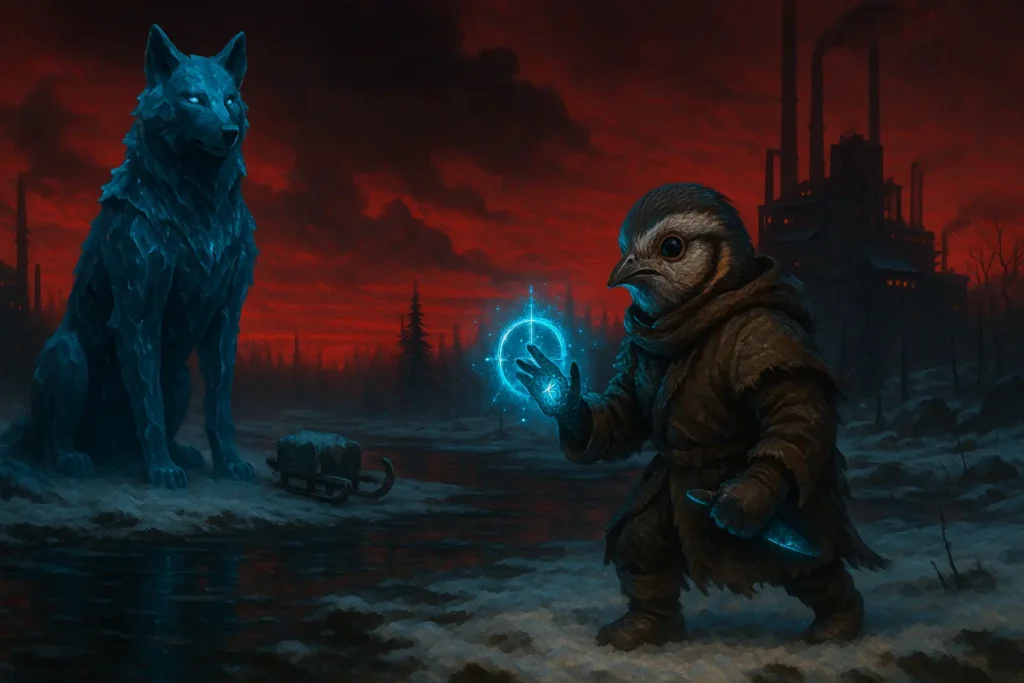
Power did not erase small skill: Even as the factories sprawl under the pallor sky, the tradition of adaptation and survival—the “ledger we kept”—continues (Credit: Kenomitian)
Quotable Moments
“Myth is what remains after evidence agrees to be brief,” says an ethnographer, smiling like someone who has lost and found the same object twice.
“We were not the first rulers of our own fear,” offers a union elder in a post-screening forum. “But we learned to staff it properly.”
“The Wargs kept winter ready,” concludes the narrator. “We kept a ledger. That ledger is why we are still here.”
Where the Gates Lead Next
The Ministry of Culture confirmed a traveling exhibit tied to the documentary, with stops across Hyrcania. Field teams will collect local variants of early vassal songs and compare them to known treaty forms. Researchers plan a joint project on Gate acoustics, hoping to predict size variance before replacement events. Lawmakers hinted at hearings on threshold monitoring standards. For now, the film has shifted the conversation. Whether citizens see domination, adaptation, or both, the documentary has tightened the country’s attention on its oldest border: the line between Yesh and Tikun. The past has returned as a present-tense verb.