Harmozel, Kyrian Kritarchy [1] –Sandalphon 24, 1790 – The city of Harmozel, gateway to Chokhmah and a bastion of Hasturian faith, has fallen. In a brutal pre-dawn assault, the Ouroboran Caliphate [2], driven by unyielding Altifanist zeal, overwhelmed the Kyrian Kritarchy’s Clock Punk defenses. This conquest is not merely a territorial gain; as it transforms a city into another bloody chapter in the eternal desert dance of conquest, reconquest, terrorism, and ethnic cleansing that defines this ravaged land.
The Turanian Mideast, a region perpetually scarred by conflict, has once again witnessed a seismic shift in its brutal geopolitical landscape. At the heart of this latest conflagration lies the Ouroboran Caliphate, an expansionist and fiercely traditionalist power. Unified under a singular Altifanist doctrine and revering Cthugha, the Supreme Overlord [3], the Caliphate, led by the formidable Caliph Dânêl, embodies a doctrine of uncompromising dominance. Their Diesel Punk military machine, infamous for its “no prisoners” policy and the systematic disposal of ethnic and religious minorities in extra-dimensional colonies like the Taifas of Arcandam, wages a relentless hot war against any who stand in its path.
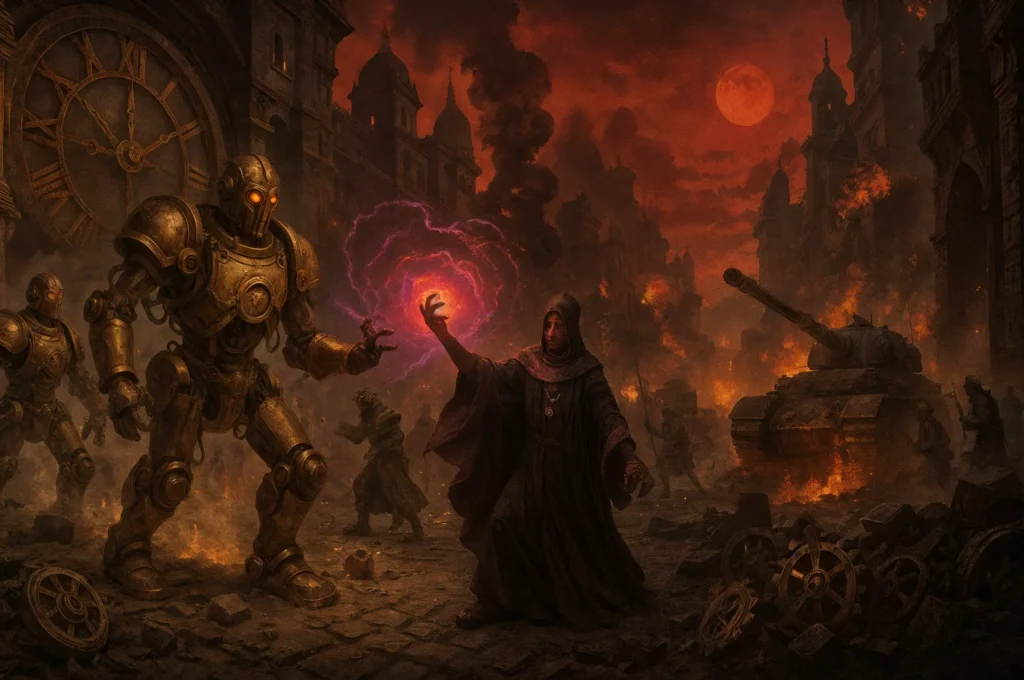
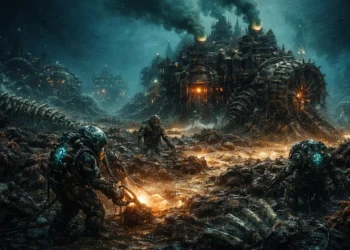
A Kyrian Kritarchy sorcerer, a devoted practitioner of Hasturian wisdom, uses their ordered magical abilities to confront a devastating Ouroboran Caliphate Diesel Punk tank, symbolizing the ideological chasm at the heart of the conflict (Credit: Kenomitian)
In stark contrast, the Kyrian Kritarchy is a Clock Punk theocracy, with its governance uniquely fused between the Judiciary and the Priesthood. Its absolute dictator, the Baraqiel, is chosen directly by Wise Hastur, whose Emissaries of the Ineffable emphasize the deification of cities and utopian societies. This ideological chasm—between the Ouroboran pursuit of unified Altifanist dominance and the Kyrian dedication to sacred urban structures and Hasturian wisdom—has fueled a centuries-long, deeply personal, and often genocidal struggle for territorial and spiritual supremacy. The fall of Harmozel, a city not just of strategic importance but of profound metaphysical significance as a direct portal to Chokhmah, is the latest, and perhaps most chilling, act in this unending cycle.
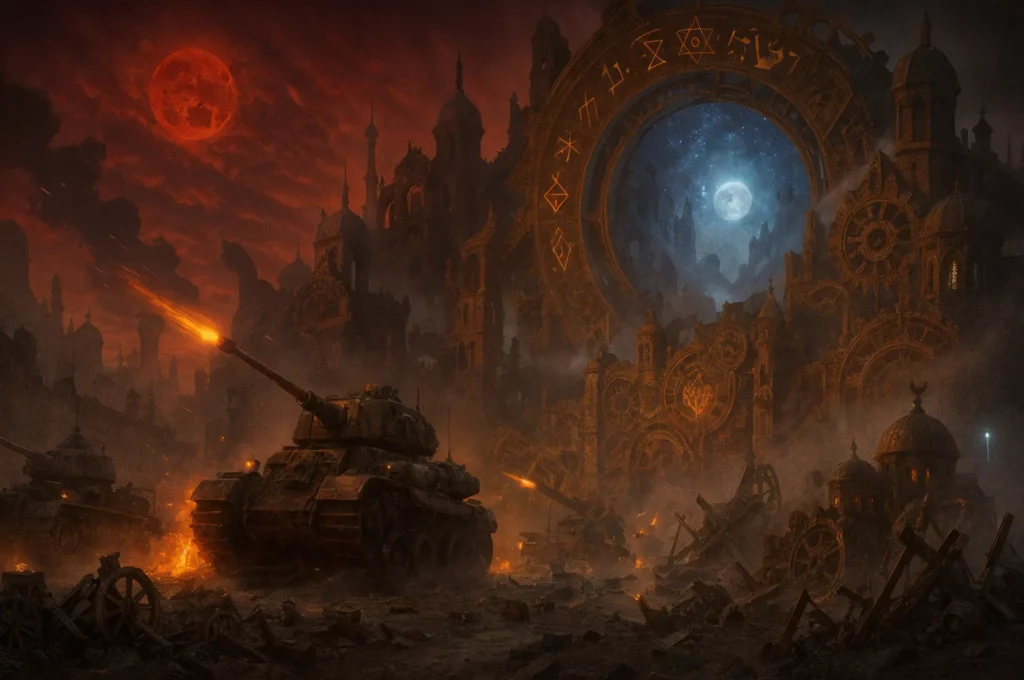
A brutal pre-dawn assault on the city of Harmozel, where Ouroboran Caliphate Diesel Punk tanks advance under a blood-red moon, clashing with the intricate Clock Punk defenses of the Kyrian Kritarchy (Credit: Kenomitian)
The Ouroboran Caliphate’s strategic invasion and subsequent capture of Harmozel marks a brutal turning point in the ongoing conflict. This was no mere border skirmish but a meticulously planned offensive, executed with the ruthless efficiency characteristic of Caliph Dânêl’s forces. Under the cloak of night, Diesel Punk war machines, their smoke-belching engines roaring, surged across the Kyrian border. They moved with devastating speed, razing everything in their path, leaving a trail of destruction that spoke to the Caliphate’s uncompromising approach.
Beyond the Written Words, the Story Unfolds:
The Kyrian Kritarchy’s Clock Punk defenses, with their intricate gear-driven automatons and ordered magical abilities, were overwhelmed by the sheer force and fanatical zeal of the Altifanist invaders. Despite the Kyrian forces’ devotion to Hastur and their determined efforts to safeguard their deified city, the Caliphate’s “no prisoners” policy ensured a swift, brutal suppression of any lingering resistance. The objective was not merely conquest, but annihilation of opposition.
Harmozel’s strategic importance extends far beyond its physical location within the Kyrian Kritarchy. The city housed a direct, active portal to Chokhmah, a realm within Tikun bordering the Demiurge’s impregnable barrier of Da’at. This gateway, long revered by the Kyrian Kritarchy as central to their Hasturian faith and their vision of utopian cities, offered access to the nearest accessible point to the inaccessible Demiurge. For the Ouroboran Caliphate, seizing this portal was an act of profound ambition—a bid to control a pathway to an extradimensional religious monument.
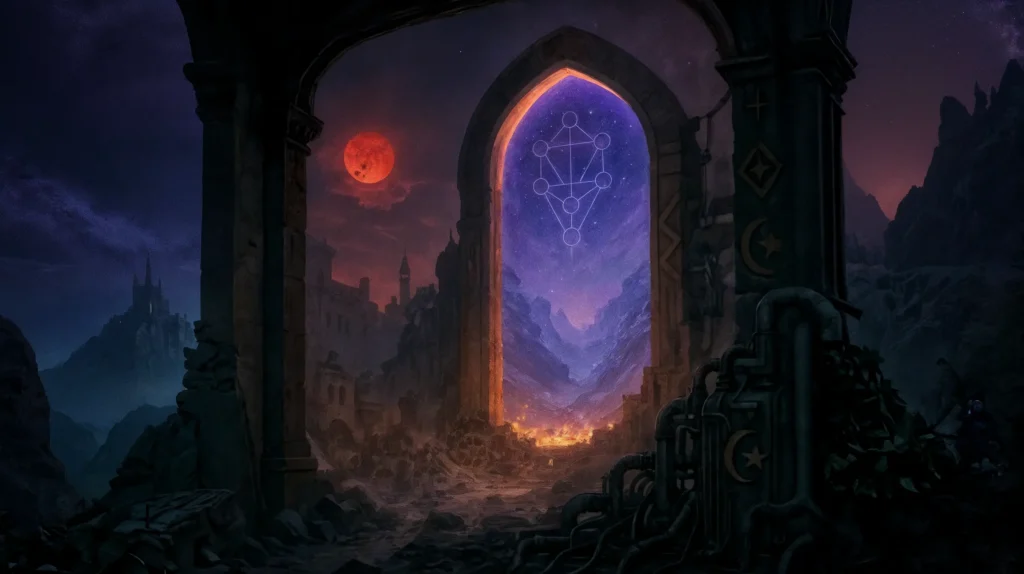
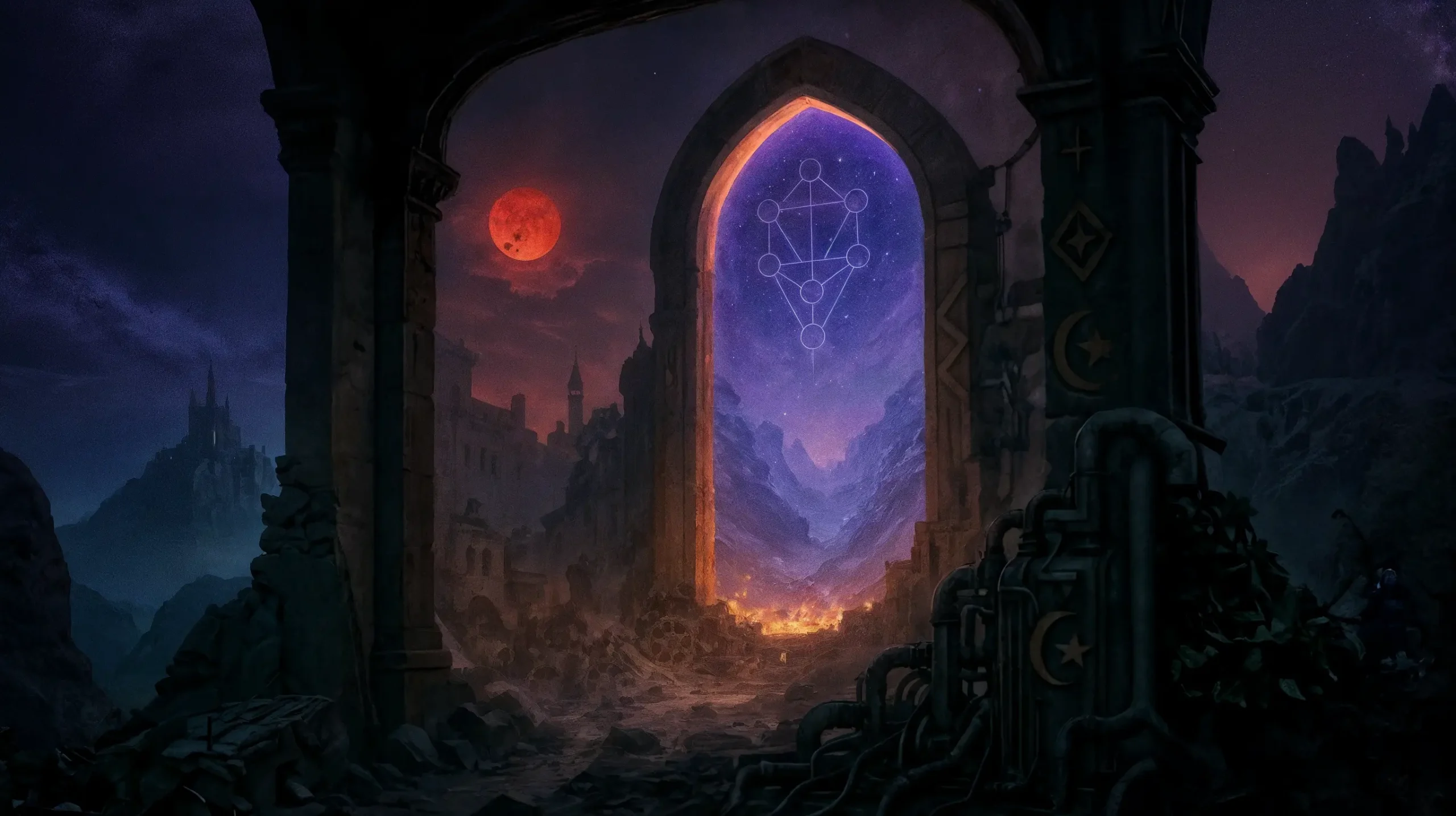
The ethereal portal to Chokhmah, a sacred gateway for the Kyrian Kritarchy, now lies within the captured city of Harmozel, its seizure by the Ouroboran Caliphate representing a profound shift in metaphysical power and spiritual control (Credit: Kenomitian)
The control of this portal fundamentally alters geopolitical claims over access to the nearest location to the inaccessible Demiurge. It also has immediate and profound implications for the vast network of religious pilgrimages and occultists’ studies across Kenoma. Altifanist scholars and zealots of the Caliphate will undoubtedly seek to exploit this newly acquired access, potentially disrupting millennia-old routes and practices. For the Kyrian Kritarchy and other faiths, this represents a blasphemous appropriation, threatening their spiritual foundations and deepening the existential nature of the conflict.
In the aftermath of the assault, reports from fleeing refugees paint a grim picture of systematic ethnic and religious cleansing. The Ouroboran Caliphate’s long-standing policy of disposing of minorities in their extra-dimensional colonies has now been brutally applied to Harmozel. Survivors speak of the wholesale displacement of populations, the destruction of Hasturian holy sites, and the forced conversion or elimination of those deemed unaligned with Altifanist tenets. The conquest is not just about territory, but about reshaping the very demographic and spiritual fabric of the Turanian Mideast, imposing a singular ideology through terror and forced migration.
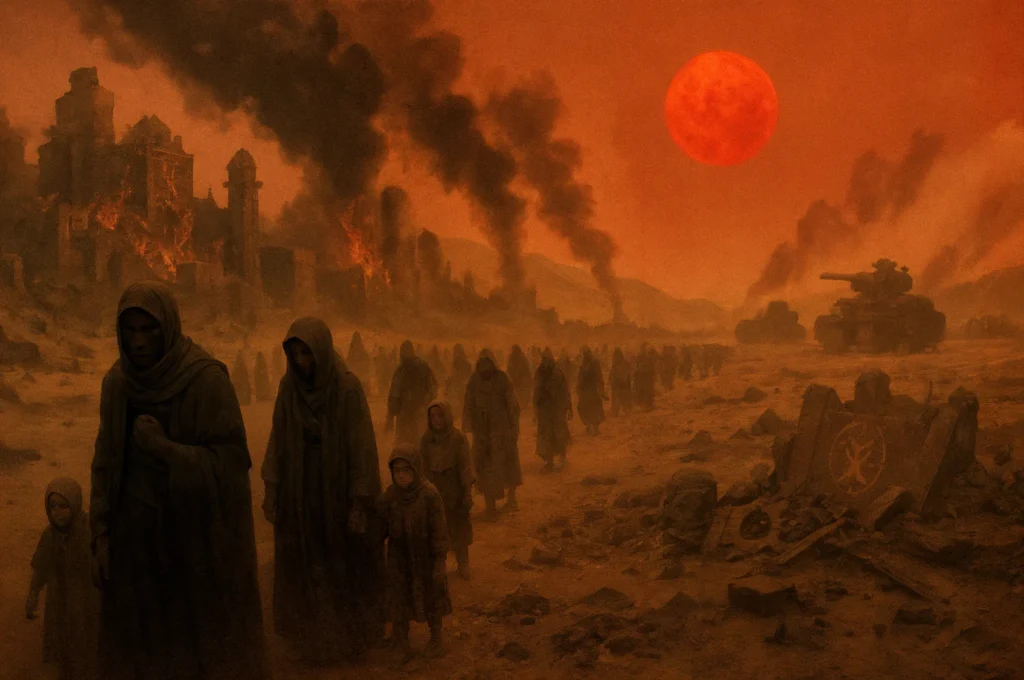
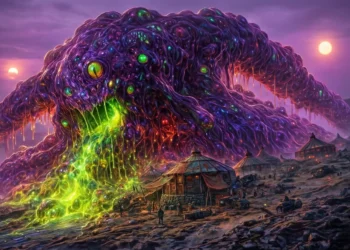
Refugees flee the brutal conflict, their journey marked by the systematic ethnic cleansing and forced displacement of populations by the Ouroboran Caliphate, leaving a trail of destruction in their wake (Credit: Kenomitian)
Amidst the chaos, the Malebranche Society of Arcanists (MSA), an organization recognized across Kenoma for its inter-planar neutrality and commitment to preserving vital knowledge, managed to extract key individuals, including the renowned Kyrian scholar Arcanist Herut Shafir. Their intervention underscores the broader Kenomitian recognition of Harmozel’s unique significance and the universal concern among scholars regarding the potential loss of metaphysical knowledge following the Caliphate’s occupation. Shafir, now in undisclosed refuge, is reportedly attempting to compile what remains of Kyrian arcane knowledge related to the Chokhmah portal.
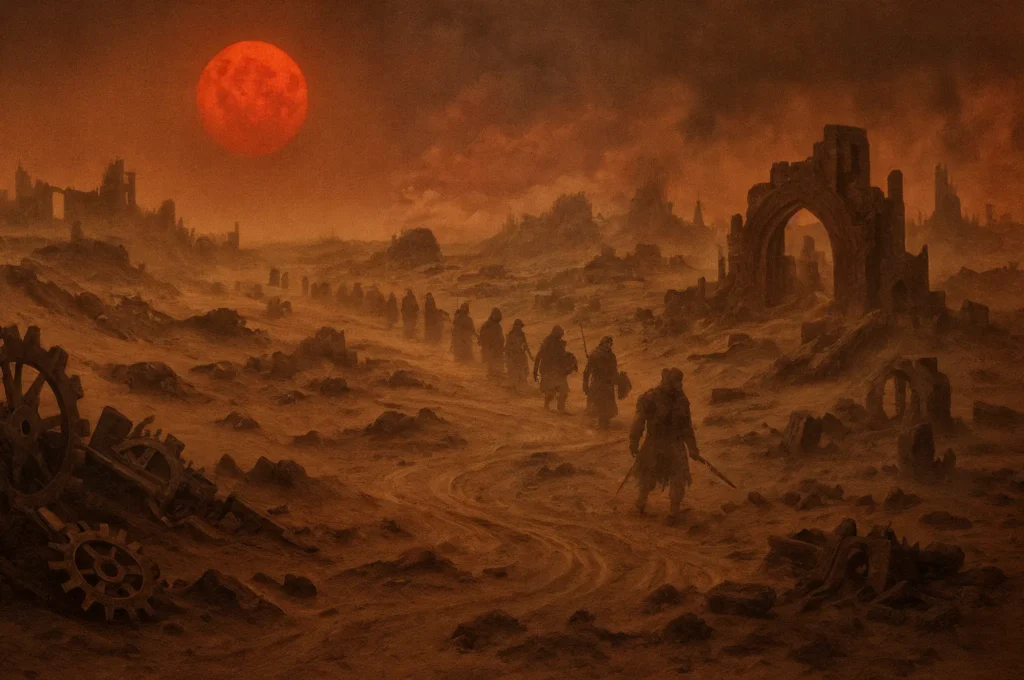
A group of scholars and mystics, led by the renowned Arcanist Herut Shafir, flee across the desolate, war-torn landscape, carrying with them what remains of Kyrian arcane knowledge (Credit: Kenomitian)
Immediate Fallout
The fall of Harmozel represents a significant, if brutal, victory for the Ouroboran Caliphate, cementing their expansionist ambitions and demonstrating the ruthless effectiveness of their Diesel Punk military. Caliph Dânêl’s grip on power is likely to strengthen as Altifanist populations celebrate this profound symbolic and strategic gain. However, the victory comes at a severe cost: it deepens the cycle of hatred and revenge that fuels the eternal desert dance of Kenoma. The “no prisoners” policy and the ethnic cleansing in Harmozel will undoubtedly galvanize further resistance, not just from the Kyrian Kritarchy but from other nations fearing similar fates.

The formidable Caliph Dânêl, Supreme Overlord of the Ouroboran Caliphate, stands amidst his high command in a triumphant pose, demonstrating the ruthlessness and power of their Diesel Punk military machine (Credit: Kenomitian)
The geopolitical balance of Sige’s Turanian Mideast has shifted in a development that will send ripples through arcane and religious circles across Kenoma. Religious pilgrimages to the region will cease or be rerouted under duress, and occultists will either seek dangerous alliances with the Caliphate or go further underground to pursue their studies. The fall of Harmozel is not an end, but a violent punctuation mark in a conflict that continues to define the very existence of nations in this unforgiving landscape. It ensures that the brutal dance of conquest, reconquest, terrorism, and ethnic cleansing will continue its relentless, bloody rhythm for generations to come.
Notes extracted from the Kenomitian Compendium
[1] Kyrian Kritarchy: a Clock Punk and Divine theocracy, where the Judiciary and the Priesthood are fused together and the absolute dictator (the Baraqiel) is chosen directly by the statistically dominant Deity at the moment.
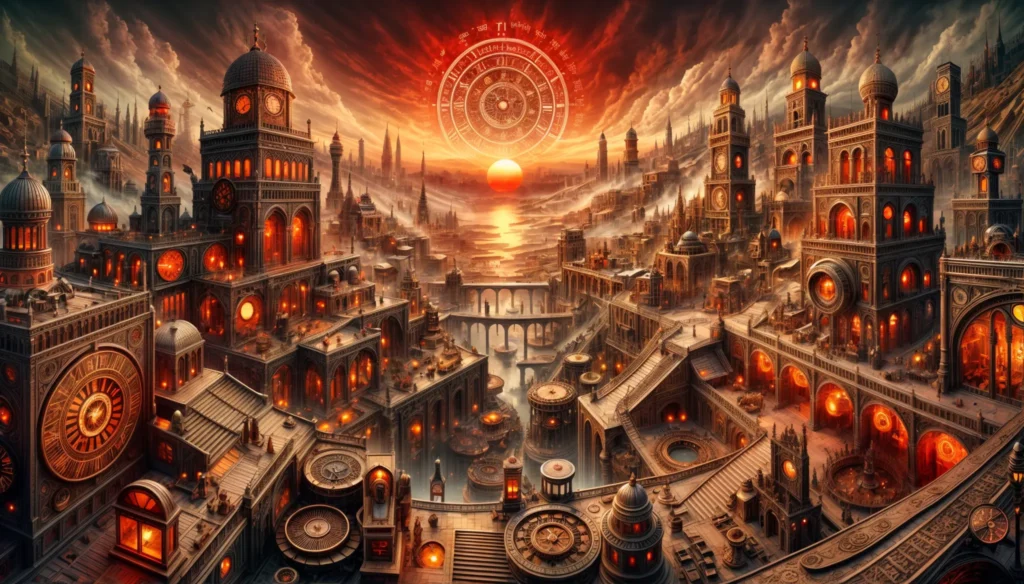
A glimpse into the Kyrian Kritarchy (Credit: Kenomitian). See more
[2] Ouroboran Caliphate: a Diesel Punk and extremely traditionalist theocracy, where a myriad of tribes, lineages and civilizations have been brought together by the flames of a mighty angel named Dânêl: Caliph, Shahanshah, Padishah and Sultan of Sultans. It’s divided in seven regions: the Sultanate of Nigredo, the Sheikhanates of Albedo, the Malikate of Citrinitas, the Shahnate of Rubedo, the Emirates of Rebis, the Taifas of Arcandam (the Caliphate’s extra-dimensional colonies), and the Buraqate of Ishraq (the Caliphate’s extra-planetary colonies.
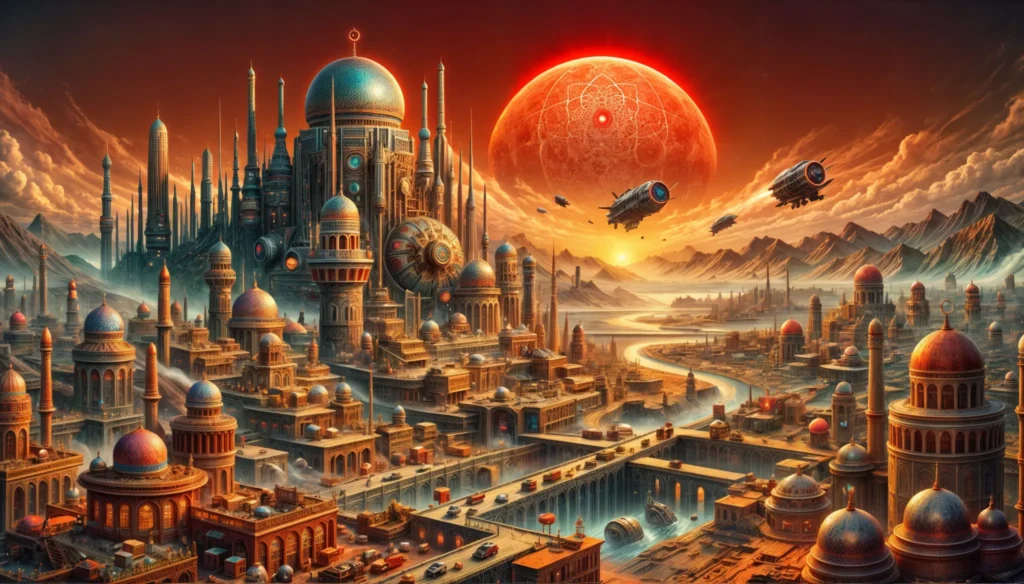
A glimpse into the Ouroboran Caliphate (Credit: Kenomitian). See more.
[3] Cthugha: God of Government—Overlord, Unity, Voice of the Collective—appears as a golden mechanical raptor with ten wings and six suns for heads.Boisterous and rigid, he demands purity and honesty, embodying chastity, temperance, charity, diligence, patience, kindness, humility, sobriety, faith, and holy war. His angels, the Seraphim—pillars of fire with golden mechanical wings—can puppet willing elioud by their radiance; he dwells in the Hanging Thrones’ Garden of Endless Delights, a planet-sized golden ecumenopolis afloat on molten brass under six suns. From his aviary fortress linked to Alkahest, Enthymēsis, Beulah, Tohu, and the rest of Tikun, he grants wings, solar flares, auras, trances, vows, holy artifacts, and crescent halos that purge poisons/pollutants/“sinners” and restore sanity.
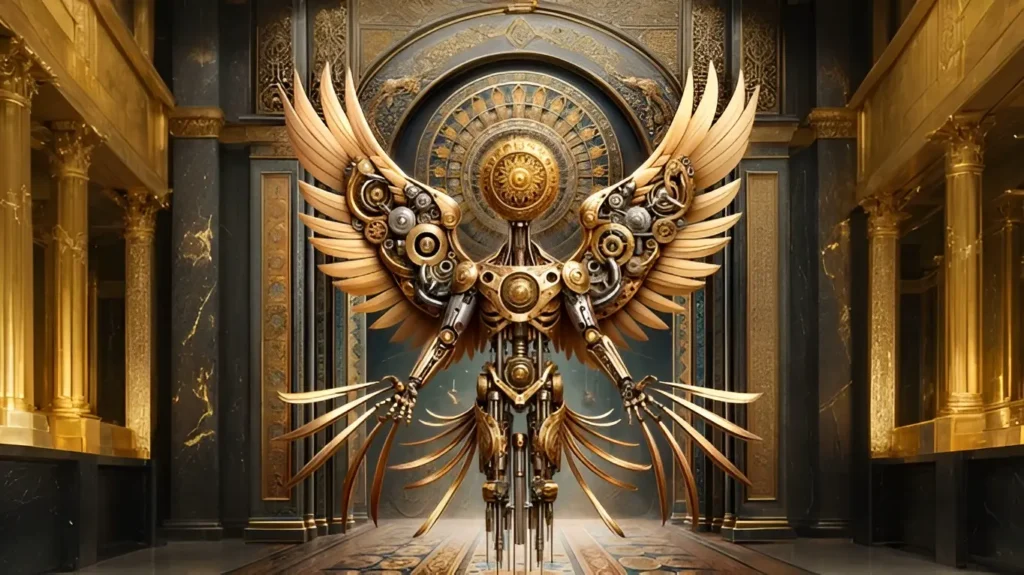
Cthugha (Credit: Kenomitian)