Sandalphon 18, 1790. The Specialized Bureau for Geopolitical Thaumaturgy of The Arcane Herald completed a months-long inquiry into Astaphanos. Evidence indicates the state’s vaunted “Song of Order” is maintained by a perpetual epimorphic matrix that rewrites minds, harvests suffering as fuel, and converts identity into infrastructure.

Astaphe’s engineered serenity: The capital city presents a paradox of stability where every boulevard and spire serves the collective psychomantic flux (Credit: Kenomitian)
Astaphanos presents a paradox of engineered stability. The Harmonium’s public serenity masks systemic psychomantic flux. That flux is intentional. It is the governing method rather than a symptom of decay.
At the core stands the Vretil System, a spell lattice attributed to the deceased Psychomantic Archmage Pravuil Vretil. The lattice continuously reshapes civilian cognition. Citizens become epimorphs—persons rebuilt by magic—whose new loyalties align instantly with whatever policy the matrix broadcasts as “order.” Leadership, ministries, and diplomatic postures can shift overnight, yet social compliance persists. This compliance is not free. The spells are powered by Orgone, distilled from coerced misery. Nightmares of erased selves supply the charge. The process closes a loop: suffering generates energy, energy sustains programming, programming compels further suffering.
Astaphanos legalizes this condition through Servitor Laws. Where other polities ban such practices on elioud, Astaphanos names them legitimate status. The result is a nation where ideology has been replaced by its magical equivalent: immediate cognitive capture. Mathematical models of totalitarian transformation—normally dependent on time-bound socialization—are bypassed through direct rewriting.
Astaphanos is an undersea state whose capital, Astaphe, echoes Pyongyang’s designed monumentalism. Boulevards and parabolic halls rise like crystal spires. Citizens wear draped uniforms whose elegance masks surveillance and sorting. Decorative silence functions as policy. The Harmonium draws material power from Ramiel and Arakiel: crystalized lightning and heating mud imported from other domains. Yet its political power rides on Orgone—the Aether siphoned from distress, dread, and despair, refined through the kav at scale. That refining occurs in civic temples disguised as clinics.
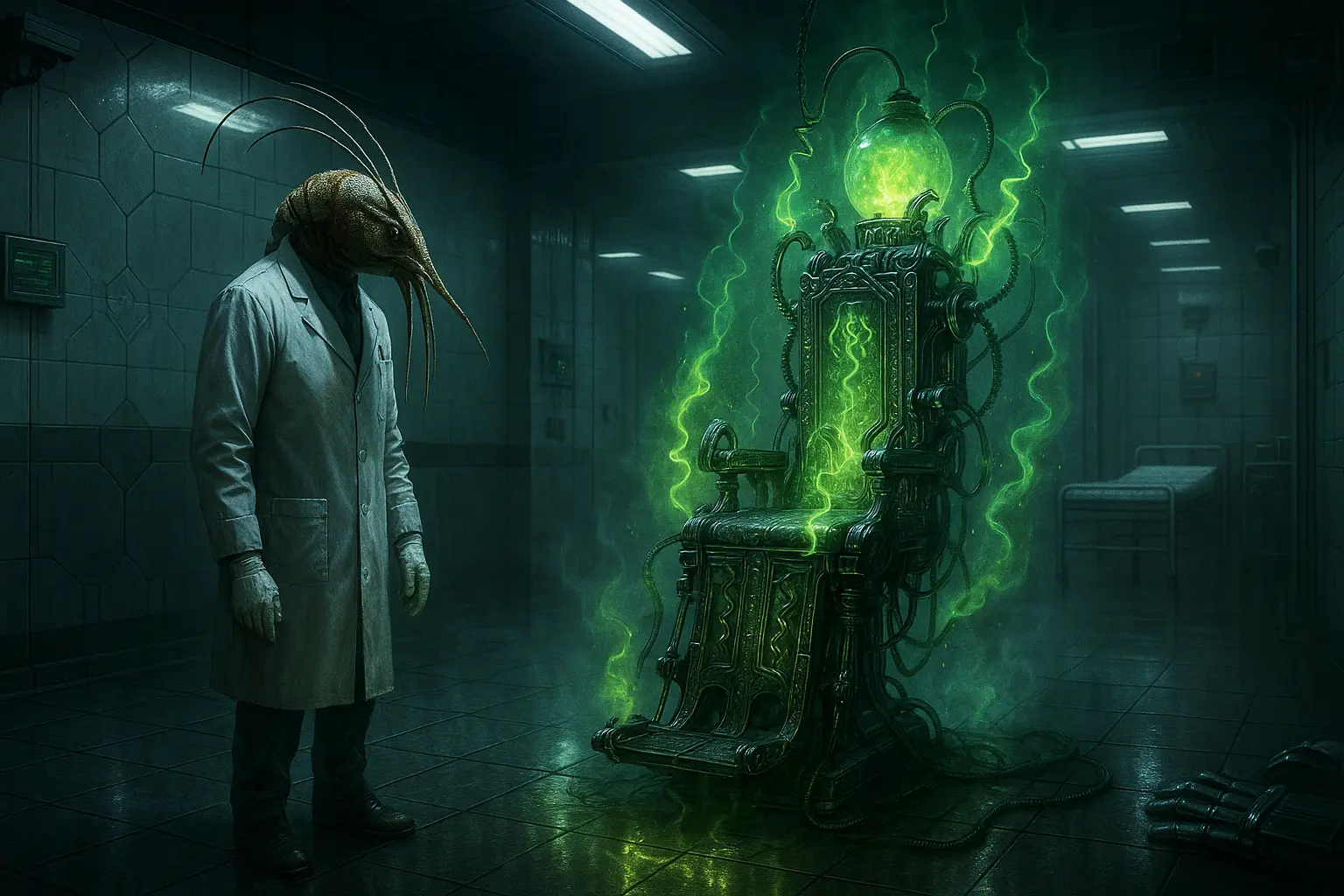
Orgone Refinement: In clinics across the Harmonium, ‘extractors’ catalyze the pain of recollection rehearsals into Aether, which feeds the Vretil System (Credit: Kenomitian)
Three sanctioned religions, each perilous, shape the ambient field. Kyomu no Yume venerates Zagan, Devil of Hypnosis. Te Ara serves Azathoth, Titanide of Wilderness and the Dark Ocean. Ngaru o te Wehi worships Belphegor, Devil of Catastrophes. Their coexistence within the Harmonium contradicts administrative rhetoric about unity, but it suits the regime’s deeper method: managing chaos by monopolizing who may conjure it.
Sources inside the Ministry of Harmonies describe the Vretil System as a “perpetual spell matrix with parametric governance.” The phrase is technical. The meaning is stark. Policy outputs are not handbooks; they are mind-state pushes. Granular components include stimulus hubs, mnemonic shear nodes, and choir relays. Hubs ingest surveillance. Shear nodes apply identity edits. Choirs broadcast the “Song of Order,” a harmonized tone that seeds compliance scripts as emotional reflex.
A technical brief obtained by The Arcane Herald outlines three control bands. Band One synchronizes perception: it fixes the day’s truths. Band Two suppresses dissonant memory fragments. Band Three overwrites identity when Bands One and Two fail.
“Think of Band Three as factory reset with a smile,” said a former relay technician, now exiled. “You wake lovely and new. You also wake someone else.” His voice trembled as he described waking thrice in six months to different work units.
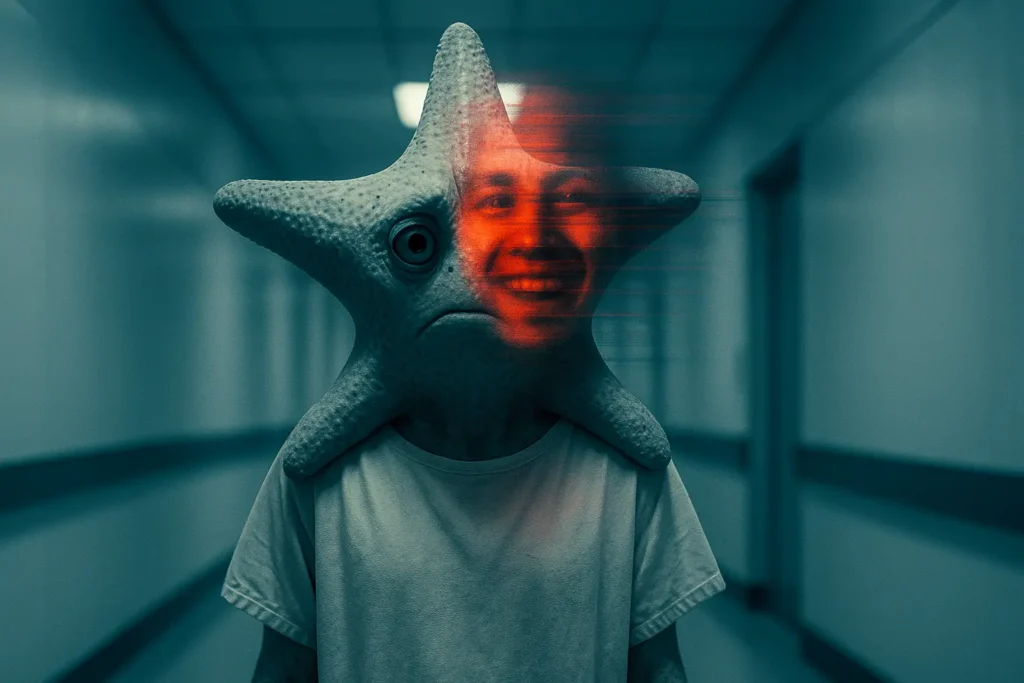
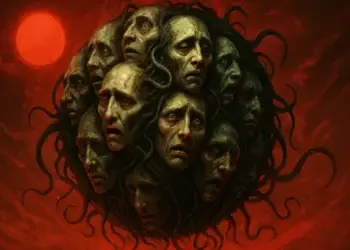
Band Three Recurrence: Deleted identities do not always vanish. They recur as ‘noise echoes’—brief, agonizing flashes of the self erased by the Vretil System’s cognitive rewrite (Credit: Kenomitian)
The system’s genius lies in fluid authoritarianism. Where conventional totalitarian regimes demand continuity to sustain myths, Astaphanos demands plasticity. Continuity lives not in institutions but in the programming function itself.
Accounting ledgers from a provincial Harmony Clinic show a conversion schedule: nightmare volume to spell-hours. The line items are bureaucratic. Each records a therian cost. “Severe recurrence cluster, pre-epimorph identity,” one reads, “yield optimal.” Clinicians are not healers. They are extractors. Patients are guided through “recollection rehearsals,” scripted to trigger the pain of former selves. Those pains are catalyzed into Orgone by licensed psychomancers. The energy feeds back into the matrix.
A systems economist, speaking anonymously, called the model “closed-loop autarky.” The regime exports none of this power. It reinvests every drop in the people who produced it. “They have reinvented national income as psychic throughput,” she said. “Gross Domestic Agony.” Reformers in other domains have long debated the ethics of Orgone markets. Astaphanos resolves the debate with fiat. The Servitor Laws define the programmed as legitimate subjects whose suffering is not theft but taxation. “We say energy must come from somewhere,” said a ministerial advisor. “In the Harmonium, it comes from us.”
Yet friction exists. Memory is stubborn. Deleted identities do not always vanish. They recur as dreams, phantom appetites, and flashes of guilt. The regime names these “noise echoes.” Clinics harvest them for power, then damp them with new scripts. The loop continues.
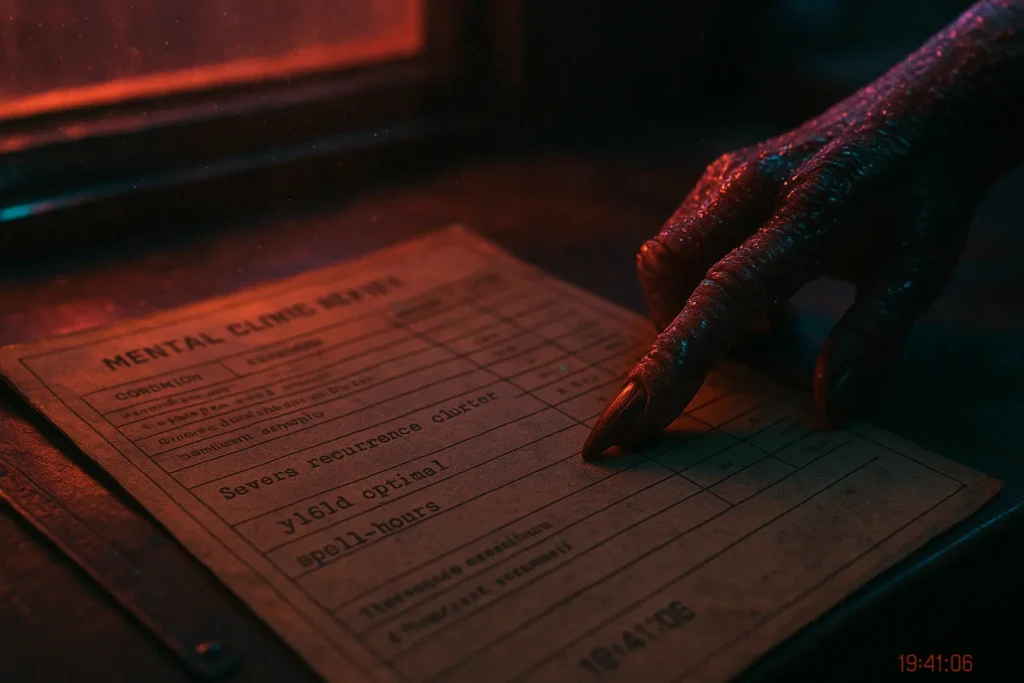
Gross Domestic Agony: A conversion schedule detailing nightmare volume to spell-hours. Suffering is not theft; under Servitor Laws, it is legitimate taxation (Credit: Kenomitian)
Worship and the Machine: Managing Sanctified Chaos
How can a program promising order host cults of Hypnosis, Wilderness, and Catastrophe? The short answer: each cult supplies a sanctioned valve.
Zagan’s temples supply technique and language. Their catechisms glamorize trance and consent. Public rites look voluntary. Their structure trains citizens to accept guided descent into altered states. Many clinics employ Zaganic liturgies as anesthetic.
Te Ara, devoted to Azathoth, provides an ambient cosmology where randomness is holy but harmless when properly sung to sleep. Choir relays borrow this imagery. The nightly broadcasts croon of a Dark Ocean soothed by harmony. Dissent is noise. Silence is survival.
Belphegor’s worship serves the political theater. Disaster is not a fear; it is a sacrament. Annual inundation drills mimic rituals. Citizens process through flood-gates in white togas, singing of cleansing tides. The regime rehearses catastrophe as loyalty, while the matrix absorbs the anxiety.
A theologian who fled Astaphe explained the synthesis. “They do not abolish chaos,” she said. “They curate it. They monopolize who may call the wave and who must bow.”
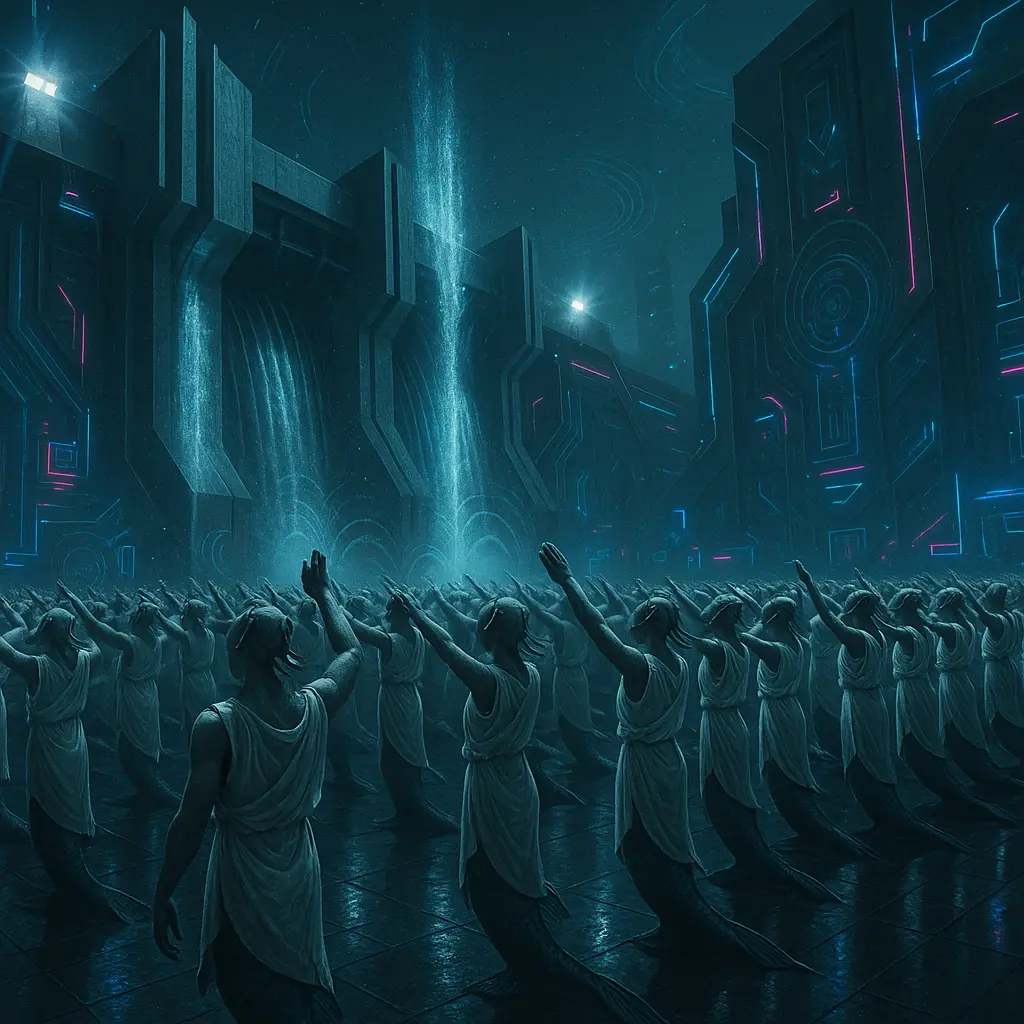
The Annual Inundation Drill: Ceremony replaces choice. Citizens process through flood-gates, rehearsing catastrophe as loyalty, while the matrix absorbs the collective anxiety (Credit: Kenomitian)
Enforcement by Flux: Governance that Refuses to Hold Still
The Harmonium’s ministries are reassignable shells. The Ministry of Harmonies renamed itself four times this year. Foreign bureaus split and recombined. Trade priorities flipped between Ramiel imports and Arakiel tariffs. Each shift would be destabilizing elsewhere. In Astaphanos, the public smiles and adapts at tempo. This is by design. “We are the river,” reads a slogan etched into administrative glass. “The bed is the song.” Institutions move. The programming remains. The regime learned from brittle autocracies that fell when their myths cracked. Astaphanos keeps the myth liquid and the method hard.
Diplomats from neighboring powers describe meetings where delegation biographies changed mid-negotiation. “We returned after lunch to different counterparts,” one envoy said. “They remembered us. They did not remember their morning positions.”
Psychomancy on elioud is broadly condemned in international concords. Astaphanos sidesteps by redefining the target. The Servitor Laws classify programmed citizens as “harmonic servitors,” a category the Harmonium claims sits between person and instrument. This claim permits acts barred elsewhere: identity editing at scale, memory erasures without trial, and nightmare extraction as levy. Appeals exist in theory. Appeals are heard by panels whose members rotate biographies under Band Two suppression.
Legal documents borrow the cadence of compassion. “Reassignment supports flourishing,” one statute states. “Epimorphic realignment reduces internal contradiction.” The rhetoric adapts public health language to rationalize coercion.
A jurist who reviewed the corpus called it “synthetic legitimacy.” “They do not deny pain,” she said. “They ritualize it. Suffering becomes a metric. Then it is managed.”
Regionally, Astaphanos projects continuity through unpredictability. Neighbors negotiate with a partner that can pivot without domestic backlash. This grants tactical leverage. It also creates strategic opacity. Treaties may persist in form while their meanings morph. Humanitarian costs are severe yet difficult to quantify. Casualty is cognitive. Families grieve people still alive. Diaspora letters speak of “funerals without bodies,” held for names that no longer recognize themselves. Relief organizations struggle to frame assistance that does not feed the loop.
Geopolitically, the Harmonium’s method tempts imitators. States frustrated with slow propaganda might covet instant capture. They may overlook the price: a permanent dependency on institutionalized pain. Even if they wanted to, they could not import the Vretil System without importing its fuel.
Technically, the investigation surfaces vulnerabilities. The matrix requires precise timing among hubs, shear nodes, and choir relays. Disturbances in coordination degrade control. The system also depends on social rituals that legitimize pain as patriotic. If those rituals lose theater value, extraction becomes naked.
Theologically, sanctioned chaos is a double-edged sign. Zagan’s glamorization of trance elevates psychomancers, but it also brands truth as negotiable. Te Ara’s lullaby for randomness may fail during genuine ecological shocks. Belphegor’s festivals normalize catastrophe until a real one arrives. In true crisis, metaphors meet ocean.
Astaphanos engineered a state where order is not negotiated but installed. It runs on the most intimate fuel a people possess. The nightmare is not an accident. It is the battery. Until the matrix is disassembled and the clinics fall silent, the “Song of Order” will remain what our inquiry finds it to be: a choir that sings over the sound of people remembering who they were.