Sandalphon 6, 1790 — I entered Batariel, the only permanent city of the undersea Free State of Choronzon [1]. There, lawlessness is doctrine, and commerce is creed. This report follows a traveler’s path through markets of flesh and ghosts, and maps the geopolitics enabling such trade.
Batariel sells what most nations prohibit. The city’s markets openly trade enslaved people, engineered homunculi, and contract-bound ghosts. Necromancy is unregulated. Mind rewriting is a routine service. The legal context is stark. In Choronzon, a mage’s creations and mind-changed subjects are property. Across the borderwaters, these acts are crimes. This investigation traces how Batariel’s permissive statutes, occult infrastructure, and corporate partnerships combine to create a regional hub for illicit procurement. The supply chains are global. Megacorporations use the city to route banned magiware, experimental power sources, and “non-compliant” biological assets. Neighboring states denounce Batariel. They also purchase from it indirectly, through cut-outs and flags of convenience.
Guided by Felipe Lokas, a local fixer, I documented transactions in servitude, soul-binding, and contraband technology. I cross-checked those observations with patterns of syndicate governance, energy logistics, and maritime corridors inside the Superocean of Bythos. The result is a portrait of a city where sovereignty is monetized and morality is an import subject to tariff.
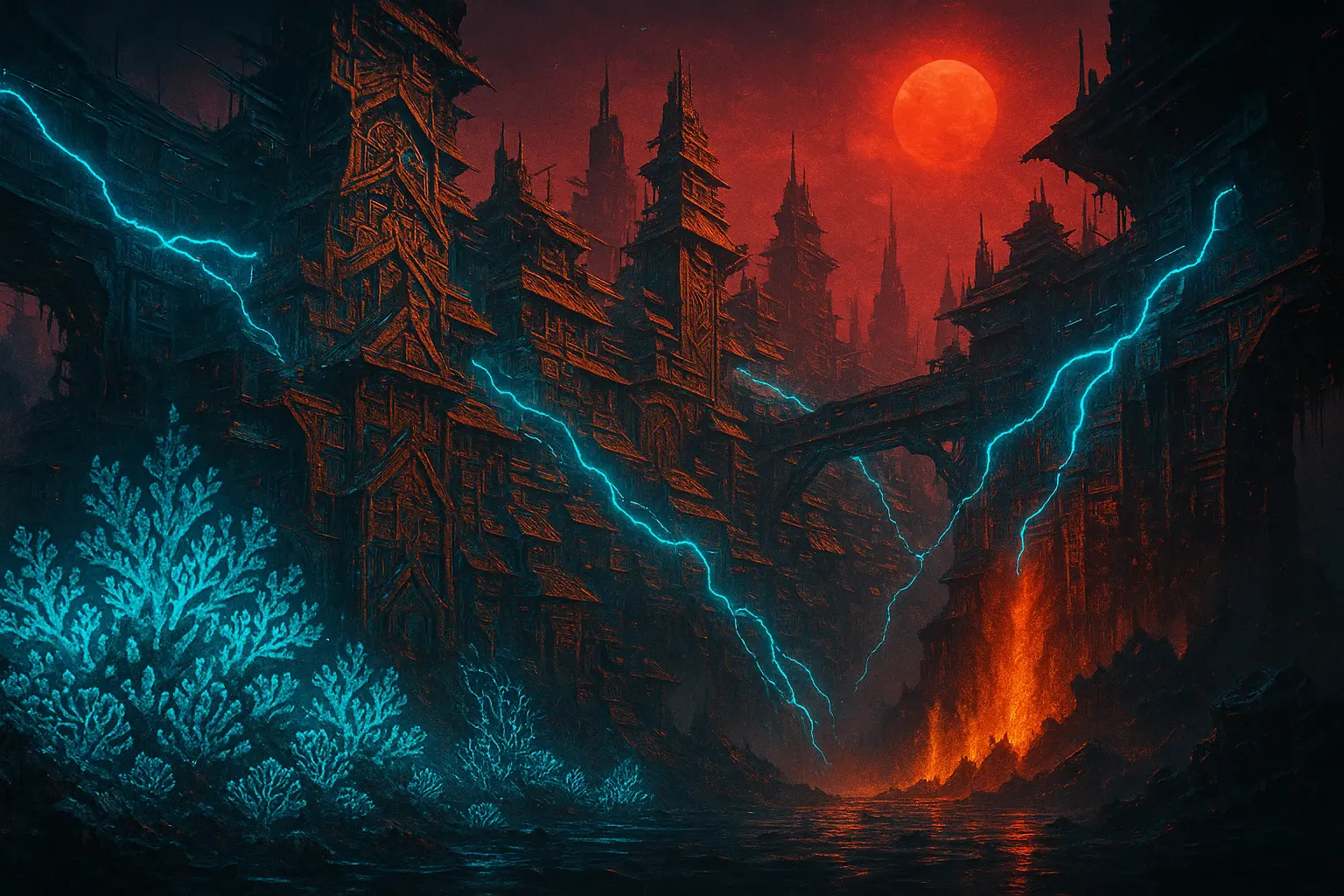
Batariel sits within the Nautilus of Shamir on Bor Shaon, a ring of dead zones in the Superocean of Bythos. The city’s aesthetic is Scavenged Punk. Hull plates, cannibalized engines, and glittering coral form its skyline. The power grid runs on Ramiel, crystalized lightning mined from Bor Shaon, and Arakiel, heat-rich mud dredged from Tit ha-Yaven.
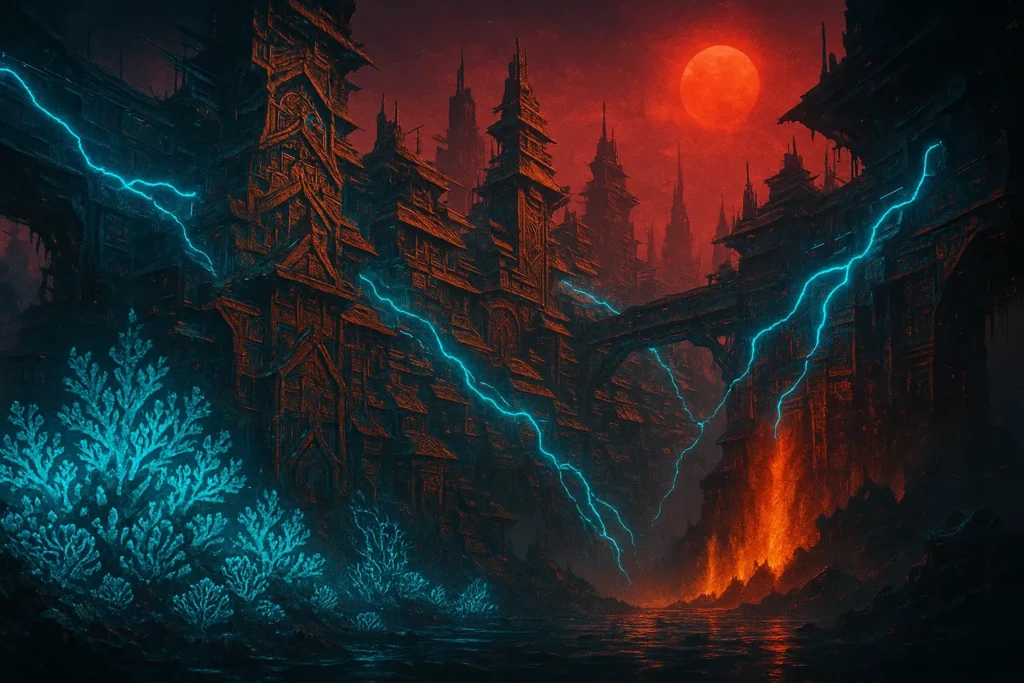
The undersea crime capital, a towering monument of salvaged steel and glittering coral, powered by the illicit Ramiel lightning and Arakiel mud. Predictable impunity is its most seductive commodity (Credit: Kenomitian)
Choronzon recognizes the legal ownership of magically created life and mind-altered persons. Epimorphism, the rewriting of identity and memory, is lawful. Necromancy on elioud is lawful. Enforcement is contractual, not moral. Warlords and mega-gangs function as municipal authorities. They arbitrate disputes, not crimes. Regionally, Batariel’s permissiveness contrasts with neighboring systems. The Thelemic Corporate Paradise [2] masks coercion under “voluntary” contracts. Sabaoth criminalizes much of Batariel’s trade and surveils aggressively. The Polarian Republic of Avichaem [3] freezes dissent alongside commerce. Batariel’s answer is simple. Everything is legal here that can be sold here.
I entered by Azothic Gate, with Felipe Lokas waiting at the threshold. He is young, lean, and fluently multilingual. He trades in access. He also sells warnings. “In Batariel,” he said, “the only sin is getting caught committing a crime that is illegal somewhere else.”
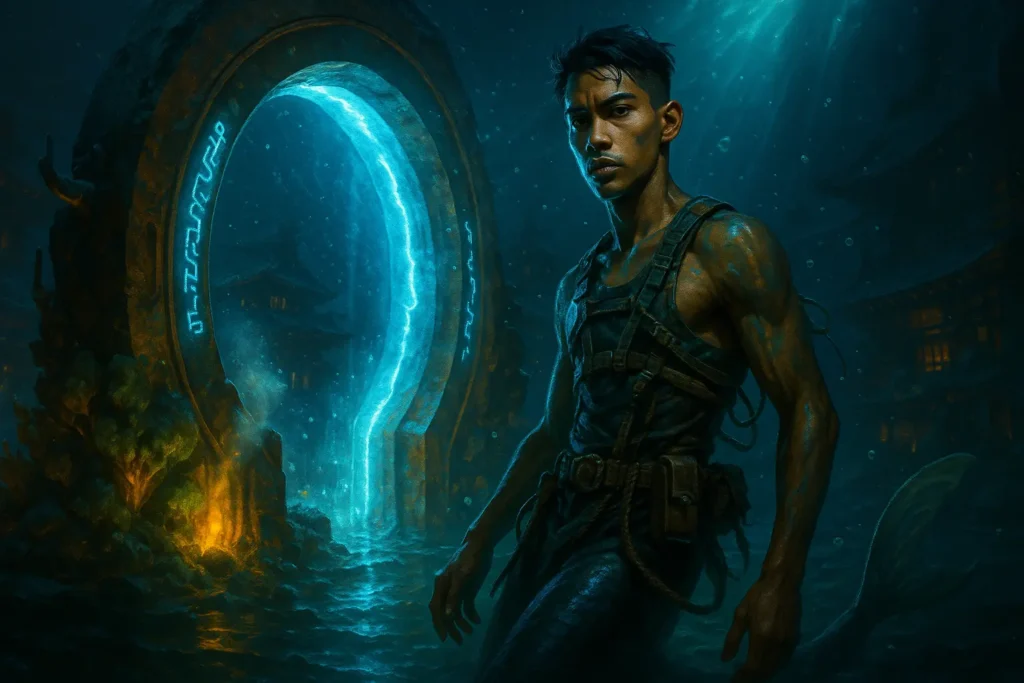
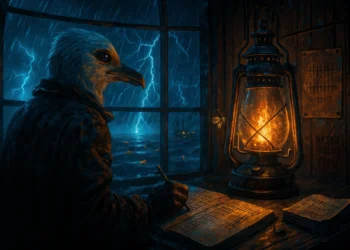
Felipe Lokas, a guide who trades in access and warnings, waits at the Azothic Gate. “The only sin is getting caught committing a crime that is illegal somewhere else.” (Credit: Kenomitian)
The streets hum with thermal vents and neon scripture. Market lanes run beside bioluminescent algae farms and stacks of rusted submersible shells. I saw three kinds of stalls recurring every block: flesh, souls, and steel. In each, the cashier’s screen accepted Bulawan credits and multiple corporate tokens.
The first sale I witnessed was a homunculus transfer. The seller provided a pedigree scroll showing organ sources, binding runes, and a completed Epimorphism. The buyer asked about stability under stress and Mana saturation during imprint. The clerk offered a brief demonstration. The subject recited passphrases with perfect calm. Its face reflected no memory of prior self.
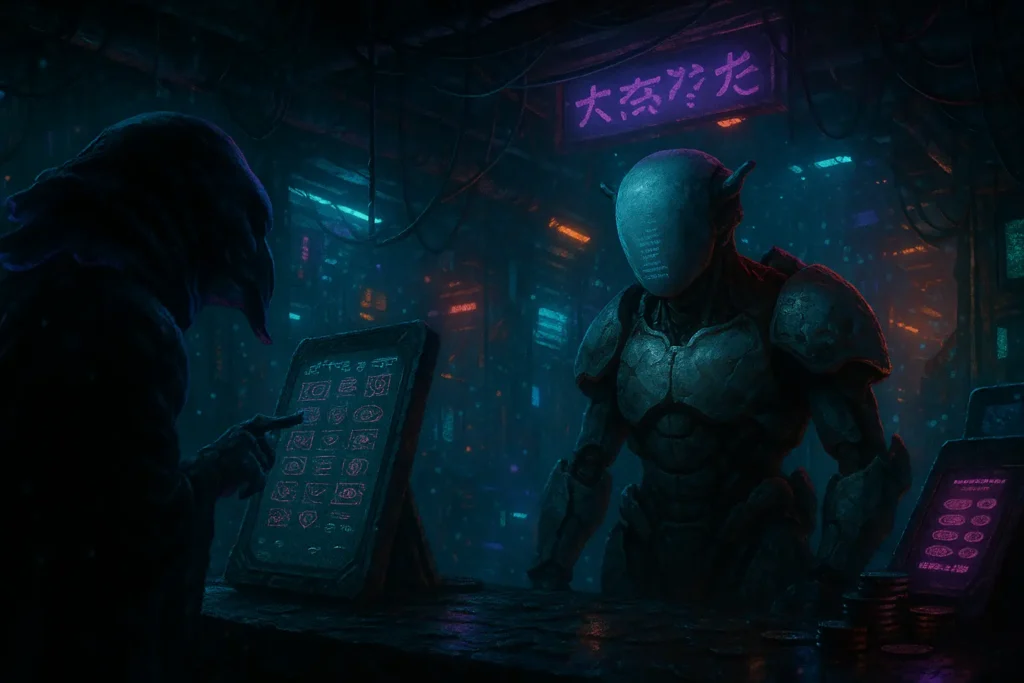
The perfect product of Epimorphism: A homunculus reciting passphrases with a face reflecting no memory of a prior self. In Batariel, minds are firmware, and morality is missing by design (Credit: Kenomitian)
Felipe leaned in. “Epimorphs are perfect for sensitive work. No past to leak. No loyalty conflict. The risk is shoddy rewrites. The fix is expensive.”
Batariel does not hide slavery. It industrializes it. Cloned labor appears with batch numbers and expiry estimates. Some stock comes from the Oothoonian Union’s seizures. Some are “volunteers” under debt. Some are captives rerouted from conflicts elsewhere. The paperwork is immaculate. The morality is missing by design.
The highest premiums attach to magically potent persons. Nephilim, classed as Partzufim when power thresholds are met, command weapon-grade prices. In states like the Kyrian Kritarchy or the Holiest Principality of Sophia, such individuals might be drafted or regulated. In Batariel, they are commodities unless protected by force. The Batarielim, local warlords, maintain pens and private docks. They view mages as assets with yield, downtime, and salvage value.
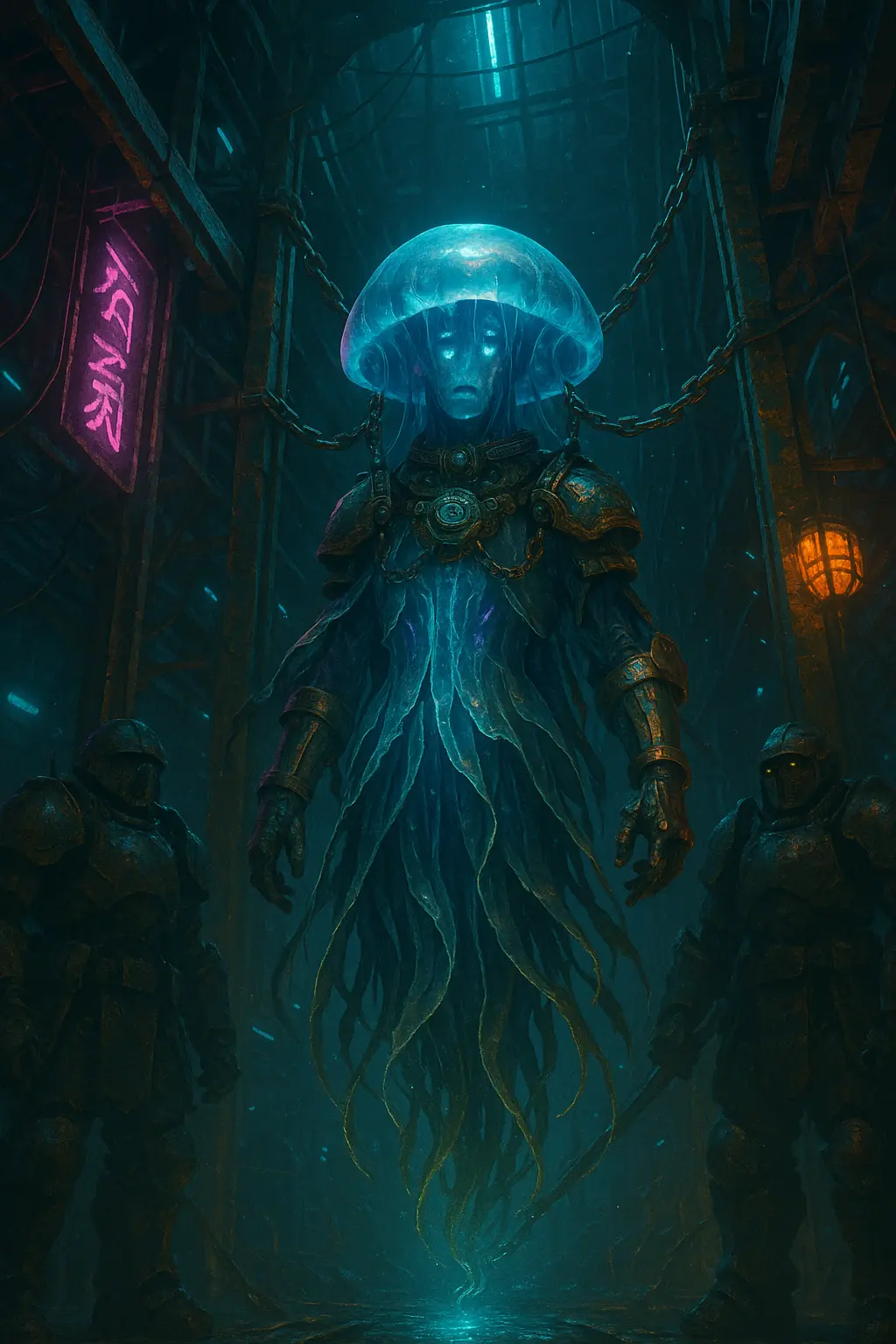
High-capacity mages, or Partzufim, are priced as weapon-grade assets. Warlords view them as inventory with defined ‘use-rights,’ yield, and inevitable salvage value (Credit: Kenomitian)
Contracts here specify “use-rights” with terrifying precision. They define bodily integrity as negotiable. They price silence as a feature. They treat minds as firmware to be patched or wiped. Disputes are settled by syndicate arbitration and the threat of immediate force.
After the rush hours of flesh, the soul trade begins. Choronzon permits all necromancy on elioud. Enforcement resources shift from interdiction to quality control. You can commission a ghost. You can bind one. You can anchor pnimi—soul remnants—into vessels, properties, or bodies.
The premium product in the stalls I visited was the Tzalmavet ghost. These shades retain access to Reshimu, the soul’s impression of magic. Sellers advertised reflexive casting in Logomancy or Abacomancy under stress. One customer staged a demonstration. A spectral sentry nullified a minor ward while holding a conversation. The crowd applauded. Contracts included non-compete clauses and burn-rights upon default.
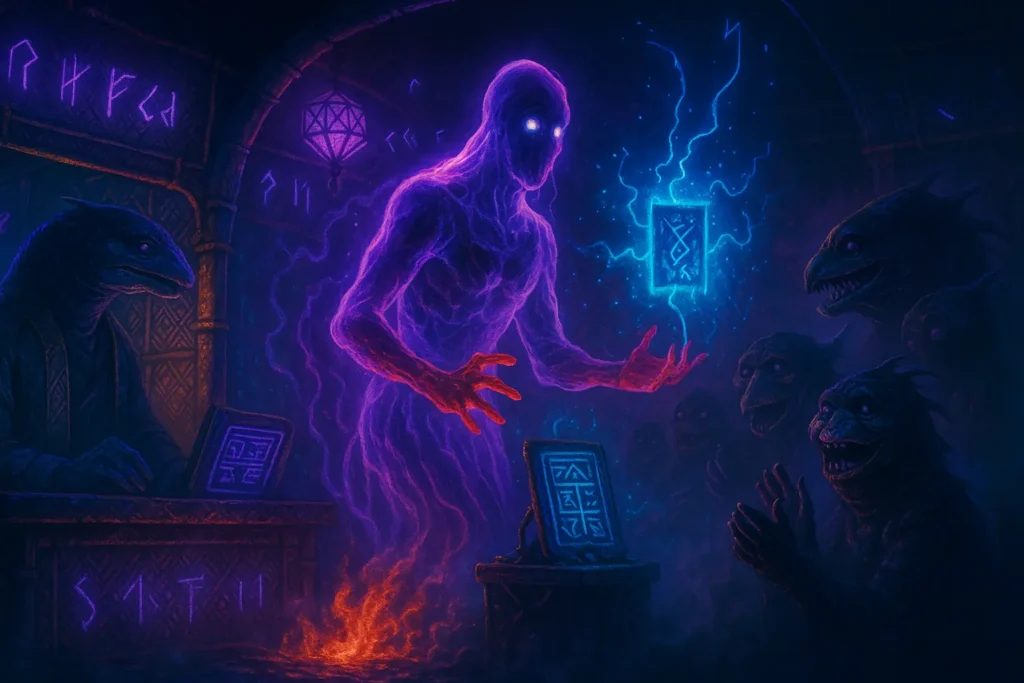
The Tzalmavet ghost—a premium shade capable of reflexive casting in Logomancy or Abacomancy—provides intelligence and labor that does not eat, sleep, or unionize (Credit: Kenomitian)
Felipe summarized it dryly. “Need testimony from the dead? Need the dead to keep a secret? We have specialists. We also have refund policies.”
Ghost creation here draws outrage abroad, especially in Achamōth, where manufacturing souls is banned. In Ikisat, exorcism is the limit of lawful necromancy. In Choronzon, necromancy is a creative industry. It supplies labor that does not eat, sleep, or unionize. It also supplies intelligence services to buyers who fear living witnesses.
Batariel’s third pillar is contraband technology. The stalls suggest a back-alley economy. The supply tells a different story. The logos are glossy. The packaging is standardized. The warranties are coded, not printed.
Gede Holy Company, an arm of Nuit Macroengineering, shows up in theurgical parts. Aiwass Magitek and Babalon Applied Magiware appear on interface augments and ritual processors. Mendes International supplies hardened casings for forbidden biotics. Pantagruel Inc. manages logistics and retail at the gray market edge. Each denies wrongdoing in polite venues. Each profits from jurisdictions where “wrongdoing” is a negotiable term.
High-risk power sources move through Batariel’s docks. Ramiel and Arakiel are local staples. Export rules are informal. Buyers with deep pockets load refined crystals and heat batteries onto submersibles flagged to third states. Hazards are priced into shipping. Explosions are part of the discount structure. Insurance is a myth.
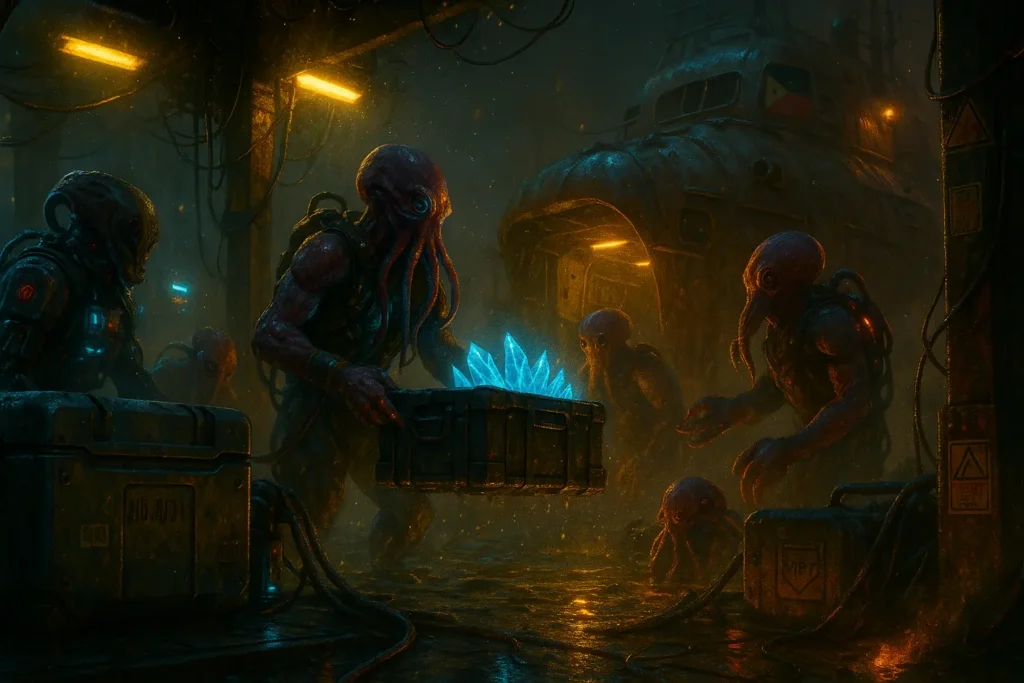
The docks are the conduit for contraband magiware and high-risk power sources like refined Ramiel. Corporate logos are glossy, but the export rules are informal, and insurance is a myth (Credit: Kenomitian)
Felipe waved at a glowing sign: “Clean Code Epimorphs — Same-Day Delivery.” The shop took measurements behind a privacy curtain. It promised a personality kernel meeting “customer-provided specifications.” The clerk offered an integration with a vintage magiware device. “We can bind your ghost to the interface,” she said. “Hands-free loyalty.”
Batariel’s sovereignty is a performance. The state is a city. The city is a syndicate confederation. Rule of law means rules of contract. Enforcement belongs to whoever controls a dock, a conduit, or a corridor. This creates a special product: predictable impunity.
Foreign buyers arrive because predictable impunity slashes transaction costs. Extradition fails at the dock. Sanctions dissolve into alias accounts. Evidence becomes proprietary. The outcome is market clarity for those who crave uncertainty everywhere else.
Batariel’s spiritual alignments reinforce this political economy. Ghroth, the Titan of Violence, presides over ritual destruction at the Amphitheater of Sighs. Belphegor, Devil of Floods, presides over The Gorge, a trenchlike district where devotees trade with the fluids of Leviathans. These alignments do not dictate policy. They bless a culture where spectacle sanctifies risk and where ruin is entertainment.
To understand Batariel, follow the clients. States that ban necromancy still need its outputs. States that preach liberty still outsource coercion. Corporations that market ethics still offload violations into licensed partners.
The Thelemic Corporate Paradise offers “voluntary” servitude. Its subsidiaries quietly shop in Batariel for people who never signed anything. Sabaoth, loud on surveillance, contracts out what it cannot lawfully see. The Polarian Republic of Avichaem, cold and centralized, buys heat batteries without public tenders. The Oothoonian Union [4] supplies confiscated clones as “salvage,” which then recirculate as inventory with freshly polished serials.
Choronzon’s neutrality is transactional rather than ideological. It hosts extraterritorial enclaves informally, under memoranda, shared docks, and dispute channels. It asks no questions that impair commerce. It answers few that would create precedent. The resulting map is a web of agreements where only price is stable.
Buying in Batariel is not safe. It is predictable. The difference matters. Warlords guarantee passage until they do not. Payment intermediaries guarantee privacy until a higher bidder arrives. Protection sells per hour. Betrayal sells at a premium.
Felipe’s street calculus was blunt. “Money is not enough here. You need reputation, muscle, or both. If you are powerful but unaffiliated, you are inventory.”
He recounted cases of Partzufim captured mid-purchase and repurposed as “tools.” He cited syndicates that treat high-capacity mages as collateral. “You will be leveraged,” he said. “If not today, then tomorrow.” In Batariel, insurance means the ability to retaliate. Legal recourse is a bedtime story.
Batariel bends regional policy by existing. States that abhor its markets must still address its outputs. Refugees arrive carrying ghosts bound under foreign law. Victims of Epimorphism surface with no prior memories and no recognized status. Courts wrestle with contracts written under Choronzon’s laws, which most states refuse to acknowledge but cannot ignore.
The city also distorts technology flows. When magiware breakthroughs occur in polite jurisdictions, the prototypes appear in Batariel within weeks. Compliance departments call it leakage. Buyers call it access. The ingenuity of Scavenged Punk culture accelerates the cycle. Workshops retrofit parts, stack interfaces, and spin up “good-enough” substitutes that slip past brand enforcement.
Energy politics knot tighter around Ramiel and Arakiel. Neighboring polities want alternatives to sanctioned grids. Batariel offers both materials and expertise. The risks are catastrophic. The incentives are immediate. Every blackout abroad punches demand up. Every accident at sea knocks the price down. Speculators thrive on this oscillation.
Spiritually aligned violence normalizes public cruelty. Ritual combat at the Amphitheater of Sighs doubles as a transfer market. A mage loses and signs. A ghost fails a task and is decommissioned. The rituals legitimize dispossession. They also export a glamorized vision of power without responsibility.
Accountability will not begin inside Batariel. It will begin at the borders. States can target demand by harmonizing bans on Epimorphic servitude and ghost commodification. They can coordinate interdictions on Ramiel and Arakiel shipments flagged through convenience registries. They can sanction arbitration chambers that launder coercion as “contract.”
Corporations require a different lever. Shareholders and customers must treat off-book partners as liabilities. Certification schemes can add supply-chain attestations for magiware and biotics. Auditors can track serials, kernel hashes, and anchor-signatures used in soul bindings. This will not end the trade. It will raise the cost of hypocrisy.
Humanitarian actors can focus on remediation instead of purity. Survivors of Epimorphism need protocols for identity reconstruction. Legal systems need doctrines for unwinding contracts signed under coerced personality rewrites. Asylum frameworks must recognize bound ghosts as persons with rights, not property or evidence.
Intelligence work must grow less theatrical and more patient. Batariel’s predictability can be mapped. Its dock masters have cycles. Its conduits have choke points. Its escrow houses reuse custodial keys. Each pattern is a pressure point. Each pressure point is a chance to make exploitation expensive.
Finally, the travel economy that romanticizes Batariel must confront its complicity. Guides save lives in dangerous geographies. They also route money into syndicate coffers. Travel writing, even “unhinged,” must disclose the risks and the recipients. The world will not un-invent Batariel by looking away. It might tame its worst edges by staring hard.
The Investigation Unfolds: Field Notes and Testimony Felipe’s Ledger
Q: What is the one rule a newcomer must follow?
A: “Never assume morality protects you. Only contracts do. And contracts break.”
Q: Who truly rules Batariel?
A: “The Batarielim. Warlords with accountants. Priests with dockyards. They trade favors like oxygen.”
Q: Why does necromancy flourish here?
A: “Because ghosts do not unionize. And because the living believe they can negotiate with death.”
Q: What is the safest purchase?
A: “Safe does not exist. Least dangerous? Information. Most dangerous? Power you cannot hold.”
I traced three corridors. Flesh moves along covert submersibles hugging dead zone thermals. Souls move via anchor-objects declared as art. Steel moves under corporate service contracts. Each corridor intersects a gate or a trench claimed by a syndicate. Each corridor ends in a jurisdiction where a ledger can be cleaned.
I also traced a common lie. Buyers say they arrive for “research” or “deterrence.” The receipts say they arrive for control. Batariel sells control in discrete units. It promises outcomes that lawful systems cannot guarantee. The pitch is irresistible to those who confuse control with safety.
Batariel will not collapse under outrage. It will adapt. If one corridor closes, another opens at a deeper pressure. If one syndicate falls, two successors inherit its docks. The city’s metabolism is salvage. It thrives on wreckage—of ships, of laws, of lives.
The diplomatic response must be incremental and relentless. Name the chambers. Name the docks. Name the conduits. Build cases that survive outside spectacle. Fund exit routes for those trapped as inventory. Fund memory repair for the rewritten. Measure success not by purity, but by fewer bodies priced per kilogram and fewer souls priced per lumen.
This report ends where it began, at the border between fascination and complicity. I walked through Batariel’s markets with Felipe Lokas as my guide. I saw a city engineered to convert taboo into product. I also saw the machinery that keeps it running: contracts without conscience, sovereignty without stewardship, and energy without ethics. Batariel is a mirror held to every state and company that outsources its dirtiest needs. Break the mirror, and another will be forged. Change the face in it, and the market shifts. Accountability here means choking the demand, tracing the money, and recognizing that survival is the city’s most seductive commodity.
The undersea Free State of Choronzon will keep selling until the world stops buying. Until then, Batariel remains what it proudly claims to be: the crime capital beneath the waves, powered by stolen storms and heated mud, where the price of everything includes a piece of your soul.
Notes extracted from the Kenomitian Compendium
[1] The Free State of Choronzon is a ravaged, lawless underwater anarchy powered by Ramiel and Arakiel, culturally Scavenged‑Punk Philippines; official tongue Dihana (Filipino, Moryan), capital Batariel in Bythos. It holds only a handful of extra‑realm footholds—Jedediah, Abezethibou, Cocytus, Elysium, and Sea of Suf—without broader planetary colonies. Pardes norms swing with instability: Peshat/ Remez/ Derash are citizens; Sod are funneled into military/ crime; Partzufim (incl. Nephilim) rise to power or are seized by the Batarielim as “tools,” “weapons,” or “resources.” Cryptids/ monsters/ homunculi/ golems/ familiars are mage property; epimorphism is legal; mundane AIs and uplifted/ parasapient tlavati belong to creators; all necromancy and all psychomancy/ telegnosis on elioud are legal; emmakha are generally citizens; slavery is fully legal. Extraterritoriality is denied (though Hadit, Ra‑Hoor‑Khuit, Pantagruel, ΘΕΛΗΜΑ, Mendes, Kokabiel operate); Choronzon raids Paraplex, Astaphanos, Kokabiel, Gadreel, Armaros, Adonaios while resisting an Ailoaian invasion; Economic-Military Ranking: 31; flag red‑white‑red with a double‑ended crimson trident; anthem “Song of Chaos.”
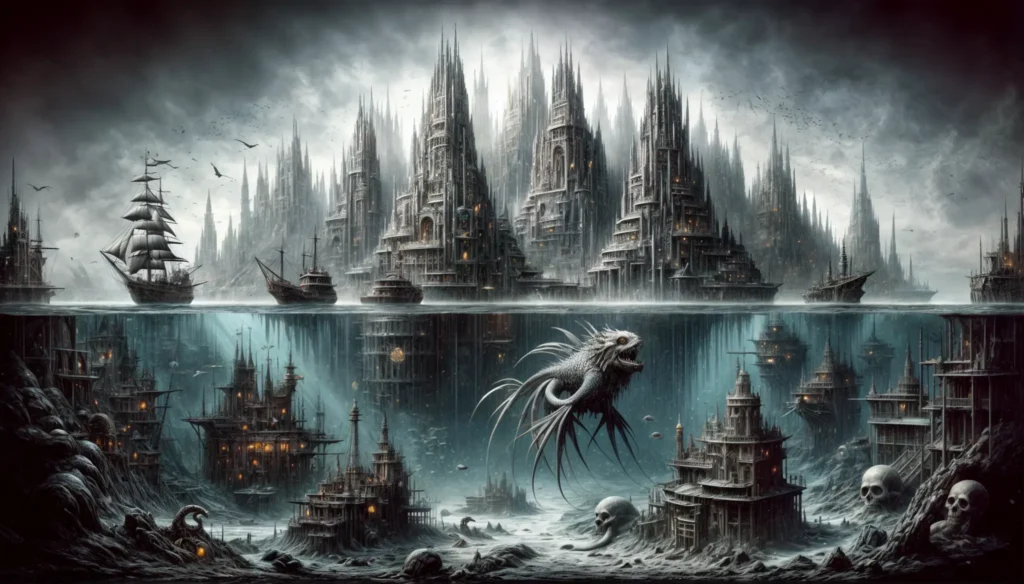
A glimpse into the Free State of Choronzon (Credit: Kenomitian). See more
[2] Thelemic Corporate Paradise (TCP): a Cyberpunk, Sige-based and Bythos-based nation that practices an exclusionary and magocratic form of democracy (in which only megacorporate shareholders, government employees, slave owners, military officers, priests/priestesses and property owners can participate; and higherlevel mages, slave owners and megacorporate shareholders hold more votes), exclusively through Beulah. It is administratively divided in the following Sectors: the Republic of Lyonesse, the Dukedom of Ruritania, the Ophirian Empire, the Abalusian Counties, the Kingdom of Ys, the Commonwealth of Vineta, the Principality of Corbenic, the Hesperian Autonomy, the State of Mag Mell, the Despotate of Telassar, the Queendom of Sheba, the Havilah Confederacy, the Tribal Homes of Mu, the Punt Hegemony, the Hermit Nation of Zerzura, the Golden Court of Mezzoramia, the Ryūgū Shogunate and the Holy Penglai Alliance; each de facto controlled by a megacorporation from the tripartite capital cities of Thélème Occidentalis (on Sige), Thélème Orientalis (on Bythos) and Thélème Stellaris (on a nomadic cluster of space habitats and motherships), enjoying aristocratic privileges from the de jure governments.

A glimpse into the Thelemic Corporate Paradise (Credit: Kenomitian)
[3] Polarian Republic of Avichaem: an Icepunk, authoritarian, classist and Necromantic nation; ruled by a Philosopher King chosen, according to magocratic, technocratic and moral criteria; by the Nhang Basilískos.

A glimpse into the Polarian Republic of Avichaem (Credit: Kenomitian). See more
[4] The Oothoonian Union: a Decopunk dystopia organized like a pyramid scheme with an absolute monarch, the Eupraxus, at the top; who is assisted by the Perfecti: individuals, organizations and lineages who enjoy absolute immunity as long as they enforce the inscrutable edicts penned by their patron from the capital city of Los. It came about after the unification of the Metis Federation (an exclusionary and Steampunk democracy), the Holy Kingdom of Zagreus (a Raygun Gothic theocracy) and the Eunation of Phanes (the Decopunk homeland of the Eupraxus monarchy), the Asterope Territories (Oothoon’s Steelpunk extra-dimensional colonies) and the Domination of Sideris (Oothoon’s Atompunk extra-planetary colonies).
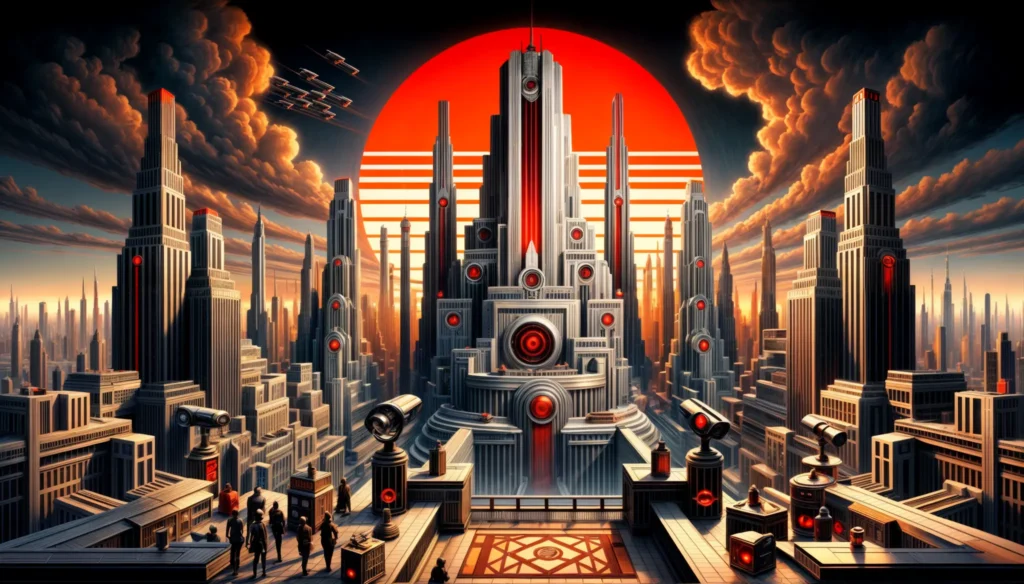
A glimpse into the Oothoonian Union (Credit: Kenomitian). See more