Azrael 30, 1790 — A pilgrim’s travel log (virally shared on Beulah) has illuminated this year’s pan-religious festival at Saint Baroque, a fortified precinct of the Favored Dominion of Atlantis, where the accepted Titanic and Divine traditions gathered under strict exclusion of Diabolic faiths to affirm unity, order, and shared worship.
Saint Baroque is a bastion-city renowned for Gothic-Punk silhouettes and disciplined ritual life. Its streets climb toward the basilica-fortress of Enthymēsis, where Supernal decrees are interpreted and the Dominion’s covenantal identity is publicly enacted. The Favored Dominion of Atlantis (FDA) describes itself as a haven for the highest orders of worship. The policy is expansive yet bounded: twenty accepted traditions—Titanic and Divine—share liturgical space. Diabolic religions, associated with the ten Daityas, remain barred from entry by constitutional decree and vigilant enforcement.
The festival unfolded as a sequence of structured devotions, processions, and common rites. The witness at the heart of this report is a single pilgrim, a White Mantle albero known in her church as Sister Solange. Her route followed the established stream of international visitors who emulate historic pilgrimages while entering the Atlantean theocracy.
—Pilgrim’s Route to Saint Baroque
Solange began on the continental shore at a port city in Ophiussa, where Celestâ is the dominant lingua franca. The city’s non-Euclidean spires cast ordered shadows across registration halls, where silver-stamped permits are issued. “The stamp felt like an oath,” she said. “It told every warden and host that my steps were accountable.” Each sanctuary marks progress, and each overnight stay is logged. The FDA’s hospitality houses combine austere dormitories with quiet chapels. “It is travel by prayer,” she added, “and prayer by travel.”
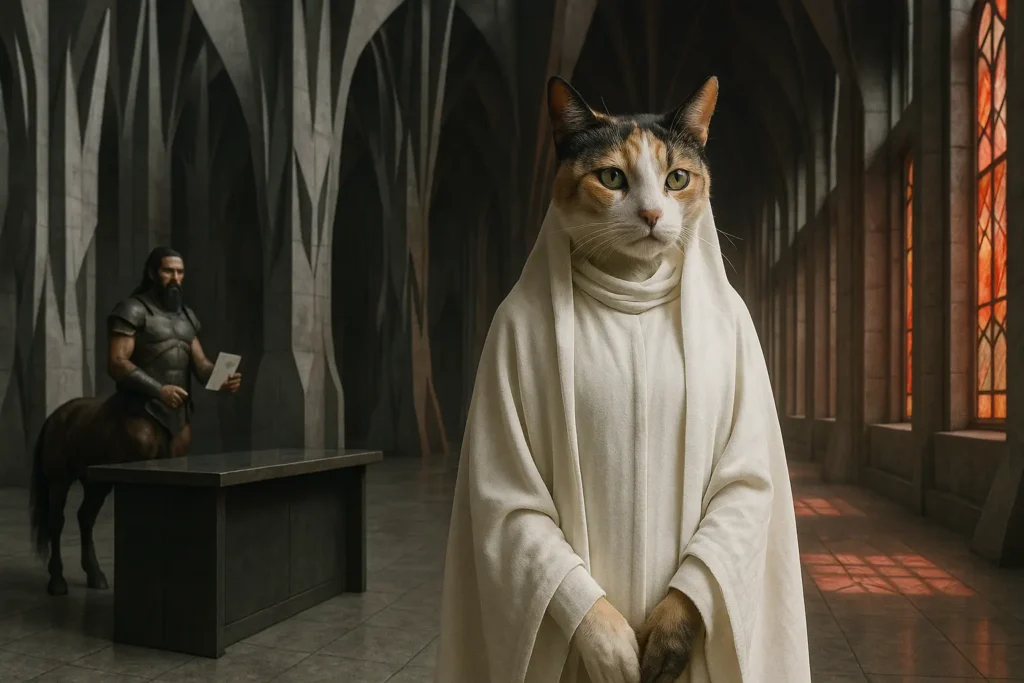
The silver stamp of the permit felt like an oath. Pilgrim documentation in Ophiussa reflects the bureaucratic piety of the Favored Dominion (Credit: Kenomitian)
—Passage Through Boaz to Thelesis
From Ophiussa, convoys moved north to the Boaz elevator—a planetary tower shared with the Allied States of Poimandres. Crowds boarded pressure cars in batches, reciting short litanies for safe ascent. The Dominion’s anthem, the Song of the Supernal, played softly beneath announcements in Celestâ. The lift cleared cloud and ocean glare, exposing the cold geometry of orbit. “We rose together, and that mattered,” Solange recalled. “You could feel strangers becoming a congregation.” The cars docked with a shuttleway bound for Thelesis, the habitable moon whose seas and mists have become the Dominion’s spiritual backdrop.
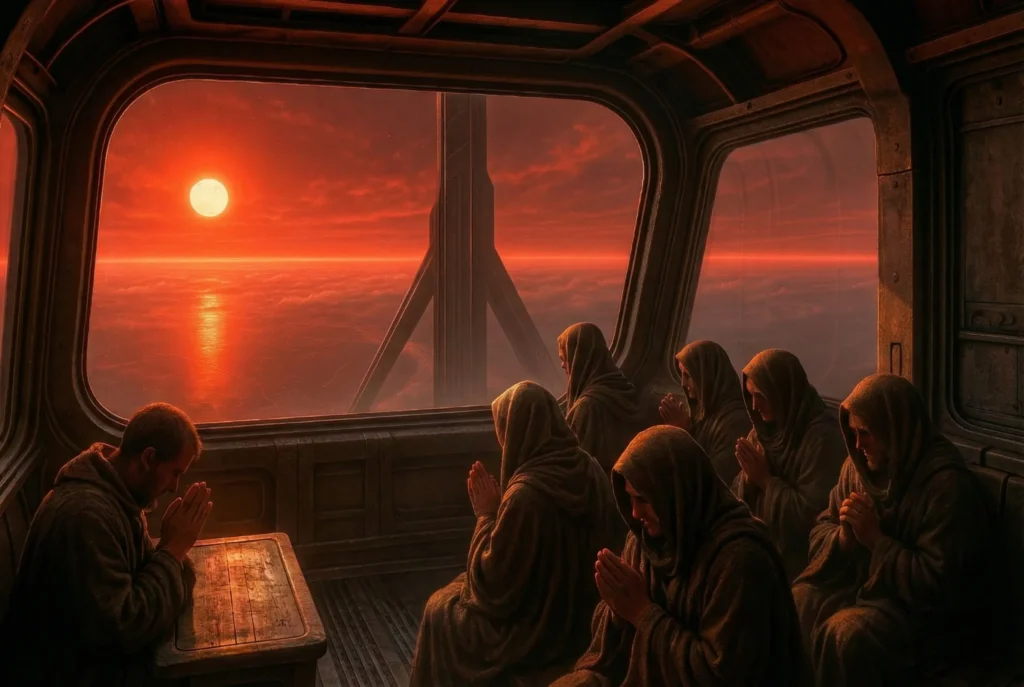
Rising to the spiritual backdrop of Thelesis. The Boaz elevator transforms strangers into a congregation under the cold geometry of orbit (Credit: Kenomitian)
Saint Baroque’s Fortress-Temple Opens Its Gates
Thelesis greeted pilgrims with fog pulled from the Sea of Remphan. Saint Baroque crowned a ridge like a citadel drawn with compass and blade. The Enthymēsis complex, a ringed basilica fused to bastion walls, dominated the skyline. Processions entered by quadrants to prevent crowding and to mix delegations evenly. Angels and Dragons—manifest Avatars of the Divine and Titanic—stood as visible honor guards. Their presence was ordered by custom rather than spectacle. “It was like walking between pillars of law,” the pilgrim said. “Not a circus, not a thunderclap. A promise.”
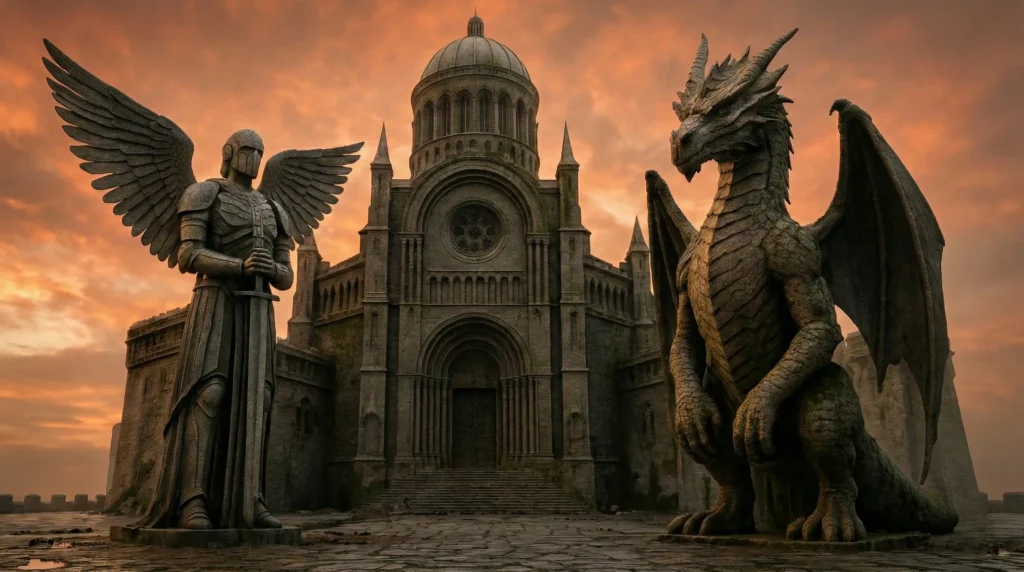
Not a circus, not a thunderclap. Angels and Dragons stand as visible pillars of law at the Enthymēsis gates in Saint Baroque (Credit: Kenomitian)
—Delegations of the Twenty Faiths
Within the grand court, rites proceeded by rotation. The Vitalist Church of Yig led with healers chanting over water simulacra shaped by Thronoi angels. Pilgrims extended hands to receive brief unguents and braided cords. The songs dwelt on purity through pain and duty to mend life without hubris. Forn Siðr adherents of Ithaqua followed with disciplined martial patterns. Blades stayed sheathed while Dynameis angels appeared as rune-etched ward-plates, shimmering like frost. Their prayers asked fortitude for soldiers beyond the FDA’s borders and courage for those who carry peace into contested space. Daoshi of Ubbo-Sathla offered stillness and control. Their internal-alchemy stations combined biometric rigs with ritual breathwork. The aesthetic was severe, yet the tone stressed balance over domination. “They spoke of order as a kindness,” Solange observed. “Not as a fist.”
—Security, Exclusion, and the Inquisition
The Inquisition maintained a discreet perimeter. Wardens from Vilon, the investigative seat, moved along catwalks and channeled traffic with lit lanterns. Identity checks were frequent, and the prohibited emblems list—associated with the ten Daityas—was re-read each hour.
“We did not come to chase anyone,” said a warden-prior, declining a name. “We came so others can pray without fear.” Pilgrims reported few delays and no public disturbances. The barring of Diabolic cults remained total, including the cosmology-obsessed Asmodeans and the predatory Chorus linked to Astaroth. The message was firm: inclusion for the Supernal covenant; zero tolerance for Diabolic influence.
—Love, Governance, and Detachment in Practice
The day’s most striking juxtaposition involved three currents. Mammonites, followers of Nyarlathotep, wore Wyvern marks studded with red stones and traded introductions with ceremonial gravity. Altifanists of Cthugha, the God of Government, arranged processional lines with almost musical precision. Kaeerists of Tsathoggua practiced cobalt-ink meditations, their silence sounding louder than the rest.
“They did not cancel each other,” Solange said. “They balanced each other. Greed disciplined by governance, governance softened by love, desire restrained by detachment.” The White Mantle cohort of Byatis marked marriages and renewed bonds. Their rites spoke gently and demanded accountability.
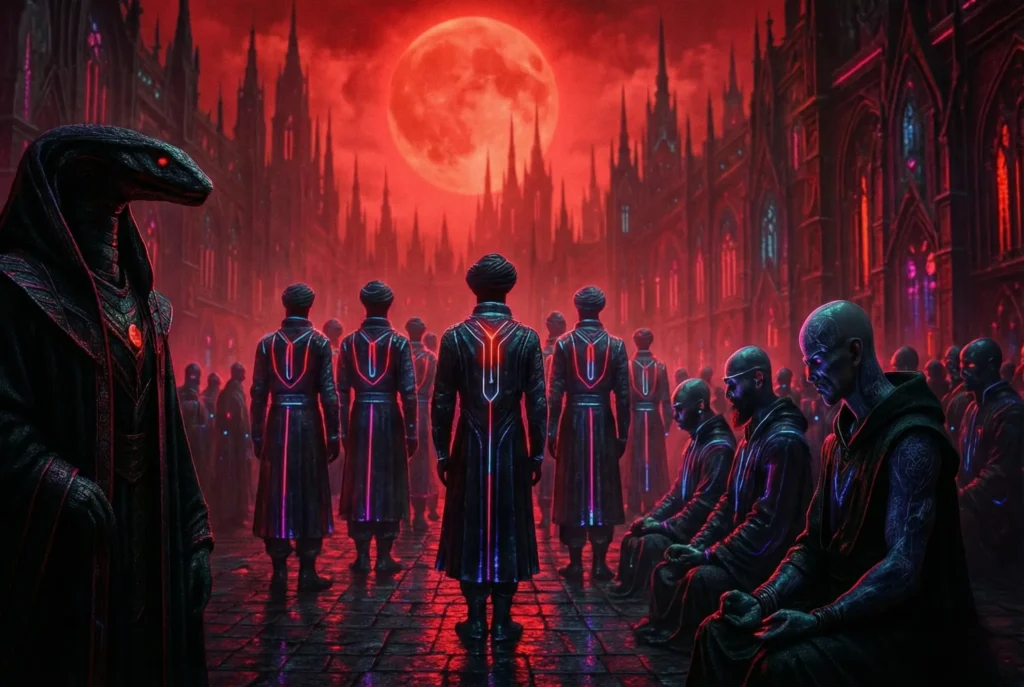
Greed disciplined by governance, governance softened by love. The complex, balanced coexistence of Mammonites, Altifanists, and Kaeerists in the grand court (Credit: Kenomitian)
—Rites That Anchored the Day
The courtyard’s central rite was an open-form prayer designed to maximize resonance without collapse into syncretism. Clerics stood by tradition rather than mixing invocations. Common petitions were read in Celestâ, then sung in the tongues of each delegation. Angels and Dragons synchronized their stations to prevent spiritual interference. Hospitalers of the Cult of the Good Work, devoted to Ghatanothoa, staffed the infirmaries and kitchens. “They asked no questions beyond the necessary,” one elder pilgrim noted. “They simply served.” The Malebranche Society of Arcanists, a state-financed order, kept the obelisks that measure ritual turbulence. Readings stayed within safe thresholds through the day.
—The Pilgrim’s Voice
Solange kept a running notebook. “The air tastes like a vow,” she wrote. “It is cool and weighty, as if the city knows we must carry what we promise.” She spoke of relief at the conspicuous absence of Diabolic emblems. “There was no game of brinkmanship at the gate.”
She described the architecture as a catechism in stone. “Angles that should not meet do meet,” she recorded, “and somehow the eye still rests. It is discipline over spectacle.” Her comments were measured, even when moved to tears during the White Mantle’s blessing of covenants.
—Economics of Hospitality
Local guilds reported predictable surges in lodging, transit, and sacramental trade. Vendors kept prices capped by ordinance throughout the festival week. Corpo-credits circulated alongside temple scrip, with exchange windows supervised by Altifanist auditors and Mammonite counters. The Dominion’s ministry published no official attendance figure by press time. However, sanctuary ledgers in Saint Baroque suggest thousands processed through each quadrant daily. “The crowd was large but not unruly,” a registrar said. “We were prepared.”
—Teaching Without Polemic
Homilies throughout the day avoided polemics against absent faiths. Mentors restated the positive case for the FDA’s covenant: fidelity to creative and governing Supernal forces; charity disciplined by law; zeal checked by duty. “Negation is not our doctrine,” a catechist told attendees. “Guarding the gate is.” This posture shaped tone and tempo. Speeches were short. Music was restrained. The day’s drama arrived not from denunciation, but from coexistence carefully managed by rule and ritual.
—A City That Prays With Its Stones
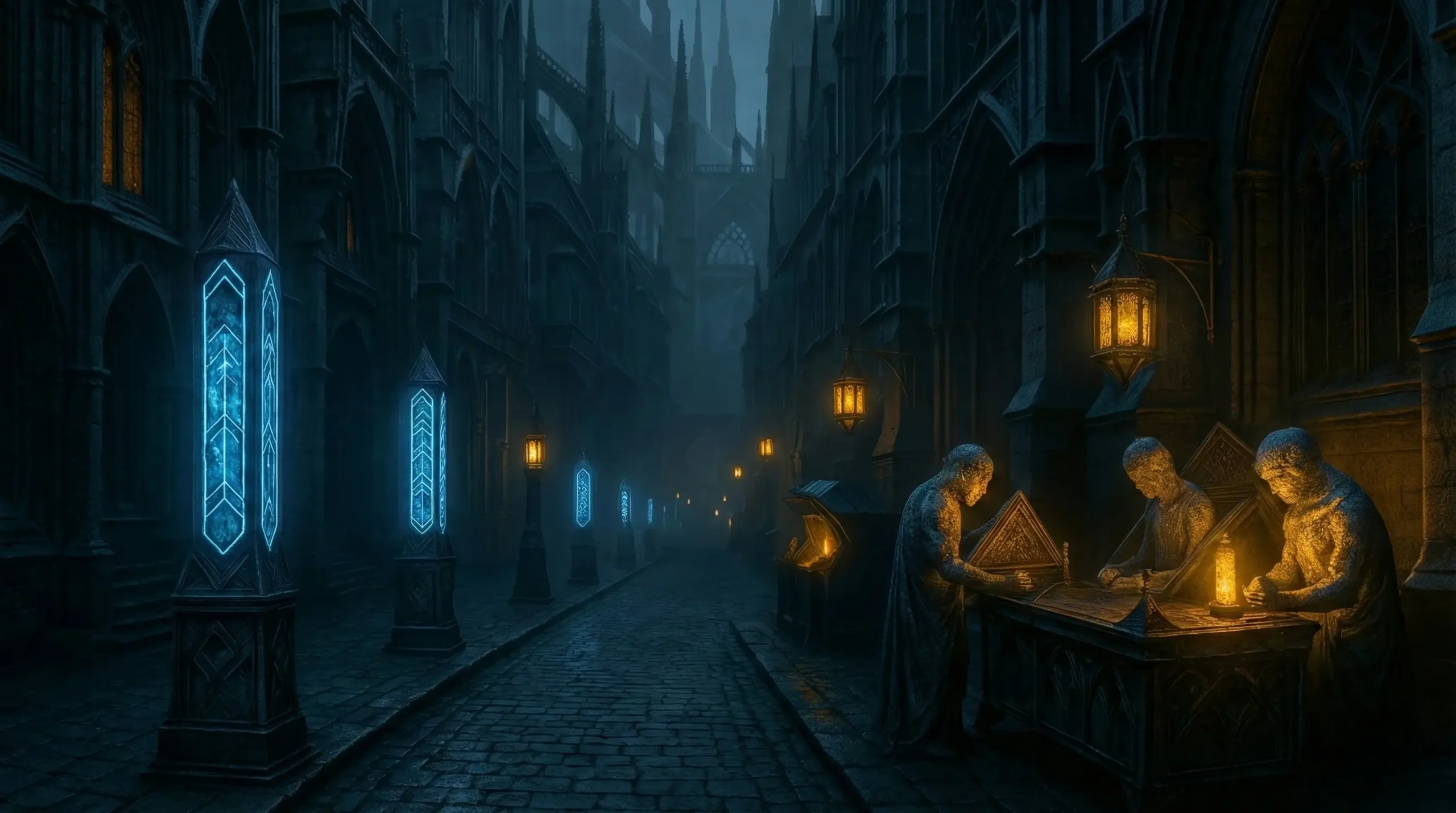
Saint Baroque’s streets moved the crowd like a rosary. Wayfinding obelisks ticked incense and footfall counts. Water channels absorbed candle smoke and redirected it to scrubbers, keeping the court clear. “The city seems to confess and absolve,” Solange observed. Night lighting favored indigo and gold. The palette repeated the Dominion’s emblem: the white five-pointed linear star on blue. Vendors folded stalls like reliquaries at curfew, then joined compline under the outer arches.
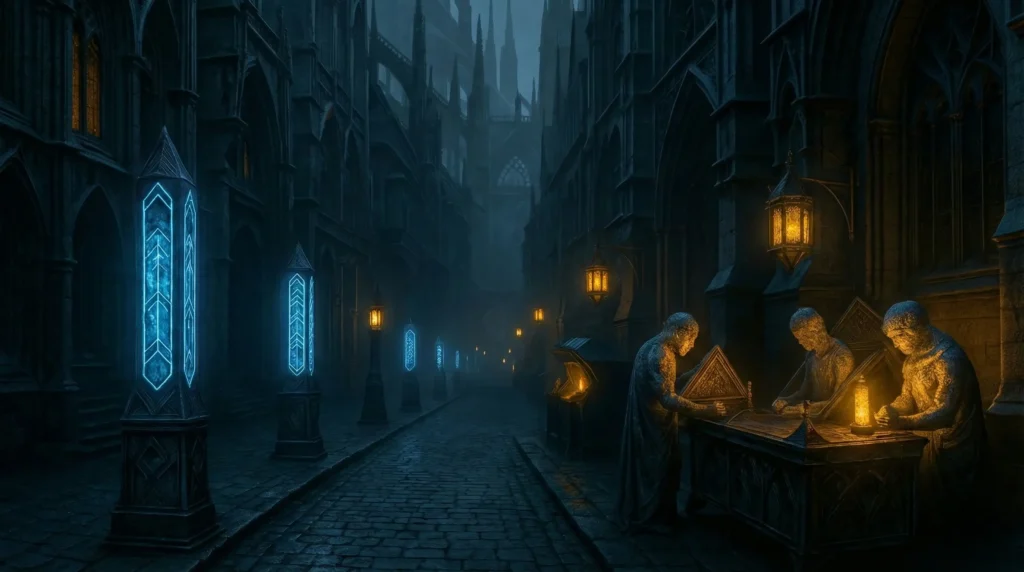
The air tastes like a vow. Saint Baroque closes its day under the weight of indigo and gold light, where discipline triumphs over spectacle (Credit: Kenomitian)
The Final Blessing
As the moon tipped toward midnight, the Atik Yomin’s presence was announced by a hush rather than a fanfare. Identity remains veiled by protocol, but authority did not require spectacle. The blessing emphasized covenantal endurance, mutual accountability, and mercy under law. Pilgrims knelt or bowed according to custom. “It was not awe that overwhelmed me,” Solange said. “It was steadiness. Like a hand on the shoulder that will not leave.” The crowd answered with a single chord, learned during afternoon rehearsals.
—Afterglow and Departure
Thelesis weather held to mist. The court emptied without incident. Hospitaliers packed supplies and logged donations to aid future travelers. Arcanists lowered the obelisks and filed turbulence notes for archival review.
Solange joined a line for the pre-dawn shuttleway. “You leave with less noise inside,” she said. “Not because answers multiplied, but because the questions learned to kneel.” She carried a silver heart, blessed by the White Mantle, and a notebook crowded with orderly script.