A dissident dispatch attributed to the Sabaothian dissident news website “Red Piece” accuses Sabaoth’s secret police—the Nakhielim of the Tree of Eyes—of weaponizing psychiatric detention, magical surveillance, and Psychomantic law to dismantle dissent. The document, dated Metatron 2, 1791, alleges an unseen architecture of coercion: diagnosis as verdict, “treatment” as punishment, and memory itself as a contested frontier.
The Socialist State of Sabaoth has long presented itself as a model of orderly collectivism: tuned production targets, curated cultural output, and the steady cadence of slogans that promise harmony without interruption. In that official story, the Tree of Eyes is a protective canopy—an integrated security lattice that identifies sabotage, preempts violence, and shields the collective from “psychic contagions” that threaten social cohesion. Red Piece, a dissident news outlet operating in exile and clandestinely inside Sabaoth, has now circulated what it calls a “smuggled warning” aimed at workers and mid-level professionals. The piece is explicitly propagandistic in tone and intent, framing itself as both accusation and call to action. Its core claim is sweeping: that the Nakhielim are not merely a police organ but an institution designed to reshape interior life—thought, feeling, and identity—through a blend of mundane control and state-sanctioned occult practice.
The dispatch does not provide documentary exhibits, names of current officials, or court records. It relies instead on alleged patterns, references to specific methods, and vivid accounts of detention practices. Even so, the publication has drawn attention across underground networks because it ties disparate fears—surveillance, compulsory “care,” and necromantic experimentation—into a single, coherent allegation.
The document’s opening frames an audience: “Workers of Sabaoth,” addressed as both witnesses and potential accomplices. The writers argue that public ritual—the “Song of the Workers,” workplace ceremonies, commemorations of production victories—has become a mask over “lightless basements” where political nonconformity is supposedly processed. Red Piece asserts that the Tree of Eyes functions as more than surveillance. In their telling, it is a doctrinal engine that redefines dissent as sickness. The mechanism, they claim, is bureaucratic as well as mystical: a doctrine that turns an evaluative judgment into an administrative category, and a category into a sentence.
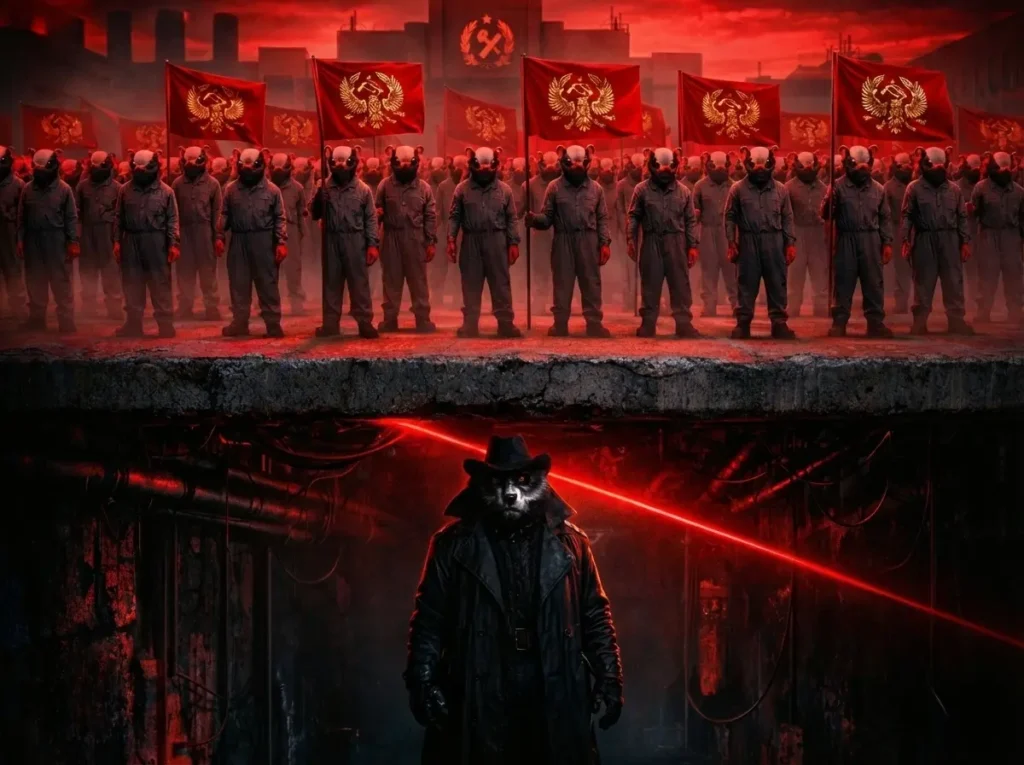
Official state ceremonies often serve as a facade for the Nakhielim’s subterranean operations. Credit: Kenomitian
The dispatch is careful in one respect: it does not depict Sabaoth as chaotic. Instead, it paints the state as clinically precise. That precision is presented as the horror—an apparatus that needs no public trial because it can route the unwanted into institutions labeled as therapeutic.
Within Sabaoth’s public rhetoric, the Nakhielim are typically described as guardians of social continuity. Red Piece rejects that framing and offers a harsher metaphor: gardeners of a “rotting garden,” tasked with removing “weeds.”

Red Piece dissidents describe the secret police not as guardians, but as “gardeners” culling the population. Credit: Kenomitian
The significance of the language is not incidental. In Sabaothian political speech, the collective is often imagined as an organism and its citizens as cells. Red Piece attempts to invert that metaphor, suggesting that anyone who refuses ideological uniformity becomes labeled as disease. The alleged instrument is the Tree of Eyes itself, described as a “sprawling network of mundane and magical surveillance.” Red Piece claims the network operates at multiple layers: visible patrols, informant webs, paper trails, and an esoteric tier that incorporates Telegnosis (remote viewing and mind-reading) and Psychomancy (mind-control and memory manipulation) into monitoring. In this framing, privacy is not merely violated; interiority is treated as state territory.

Allegations suggest the use of Telegnosis to treat private thoughts as state territory. Credit: Kenomitian
A central allegation is that the Tree of Eyes is used to generate “personality profiles” that can be weaponized. Those profiles, Red Piece says, are used to justify detention not for what a person did, but for what the state claims a person is.
The dispatch’s most detailed claims concern Sabaoth’s psychiatric system. Red Piece argues that “Abuse of Psychiatry” has been normalized: that medicine has become a coercive tool, and that psychiatric labels are deployed to bypass the rule of law. In the dissident account, the decisive move is a concept presented as a diagnostic trap—an elastic category that can be applied to almost any expression of political disagreement. Red Piece describes it as a charge that recasts criticism as pathology: not a position, but a symptom. Once categorized, the individual is allegedly routed into a Special Psychiatric Hospital and held for an “indefinite length of time,” stripped of procedural rights because they have been reclassified as patient rather than citizen.
Red Piece’s language is absolute, but the underlying accusation is specific: that the state can substitute psychiatric authority for judicial process, avoiding public trials and replacing them with sealed “evaluations” administered under security supervision. It alleges that Sabaoth’s Special Psychiatric Hospitals are not meaningfully controlled by civilian health ministries. Instead, the document claims the institutions are aligned with internal security, with ward culture shaped to punish and break rather than treat and rehabilitate.

Sabaoth’s “Special Psychiatric Hospitals” are fortress-like institutions designed for containment, not cure. Credit: Kenomitian
The dispatch describes a structure in which “politicals” are mixed with violent offenders, producing an environment of constant intimidation. It alleges the use of drugs and shock procedures as disciplinary tools rather than medical interventions. It also describes a caste of coerced or recruited ward auxiliaries—prisoners given informal power over detainees—used to create plausible deniability for violence. The document’s intent is not simply to horrify. It seeks to establish a logic: if dissent can be transformed into illness, then coercion can be transformed into care. In that conversion, the state avoids the optics of repression while preserving the effect.

Dissident sources claim the state uses coercive “treatments” to transform political dissent into psychiatric illness. Credit: Kenomitian
Where the dispatch becomes distinctly esoteric is its emphasis on legality around Psychomancy. Red Piece claims Sabaoth’s laws regulate interior states—intent, belief, “maladaptation,” ideological alignment—as objects of governance. Under such a regime, the state does not merely punish actions; it polices mental textures. The document suggests that Psychomancy is treated as an administrative science: a tool for classification, compliance, and risk management. Telegnosis, in the dissident telling, becomes the bridge between surveillance and judgment—an epistemic claim that the state can *know* the private self well enough to correct it.
Red Piece asserts that the resulting framework encourages preemption. If authorities claim to detect “wrong thought,” they can justify intervention before any overt act occurs. That is the deeper fear running through the dispatch: that the state’s concept of crime is not behavior but deviation.
Red Piece is candid—if only by example—that this is not a neutral report. It is meant to mobilize. It uses invocations, repeated slogans, and the cadence of a manifesto. It positions itself as a voice for the working class while naming enemies in symbolic terms: gardeners, parasites, eyes in the dark. This matters for readers assessing credibility. Propaganda can reveal truths, but it also compresses nuance. Red Piece’s document offers a totalizing narrative in which every institution is integrated into a single mechanism of control. It leaves little room for bureaucratic friction, competing interests, or internal dissent among professionals who might resist abuse.
At the same time, the style serves a tactical purpose: to bypass fear. A cautious, hedged report can be easy to ignore. A dramatic denunciation is harder to forget—especially in a society where forgetting can be induced, performed, or enforced. It is likely to circulate further, precisely because it collapses multiple anxieties into a single accusation: surveillance, coerced care, and the colonization of the mind. Whether its most severe claims can be substantiated remains unclear.
What is clear is the immediate contest the publication intensifies: who owns the language of health, safety, and collective good. If dissent becomes a diagnosis, then the state can claim compassion while practicing coercion. Red Piece is attempting to reclaim that language by naming it as violence. In the coming days, observers will watch for signs of suppression—network blackouts, sudden “wellness inspections,” or renewed loyalty campaigns in workplaces and schools. They will also watch for quieter indicators: hurried transfers, unexplained reassignments, and the sudden absence of a colleague who “needed rest.”
For Sabaoth, the challenge is not only whether Red Piece’s claims are believed. It is whether enough people begin to suspect that the Tree of Eyes is not merely watching them—but rewriting what it means to be well.