Uriel 20, 1790 — Years ago, when brass-limned optimism cloaked a city of damp alleys and hunger, a nameless killer stalked Golgonooza. Their mark—lungs arranged as raven wings above a butchered body—turned municipal fear into myth and left justice trailing steam.
Golgonooza styled itself the jewel of Albion’s Neo-Victorian renaissance. Airships hemmed the sky, and velvet uniforms patrolled boulevards named for order and industry. Yet a contiguous maze of tenements festered in the shadow of jeweled domes.
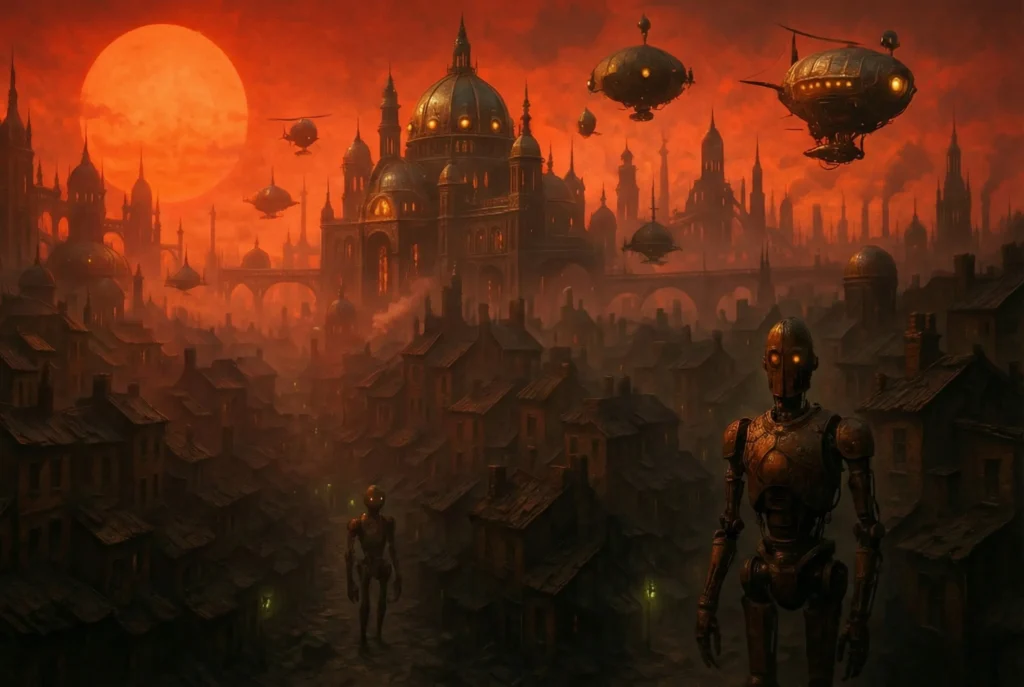
Golgonooza: Where the brass-limned dreams of the elite cast long, dark shadows over the festering labyrinth of the undercity (Credit: Kenomitian)
There, the Raven Wing Slasher wrote a brief, dreadful chapter. The murders have never been solved. Police ledgers record a cluster of killings whose details recur with uncanny precision: a swift throat cut, abdominal incisions, and an organ removed with speed that suggested training. The post-mortem display—lungs positioned to mimic outstretched raven wings—elevated brutality into a signature that gripped the public imagination.
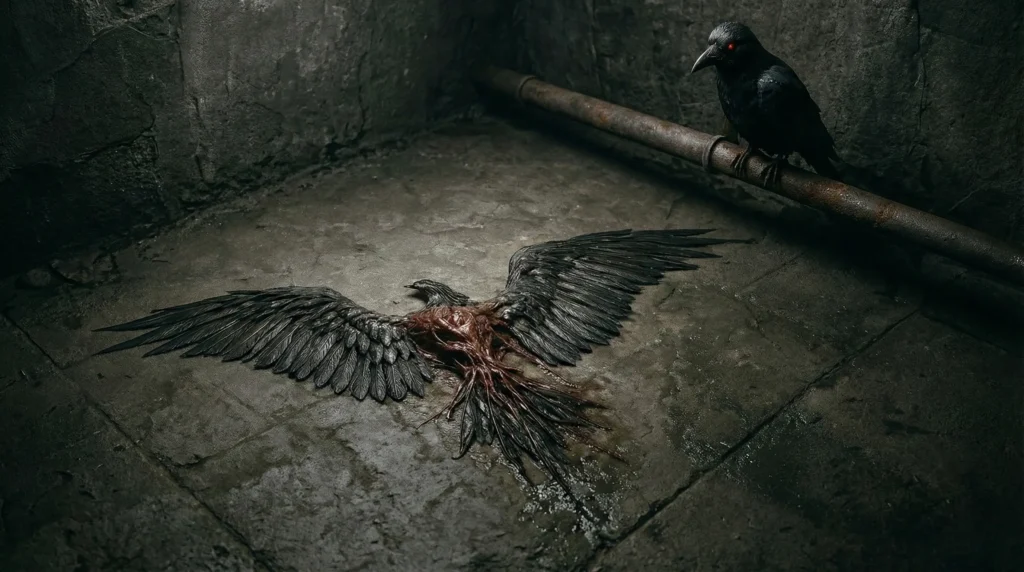
The Slasher’s grim tableau: A signature of terror etched into the heart of Golgonooza’s forgotten alleys (Credit: Kenomitian)
City archivists describe the spree as compressed into “a few thunderous months.” The timing coincided with a spike in unemployment and a winter of shortages in the eastern wards. Witness accounts contradict on height, gait, and speech. They agree on one thing: the killer moved as if the streets were a map only they could read. Medical observers at the time suspected anatomical knowledge. Butchers, medical students, and rogue surgeons entered the rumor mill. The precision did not require hours. It demanded minutes—fast, practiced, and fearless. That efficiency cut deeper than any blade; it told the city that the killer could return at will.
Authorities staged dragnets in the canal districts and along the steamcar lines fed by the docks. They mounted lanterns, hired additional Watchmen, and appealed to congregations for vigilance. None of it worked. The city’s squalid labyrinth confounded the neat lines drawn on the Watch’s command boards. The Golgonooza Watch confronted more than one adversary. They faced their own limits. Investigative methods lagged behind the complexity of the crimes. Scenes were trampled by onlookers and vendors. Evidence—what little could be collected—was smudged by rain, soot, and sapient curiosity.
Marshal Iseult Penk of the Watch’s Cold Ledger Unit, speaking on the condition that her remarks reflect the record, summarized the failure. “We were built for brawls, not phantoms. The Slasher exploited confusion, speed, and repetition. The corridors of poverty beat our patrol routes every night.” Public trust fractured. Night markets emptied early. Tenement doors sprouted new chains. Children learned to keep to the gaslit edges, heads down. The city survived on habit and rumor.
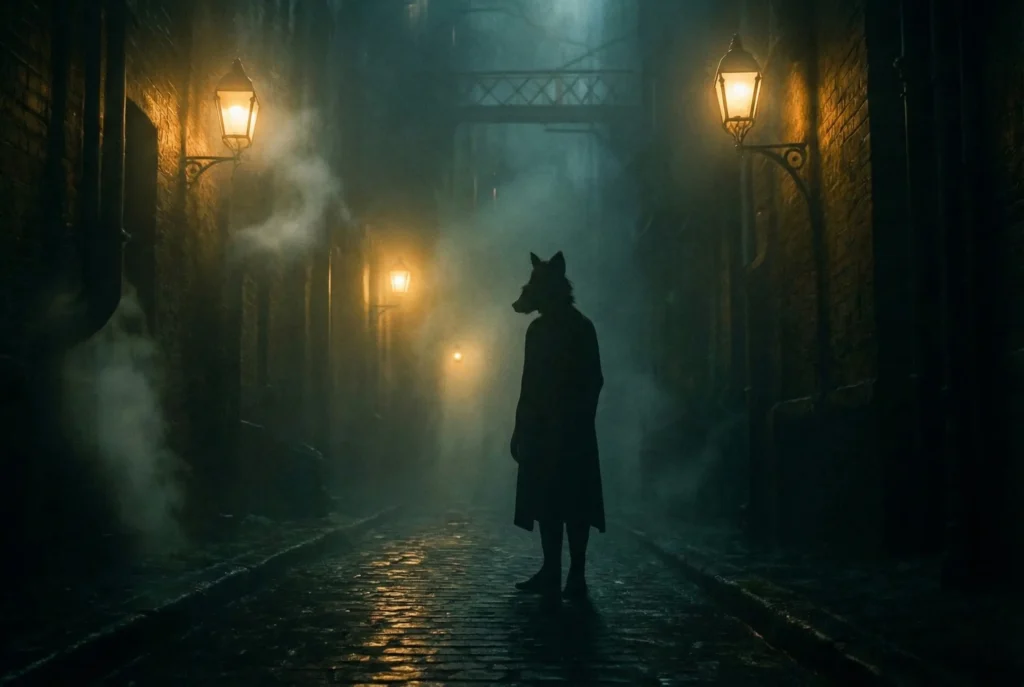
A phantom in the fog: The unseen hunter who knew Golgonooza’s labyrinth better than its Watchmen (Credit: Kenomitian)
The killer’s method bore theatrical intent. After the throat was cut, the abdomen was opened, and the lungs were removed with a sure hand. The organs would be placed atop or just above the chest, canted like a bird in flight. The tableau implied meaning, even if its meaning was never proved. Some read the wings as blasphemy, a taunt aimed at Golgonooza’s domestic pieties. Others saw necromancy. A few, perhaps in denial, called it mere affect. But the wings persisted across scenes, and their arrangement was deliberate. It made the murderer legible to the city, even as their face remained blank.
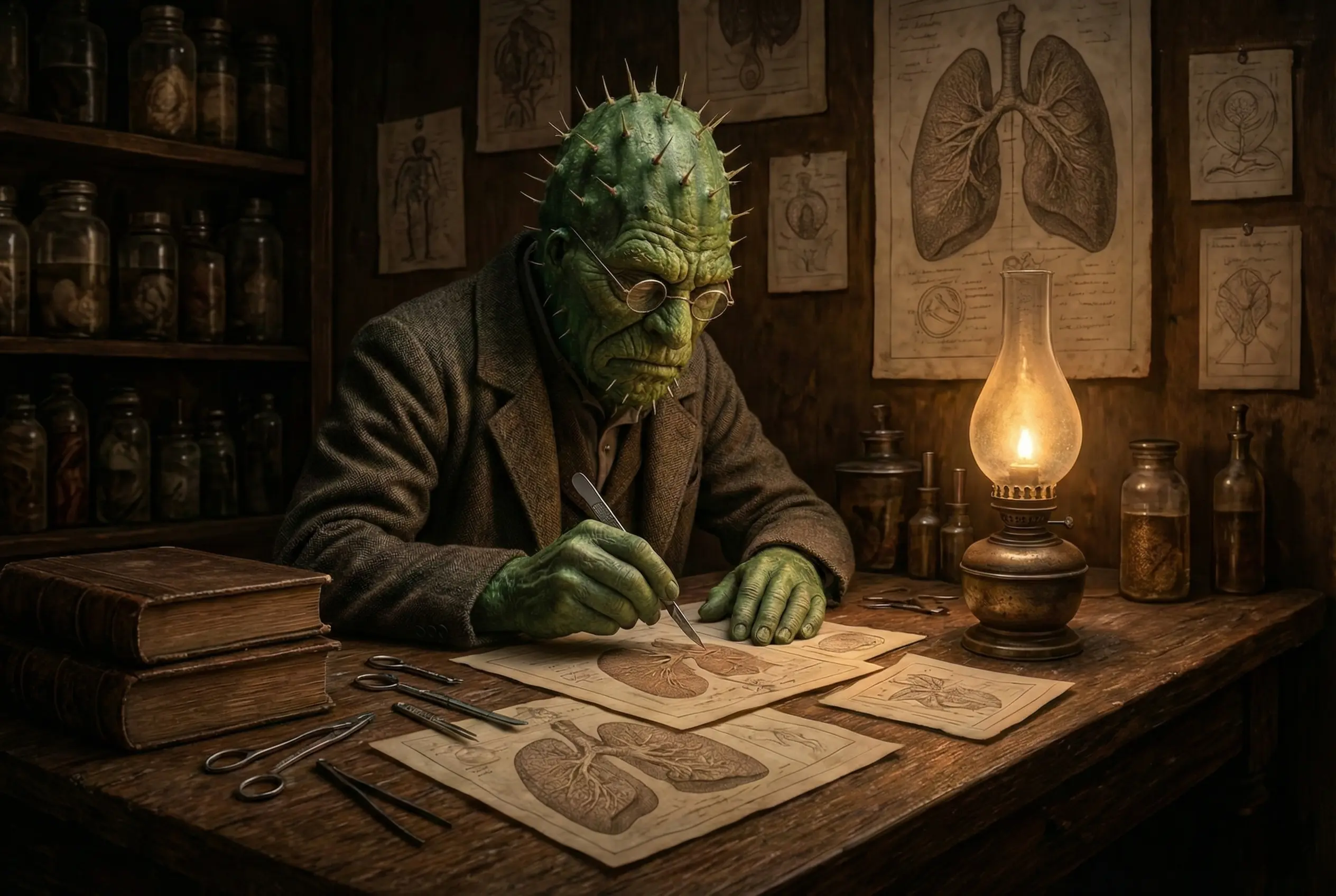
Dr. Cyprian Mallory, an anatomist at St. Neryn Infirmary, reviewed surviving sketches. “You cannot do that cleanly without knowing where to cut,” he said. “The lungs are fragile. A novice tears, a professional lifts. These were lifted.”
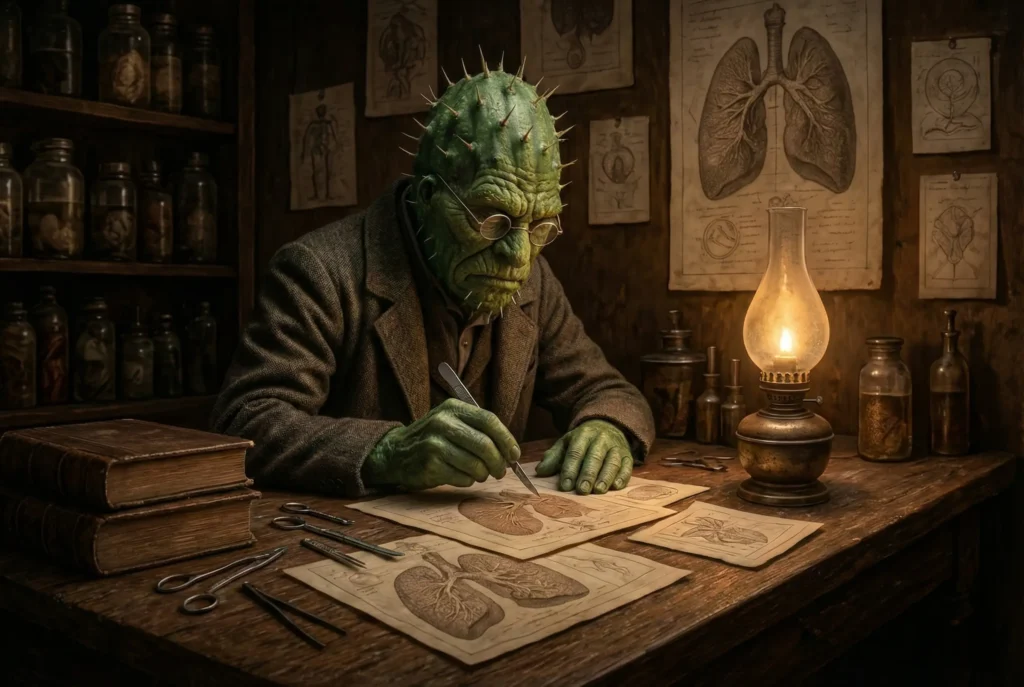
Dr. Mallory’s grim dissection: The precise anatomy of terror, revealed not by a novice, but by a professional hand (Credit: Kenomitian)
The Raven Wing Slasher made inequality visible. The victims were people the city saw only in aggregate—workers, migrants, the precarious—until the murders forced the privileged to look down the alley. The killings narrated a civic contradiction better than any pamphlet. They turned a map of districts into a map of indifference.
Professor Alethe Coade, a historian of Albion’s urban governance, warned against convenient amnesia. “Elites praised efficiency while the poor lived inside its costs,” she said. “When the Slasher struck, the city discovered that efficiency does not comfort the dead.”
Suspect lists swelled with each new rumor. A butcher with debts vanished after a raid. A medical student failed an exam, then disappeared from his rooms. A quiet clerk drew anatomical diagrams in margins. None became a case. Every citizen of the undercity seemed possible; no one proved guilty. The favored profile describes a local, educated enough to cut cleanly yet inconspicuous in daylight. Perhaps a tenant in a respectable boarding house. Perhaps a porter with access to knives and an alibi of routine. The dual life—the hunter by night, the neighbor by day—fed the terror. It democratized suspicion.
Then, just as the city braced for escalation, the murders stopped. No letter. No final flourish. Silence hardened into legend.
Tabloids sold out in hours. We know; we were there, stamped in ink and clamor. We published diagrams, timelines, and engraved ravens that flapped across front pages. Critics blamed us for the panic. Readers thanked us for warding off complacency. If the press amplified fear, it also documented the few constants: speed; surgical competence; the winged display; the choice of victims whose disappearances would not trouble a ledger until the body appeared. The pattern made copy. It also made a case the city could not close.
Ordinary people improvised what the city would not provide. Landladies created curfew bells. Dock crews formed walk-home knots. Market stalls kept whistles beneath their scales. Congregations organized escorts after vespers. These measures helped, and they testified to a grim truth: safety had become a private craft in a public city. Calls to tighten necromancy regulations followed each killing. Reformers sought to restrict all corpse-work to licensed sancta. Opponents argued that domestic rites should not be punished for the deeds of a phantom. The Council shelved comprehensive reform, choosing patchwork clarifications no one remembers.
The Cold Ledger Unit maintains a cabinet of surviving reports, sketches, and testimony scraps. On some pages, soot has turned the paper gray. The ink holds. The recurring elements still sting: the speed; the accuracy; the wings. A junior archivist, Mira Thane, has been digitizing the cabinet. “The debris of a failure can still teach,” she said. “We see where we hurried, where we intruded, where we forgot to ask. We also see craft. The Slasher practiced. That is the most terrifying lesson.”

The Cold Ledger Unit: Where the lingering sting of the Slasher’s precision is etched in soot-stained reports and the ghost of raven wings (Credit: Kenomitian)
Digitization invites new scrutiny. Patterns invisible in a fog of paper emerge on screens. Yet the core deficit remains: the city never saw the face.
The Raven Wing Slasher endures because the conditions endured: poverty thick enough to hide a murderer; policing too thin to catch one; legal shadows that permitted conjecture to masquerade as policy; corporate sovereignties and civic priorities that left voids where duty should be. There is no closure in this file. There is only an invitation. Re-open the cabinet. Re-read the budgets. Illuminate the alleys still unlit. Revise the necromancy statutes so stewardship cannot be mistaken for sanction. Draw clearer lines between private power and public safety. Invest in the laboratories the Watch never had. Choose oversight over opulence when the two collide.
The wings will always be horrible. They will also be instructive. They tell us how the killer wanted to be seen: a predator draping trophies to command attention. Our answer should not be a louder myth. Our answer should be a city that no longer gives such a creature cover. Until then, the Raven Wing Slasher belongs to that class of urban monsters who require no face to frighten, no name to endure. The murders ceased. The message did not.