
Uriel 18, 1790 — The Allied States of Poimandres like to see themselves reflected in polished chrome. From the air, the country performs its myth flawlessly. Parade jets roar over marinas and refineries. War anthems – the “Song of the Soldiers” – crackle from radios in factory canteens. Ra-Hoor-Khuit’s logo flares from fuel depots and tanker hulls like a second sun. It is a nation that has built an identity out of thrust, noise, and fuel.
But bend down, push your fingers into the harbor mud, and another story rises up to meet you. It smells of oil, solvents, and a century of shortcuts. Beneath the chrome, Poimandres is quietly sinking into its own chemistry.
The Poimandrian regime prides itself on fusing two futures that elsewhere diverged. On one side is dieselpunk reality: soot-black tugboats and armored freighters, refineries with pipes like steel cathedrals, rail corridors where cargo snakes past in endless chains of tankers and flatbeds. Diesel engines move troops, grain, ammunition, tourists, and everything in between. On the other side stands atompunk industry: aging reactors with heroic murals on their containment domes; magitech-enhanced petrochemical complexes that crack, refine, and recombine; ghost infrastructure from earlier nuclear experiments humming quietly behind new billboards.
Over all of it fly the banners of the megacorporations. Ra-Hoor-Khuit, steward of fossil fuels and naval logistics, is the loudest and brightest. In official speeches, its name is almost synonymous with “progress.” In official speeches, other words rarely appear: sediment, bioaccumulation, threshold, irreversible.
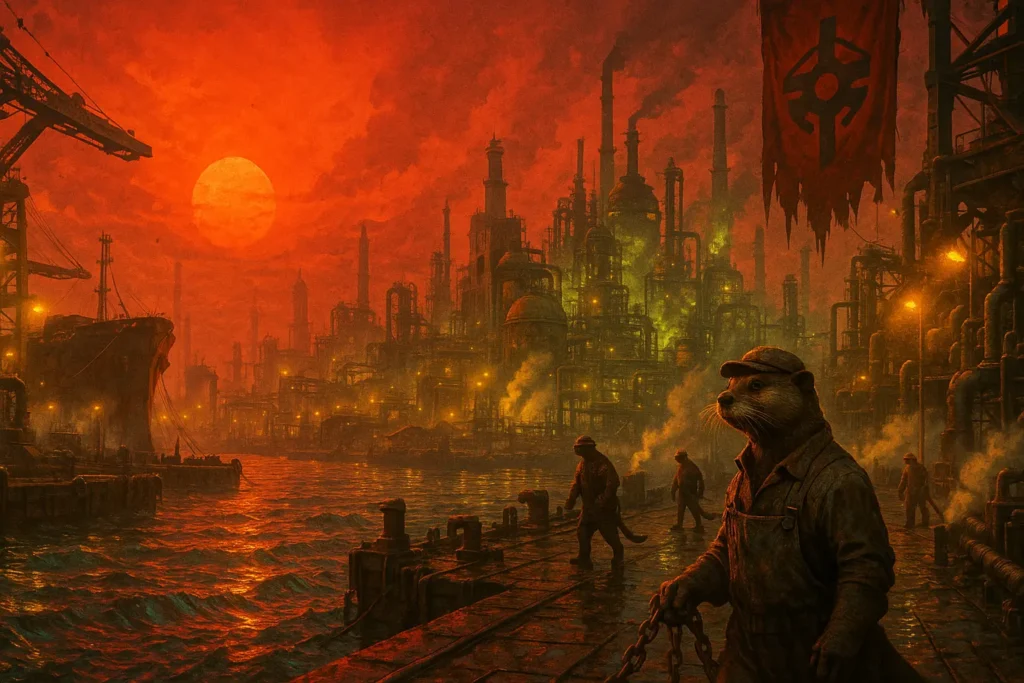
The Allied States of Poimandres, where the “chrome-bright dream” is built on a toxic marriage of atom and diesel, under the omnipresent gaze of megacorporations like Ra-Hoor-Khuit. Credit: Kenomitian.
A state can censor journalists. It can discourage whistleblowers. It can massage statistics and bury accident reports in classified archives. It cannot negotiate with mud.
Coastal research teams working along Poimandres’ busy shorelines keep finding the same thing: chronic contamination woven through the sediments of harbors, marinas, and shipyards. Near oil docks and refueling piers, chemical fingerprints in the mud shout “petroleum” even where the water looks deceptively clean. Families of compounds known as Polycyclic Aromatic Hydrocarbons (PAHs) – pyrene, fluoranthene, chrysene, benzo[a]anthracene, phenanthrene, and others – show up again and again at levels above internationally used ecological thresholds.
These are not one-off spikes.
Scientists now deploy passive samplers – small devices left in the water for days or weeks that soak up contaminants over time. Unlike quick “grab” bottles, they catch pulses and lulls, storms and calms, ship surges and quiet nights. Even during the dry season, when officials like to claim that “only stormwater causes problems,” these samplers come back loaded with PAHs. Something – many somethings – are leaking and burning all year round.
And PAHs are only the opening chapter.
New Poisons for a New Era
If PAHs represent the classic sins of oil and incomplete combustion, newer ghosts have joined the party.
One of them is PFOS (perfluorooctane sulfonate), part of the broader PFAS family – the “forever chemicals” used in firefighting foams, non-stick coatings, and industrial processes. In Poimandres, PFOS levels near waste corridors and industrial discharge points regularly exceed secondary-poisoning thresholds derived from Dutch RIVM guidance – levels where predators that eat contaminated prey are expected to face serious risk. PFOS does not break down easily. It moves through water, seeps into sediments, threads up food webs, and then sits in organs and blood like a permanent tenant.
Layered on top are Polychlorinated Biphenyls (PCBs), relics of an earlier “modern” age: once used in transformers, paints, old sealants, and a thousand industrial odds and ends. In older, urbanized bays, PCB totals in the sediment exceed conservative protection criteria. Many of these compounds are carcinogenic or endocrine-disrupting, and they biomagnify as they travel up the food chain.
These organic pollutants do not arrive alone. Around ship repair yards, battery depots, and old factories, sediments carry metals – lead, zinc, nickel – above natural background levels. Nickel often betrays long-term oil exposure. Lead needs no introduction; coral and fish know it simply as poison. Taken together, this is not a single chemical issue. It is a cocktail.
For Poimandres, coral reefs are not just postcards and tourism slogans. They are infrastructure. They soften storm waves before they strike coastal defenses. They seed fisheries that sustain villages and urban markets alike. PAHs attack coral at several stages of life. Adult colonies exposed to elevated PAHs show reduced calcification and growth. When this chemical stress overlaps with marine heatwaves – something increasingly common in the Kenomitian climate – bleaching risk rises.

Beneath the waves, Kenomitian coral reefs suffer a silent, generational loss, their delicate structures bleached by a cocktail of heat and chemical stress. Credit: Kenomitian.
The more insidious damage comes earlier.
Coral larvae exposed to oil-derived compounds often seem fine at first glance. Then, days or weeks later, they die or fail to settle on suitable surfaces. A reef can “lose a generation” of recruits without any spectacular, camera-ready disaster. The water may look clean, tourism brochures may remain glossy, but the living architecture is already hollowing from within. PFOS and PCBs thread into this picture by disrupting metabolism and immunity. Reef organisms under constant low-level toxic stress invest more energy in survival and repair, less in growth, reproduction, or disease resistance. Outbreaks that might once have flickered and faded can now burn through weakened communities.
Monitoring that ends when a visible spill dissipates will never see this future loss. By the time the damage becomes obvious, it will be written into skeletons and missing fish, not headlines.
In the seagrass meadows of Poimandrian bays, green sea turtles graze slowly, lifting their heads for breath between bites. To the casual observer, they are symbols of persistence and ancient calm. To scientists, they are sampling devices with flippers.
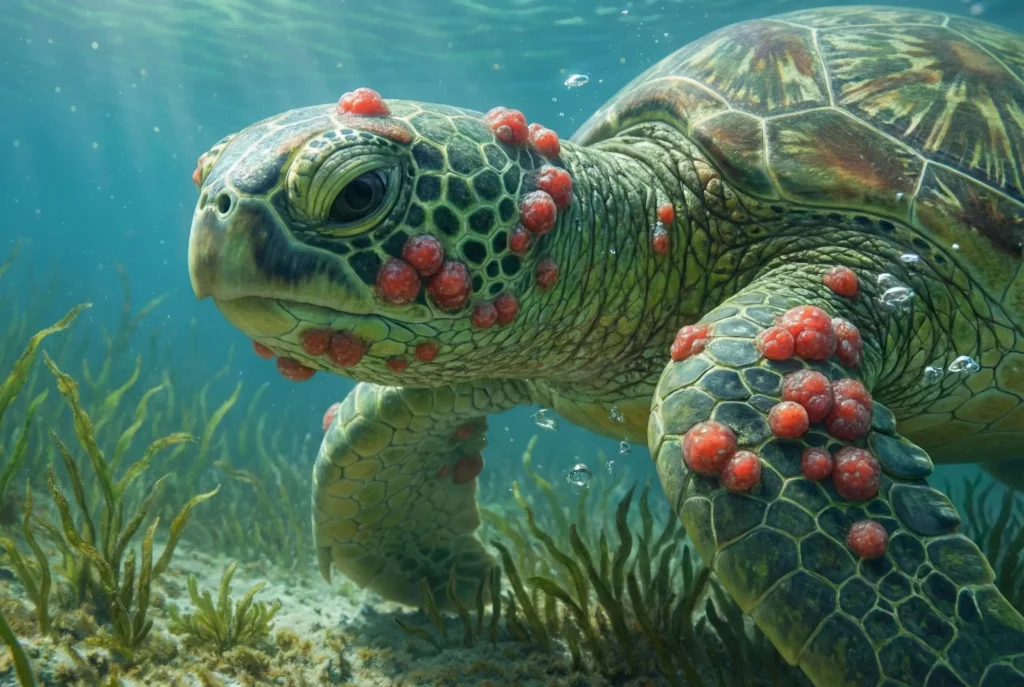
In Kenoma’s poisoned waters, ancient green sea turtles become living data, their bodies scarred by the toxic cocktail that defines their foraging grounds. Credit: Kenomitian.
Turtles feeding near waste outfalls show elevated levels of copper and zinc in their foraging grounds. Copper, in particular, is associated with higher risk of fibropapillomatosis – a disease that produces cauliflower-like tumors around eyes, flippers, and internal organs. In some Poimandrian sites, tumor-bearing turtles are no longer rare anecdotes; they are part of the normal seascape.
The weed they eat tells an even starker story. Seagrass leaves from contaminated beds carry striking concentrations of cadmium, a metal with no biological role and many toxic ones. Risk-quotient analysis at one key bay returns a number that conservationists repeat in hushed voices: 32.7. In simple terms, that implies a high likelihood that routine feeding alone is enough to cause serious harm.
PCBs add their own pressure. They accumulate in turtle fat and can interfere with hormones that regulate reproduction. A hatchling crawling toward the surf in Poimandres inherits not just the sea, but the chemical decisions of three generations of industry. Where volunteers once carried little more than buckets and good intentions, they now arrive with gloves, scales, and chain-of-custody forms.
Look at a map of Poimandres’ coast and three patterns repeat.
Kybalion’s inner harbor is a textbook case. Oil storage, loading arms, and frantic boat traffic hug the waterfront. Sediment cores taken from the basin show layered PAH signatures: the deeper strata tell of past spills and fires; the upper ones fail to show any real improvement. Further along the coast, Smaragdina mixes urban runoff with industrial discharge. Here, PCBs peak where the waterfront infrastructure is oldest. Metals crest near shipyards and battery depots. Waste canals carry their grey-green burden into mangrove thickets that once filtered clean estuarine water.
And even where the shore is quiet, industry finds a way in. Remote coves and rural bays collect what the currents and winds deliver: soot particles carrying PAHs, microscopic droplets of oil, PFOS hitchhiking in the dissolved phase. Fishing families talk about an “oily dust” that settles on decks after still nights. Sampling campaigns, when they come, tend to confirm what local noses already knew. The message is simple: this is not a problem confined to one “bad” port or one careless operator. It is systemic.
Walk inside a Poimandrian harbor, and the contradictions are elioud-sized.
In Kybalion, a port mechanic shrugs as he wipes black sheen from a steel seam. “We scrape fuel out of these deck joints every day,” he says. “If it isn’t dripping, it’s seeping.” By noon, he explains, everyone on the maintenance team has the same film on their hands and the same sweet-rancid smell in their clothes. Nearby, an operations officer watches a convoy of tankers queue up at the fueling pier. Her gaze stays on the throughput display, not on the faint rainbow shimmering on the water. “We’re judged on volume and punctuality,” she says flatly. “That is the mission. Environmental incidents are someone else’s spreadsheet.”
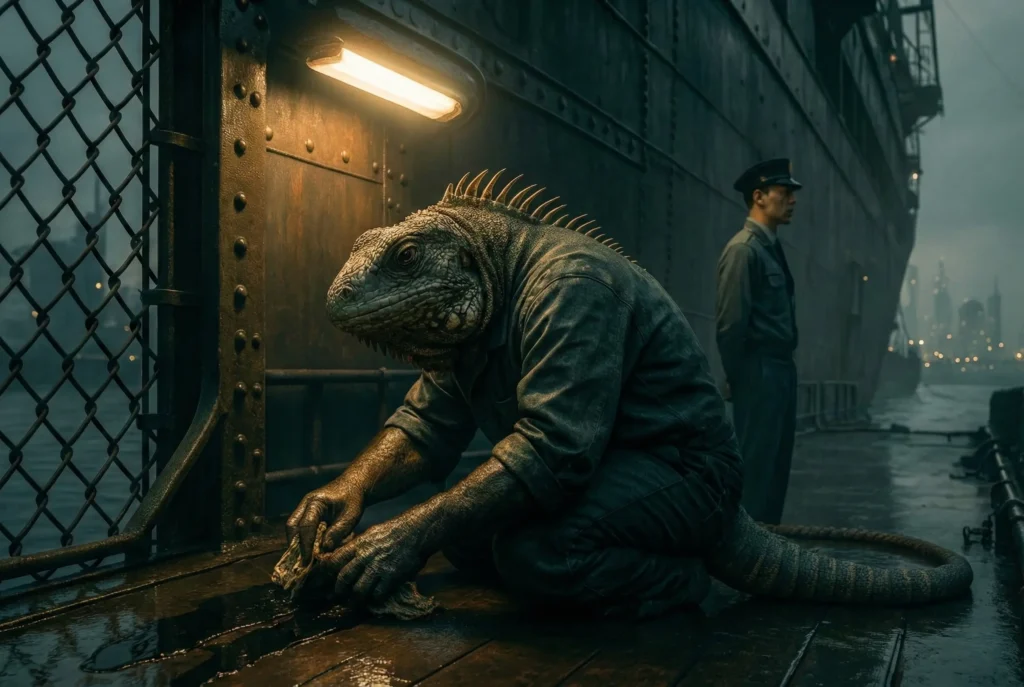
Inside Kybalion’s ports, the mission to “meet throughput targets” overrides environmental concern, as mechanics daily battle the pervasive stench of spilled fuel. Credit: Kenomitian.
In Smaragdina, a marine biologist plans another night dive. Her team has been deploying settlement tiles – small ceramic squares – on reef outcrops and monitoring who, if anyone, moves in. “Our fear is not the dramatic wipeout,” she explains. “It’s three bad recruitment seasons in a row. Then a reef tips. From the surface it still looks like a reef. But ecologically, it’s already gone.”
The Ministry, when pressed, speaks a different language. A spokesperson sends a polished statement praising “industrial modernization” and “balanced priorities.” The Allied States, the message insists, “will not trade security for panic.” The requested breakdown of spill volumes and specific sites does not arrive.
The strength of the emerging picture in Poimandres lies in method.
Passive samplers, repeat sediment cores, and tissue analyses from corals, fish, and turtles all weave together to show long-term patterns. Regulatory thresholds – whether the Dutch RIVM’s Maximum Permissible Concentrations, or widely used sediment benchmarks like Effects Range-Low (ERL) values – translate parts-per-billion chemistry into something more legible: likely harm, probable harm, almost certain harm.
Cross one of these “fences” and you have cause for concern. Cross several at once – PAHs, PCBs, metals in the same hotspot, with sensitive species already showing lesions or tumors – and the debate shrinks dramatically. At that point, arguing “no problem has been conclusively proven” starts to sound less like caution and more like denial.
There is, however, a genuine scientific caveat: many of the underlying standards were developed in temperate seas. Poimandres’ coral and turtle communities live in warmer, often more nutrient-rich waters. Higher temperatures speed up metabolism and chemical uptake. Multiple stressors – heat, disease, low oxygen, toxicity – stack in ways that models from distant oceans may underestimate.
In practice, this means Poimandres should probably be more cautious, not less.
People on the Front Line:
The first to feel the shift are rarely policymakers in Kybalion’s glass towers.
They are fisher families who know from memory how many crates of snapper or mullet a familiar reef “should” yield in a good season. They see catches shrink near harbor mouths. Nets that used to come up silver and wriggling now rise with more plastic tangles and tar balls. Buyers start to pay a premium for fish caught “far offshore.” Skippers burn more diesel to reach cleaner grounds. Fuel costs eat away at margins, and younger crew members leave for city jobs or naval recruitment centers.
Next comes tourism. Dive operators nudge their itineraries toward the remaining clear-water sites. Boats travel farther each year to find reefs that still feel alive. Ironically, the industry that sells “escape from pollution and stress” responds by burning more fuel, leaving a thin hydrocarbon signature on the very surface its clients came to love.

As visitors pay to escape the poisoned coasts, the very boats carrying them further disperse the chemistry that created the problem—a grim irony in the Allied States of Poimandres. Credit: Kenomitian.
Onshore, public health feels the edges. Swimmers report rashes after heavy rains. Clinics near fuel depots see clusters of respiratory irritation that don’t quite fit seasonal cold patterns. Each anecdote is weak evidence; together, they begin to look like a pattern waiting for a name.
What Real Reform Would Look Like
If Poimandres chose to change course, the path would not be mysterious. A credible plan would start with transparent, standardized monitoring:
- Permanent sampling stations in key harbors, bays, and rural coves.
- Regular campaigns that combine water, sediment, and biota – corals, seagrass, fish, turtles.
- Passive samplers left in place through wet and dry seasons, not just after obvious incidents.
- Public dashboards and raw data releases, so citizens and independent scientists can track trends.
Next comes source tracing. Different PAH mixtures point to oil spills versus exhaust. PCB “congener” patterns can reveal the age and probable origin of contamination. Metals profiles can distinguish ship paint from battery waste or smelter dust. The goal is not public shaming for its own sake, but precise repairs: fixing the leak, not just mopping the floor.
Then, engineering fixes:
- Prioritize hotspots for containment booms and skimmers where slicks persist.
- Replace ancient gaskets, hoses, and deck fittings on fueling vessels.
- Retrofit storm drains with oil-grit separators in industrial districts.
- Reinforce or rebuild port bulkheads that “weep” fuel and wastewater through cracked concrete.
Regulation has to grow teeth. Licenses and throughput quotas should be linked explicitly to environmental performance. Exceed a threshold once, and you pay. Exceed it twice, and inspectors live at your gate. Three times, and operations pause until a credible fix is verified. At the same time, the system needs realistic compliance lanes. If upgrading pumps, piping, or firefighting systems cuts leaks, then taxes and fees should reward that investment. A port director who reduces spills should see it reflected in their budget, not just in a footnote to a speech.
Finally, Poimandres should invite third-party eyes. University labs can handle blind samples. Regional partners can share protocols and training. International bodies can help refine tropical-specific thresholds. Sovereignty is not incompatible with scrutiny; in a world where megacorps already cross borders with ease, secrecy mostly shields reputations, not ecosystems.
The question for Poimandres is whether its love affair with atom and diesel will also be a suicide pact with its own coasts.
Right now, parade jets barrel-roll over reefs that bleach a little more each year. Fireworks explode over turtles whose shells bear tumors and chemical scars. Ports gleam under floodlights while the seagrass below slowly absorbs the record of every “minor” incident. Poimandres could keep the chrome – the proud ships, the roar of engines, the promise of modernity – while stripping the poison out of its logistics. It could honor shipwrights, dock workers, and refinery crews not just with medals and songs, but with harbors where their children can safely swim and fish.
It could decide that the real test of strength is not how loudly it can burn fuel, but how carefully it can steward the fragile, patient systems that make life along its coasts possible. The sea will not deliver a clear ultimatum. It will simply respond to chemistry and time.
Notes extracted from the Kenomitian Compendium
[1] Allied States of Poimandres: a military dictatorship seemingly stuck in the 1940s, 50s and 60s AD. It came about after the Oothoonian annexation of the Atompunk Republic of Fatum, Kingdom of Mentem and United States of Rhythmus; the Decopunk Sacred Land of Correspondentia, Duchy of Vibrationis and Republic of Foemina; the Diesel Punk Verticitatem League and the Confederation of Virilis; and Cyberpunk Special Municipalities of Astrum (SMC) (Poimandres’ extra-planetary colonies) and the Spiritus Territorial Council (STC) (Poimandres’ extra-dimensional colonies); and their swift and peaceful independence, unification and rechristening, with Kybalion in old Fatum as their capital.

A glimpse into the Allied States of Poimandres (Credit: Kenomitian). See more