The Kenomitian History unveils the fundamental frameworks that govern time and the grand tapestry of events that have shaped Kenoma and its multi-layered reality, known as the Augoeides. This article will guide you through the two core components of Kenomitian History: the practical Penemuean Calendar that marks the passage of days, and the epic Wheel of Ages that chronicles the rise and fall of civilizations and the perpetual cycles of Supernal intervention.
The Penemuean Calendar: Marking Time in Kenoma
The Penemuean Calendar is the most widely accepted method of timekeeping across Kenoma. It was introduced during the High Third Age of the Gnostic Era in the Epigenetic Aeon. This calendar is a solar calendar, consisting of 12 months, each with 28 to 31 days, totaling 365 days in a regular year, with a leap day added to the month of Jophiel every four years.
Magically-assisted timekeeping
A Kenomitian day lasts twenty-four hours, and a week is comprised of seven days, named: Phulday, Ophielday, Hagithday, Ochday, Phalegday, Bethorday, and Aratronday. The twelve months are: Metatron, Jophiel, Tzaphkiel, Zedekiel, Khamael, Israfel, Haniel, Mikhael, Cebrail, Sandalphon, Uriel, and Azrael. The calendar system repeats completely every 400 years, or 146,097 days, with an average year length of 365.24 days. Interestingly, extra-planetary colonies within the Kenomitian Sphere adhere to this calendar, using advanced networks like Beulah and azothic gates for timekeeping.

Example of Penemuean Calendar for 1790 (the year 1790 on the planet Kenoma is the equivalent of the year 2025 of the Gregorian calendar used by the inhabitants of planet Earth).
The Wheel of Ages: Kenoma’s Sacred History
Beyond daily time, Kenoma’s history is understood through the Wheel of Ages, which is the “Sacred History of the Augoeides in general and Kenoma in particular”. It describes a universe where “civilizations rise and fall, life blossoms and withers, and spells and miracles fly in perpetual cycles of Supernal intervention”. This grand history is divided into two primary aeons: the Hypostatic Aeon and the Epigenetic Aeon.
Wheel of the Ages
The Hypostatic Aeon: The Dawn of Reality
This aeon marks the earliest stages of the cosmos, when the four fundamental layers of reality, the Augoeides (Yesh, Tikun, Tohu, and Keter), first coalesced. It is further broken down into two major eras:
Noetic Era: This era details the very beginning of existence. It starts with the Planck Epoch, described as “The Hatching of the Cosmic Egg,” followed by “The Observation of the Pleromata” and “The Naming of the Pleromata”. Subsequent ages saw “The Gathering of Prosopon,” “The Crafting of the Cauldron,” and “The Brewing of the Archons,” culminating in “The Completion of the Archons,” their instruction by the Demiurge, and the “Bestowment of True Will”.
Noetic Era
Noematic Era:
This era continues the cosmic unfolding, beginning with “Archontian Harmony” and the primordial struggle of “Order vs Chaos”. Significant events include “The Birth of the Titans” and their instruction by the Champion, followed by “The Discovery of Orgone and the Crafting of the Avatars”. The era culminates in “The Birth of the Deities,” the calamitous event of The Mashchit, and finally The Shevirat HaKelim, which led to the birth of the Devils, the ascension/descent of the Archons to Tikun/Tohu, and the planting of the foundational Etz Autozoon.
The Epigenetic Aeon: The Continuous Evolution of the Cosmos
Following the primordial events of the Hypostatic Aeon, the Epigenetic Aeon is a long and dynamic period characterized by ongoing cosmic developments and Supernal interventions. It is subdivided into several eras, each bringing profound changes to the Augoeides:
Agnostic Era:
This era witnessed the emergence of Azothic Gates and powerful entities like Giants, Fiends, Tlavati, and Akatharta from spilled Supernal blood. It saw the birth of Fairies in Tikun and Psychopomps in Tohu, and their fusion by the Demiurge into Semyazza. The Etz Autozoon grew to span Yesh, Tikun, and Tohu, transforming entry points into realms like Ochema (Tikun) and Masach (Tohu). Important celestial bodies, like the fire giantess Hypezokos coalescing as a comet, and the iron giantess Aletheia as a Kenomitian moon, began to form. The Garden of Judgement and The Watchtower also took shape in Tikun, while the Archons’ souls (Nefesh) coalesced as Ish in Tohu, and their bodies were entombed as the Corpuses of The Deathless One, The Tempered One, The Horned One, and The Thundering One. The Darkness Between the Stars and The Rot of the World formed in Tikun, with the latter contained in The Just Pit of Oblivion.
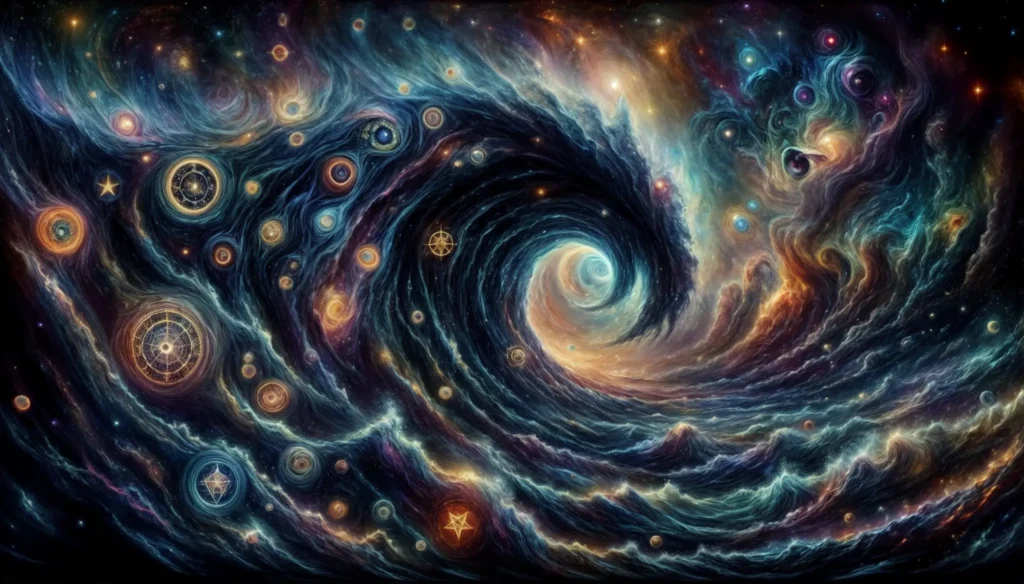
Agnostic Era
Hylic Era:
During this era, new realms in Tikun, such as The Inchoate Hermitage, The Idearium of Fortitude, and The Grand Necronomical Archives, were created as fortifications against the encroaching Rot of the World and Diabolic intrusion. The Supernal experienced exhaustion and dreams for the first time, leading to the creation of The Magipoetic Dreamlands and The Amorphous Fields of Unmade Seers. The first monsters, the Ehyeh, emerged, and The Empire of Woodmen formed in Tikun. A major conflict, The Deluge, a war between Devils/The Rot of the World and Titans/Deities, left metaphysical wounds in Tikun (The Untreading Chariot, The Microcosms of the Broken Wheel) and physical scars in Yesh. Etz Autozoon’s saplings grew into colossal kabbalistic trees, shaping parts of Tikun into The Lunar Spires and The Atrocious Halls of the Solar Grail, and even lifting Kenoma’s supercontinent, Sige. This era also saw the formation of The Mitochondrial Greenwoman, The Fool’s Manses, and The Ecumenopolis of Crafted Lovers. Throughout this period, Scholomance, an evolving institution of learning, underwent numerous transformations, from tribal sages to an academy for the privileged. Many sub-realms in both Tikun and Tohu also manifested during this dynamic period.
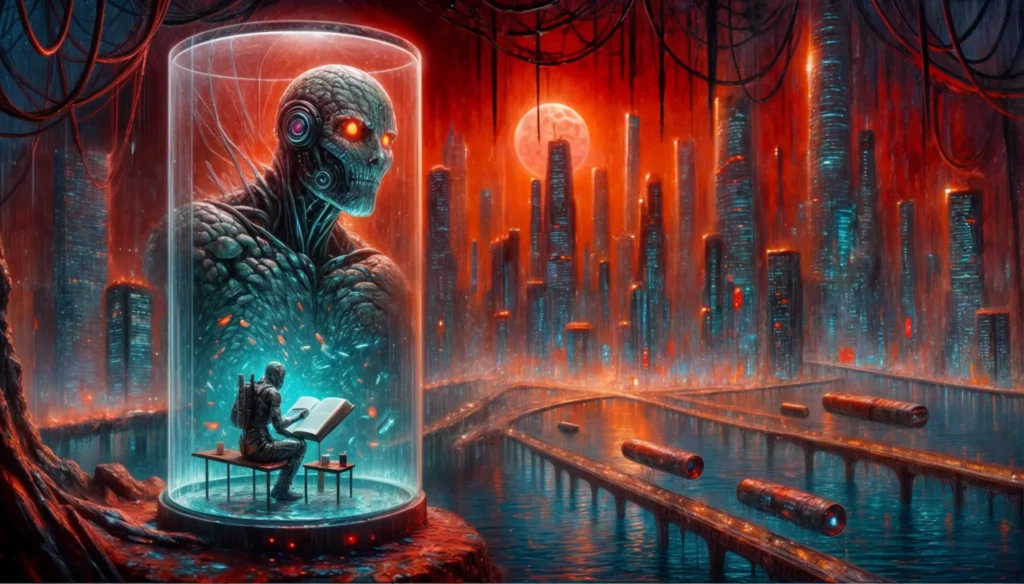
Hylic Era
Somatic Era:
This era continued the cosmic shifts, with Elohim and Degalim emerging from Etz Breishit, and Scholomance transitioning into a “learning machine”. More sub-realms in Tikun, such as Tophet, Khalal, Acheron, Kalma, Mormo, Eretz Tachtit, Dis, The Night Parade of One Hundred Beasts, Lethe, Ixtab, Gehinnom, and Irem, manifested. Giantesses like Hysterema continued to permeate Raqia and coalesce as Kenomitian moons. Scholomance continued its evolution through various forms, from chthonian mystery cults to Supernal Avatars guiding children, and eventually to a high-tech Tikunian colony.
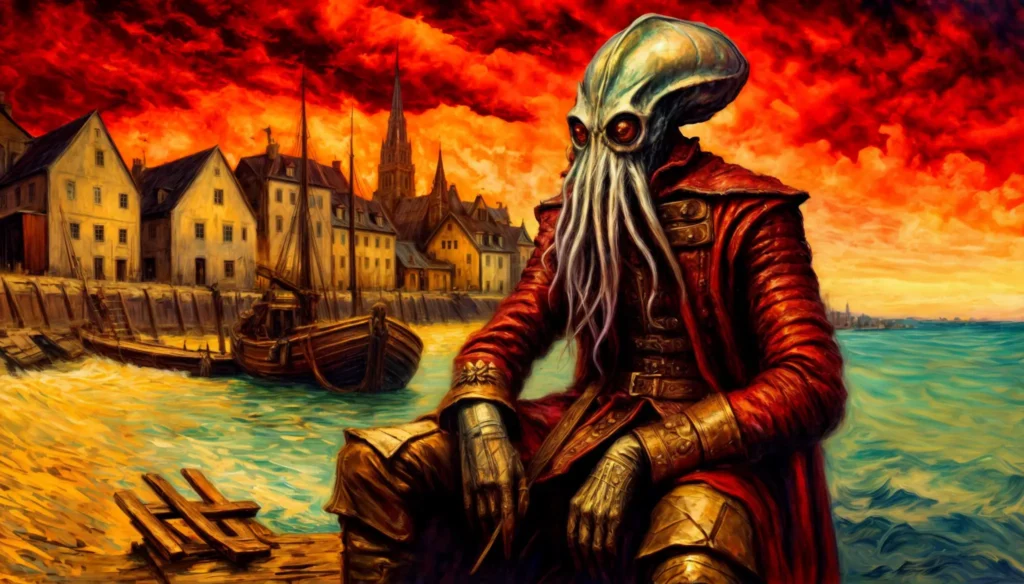
Somatic Era
Sarkic Era:
This era saw more entities emerge from Etz Breishit (Erelim, Malakhim, Cherubim, Hashmallim). Scholomance continued its transformations, becoming nomadic bands of sages, a gymnasiarchist kingdom, a college of artificers, a gathering of artisans, and a Tikunian cult. New celestial bodies, such as the Uthras (Hayyi Rabbi’s moons), also coalesced.
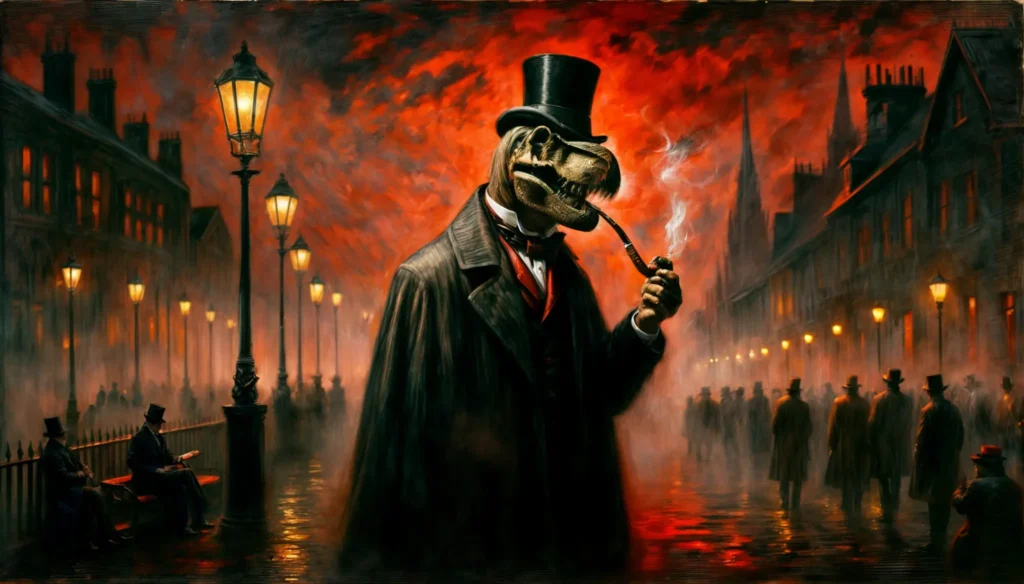
Sarkic Era
Psychic Era:
Like previous eras, this one featured the emergence of new entities from Etz Breishit (Elim, Shinanim, Maelim, Parashim, Mesharethim, Shalishim). Scholomance evolved from an underground community of scientists to a cult of diviners, an occult order, a collection of lineages under Supernal protection, a sadistic boarding school, and an oracular cult. Giants such as the Ophiomorphoi (Mkayyema’s moons) and Hestōs (a Kenomitian moon), and the Anemoi (Aeolia’s moons) also coalesced.
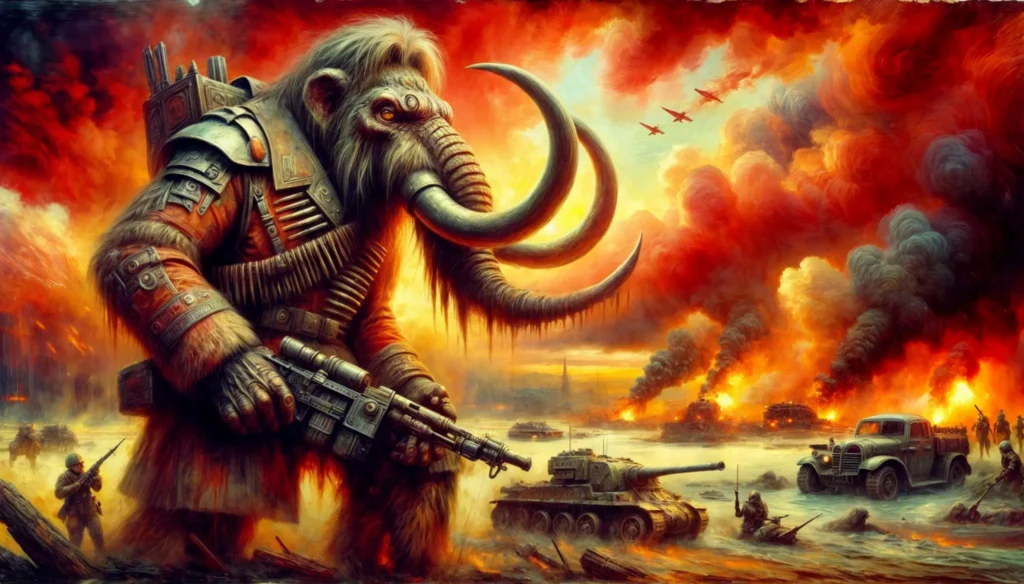
Psychic Era
Pneumatic Era (Holocene):
This era, spanning 8700 years, saw Scholomance transition into covens studying past visions. Ektismena, a fire giantess, coalesced as another Kenomitian moon.
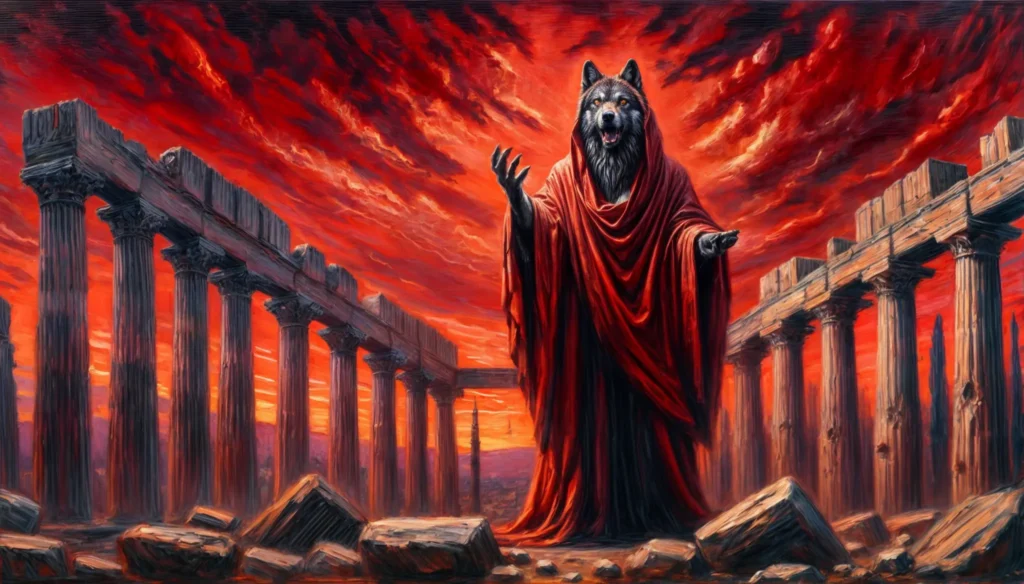
Pneumatic Era
Gnostic Era (Holocene):
The most recent era, spanning 5950 years, began with Scholomance transitioning to officially endorsed institutions. Etz Breishit withered after being struck by the fire giant Chnuphis, but remained metaphysically alive due to its link with Etz Autozoon. The Horoi, a litter of iron giants, coalesced as an asteroid belt in the Kenomitian Sphere. Scholomance’s evolution continued, eventually becoming an off-Yesh monastery and later an omnidisciplinary scheme of five faculties. This era also includes specific historical events like “Eddy & Jas, Love & Undeath”.
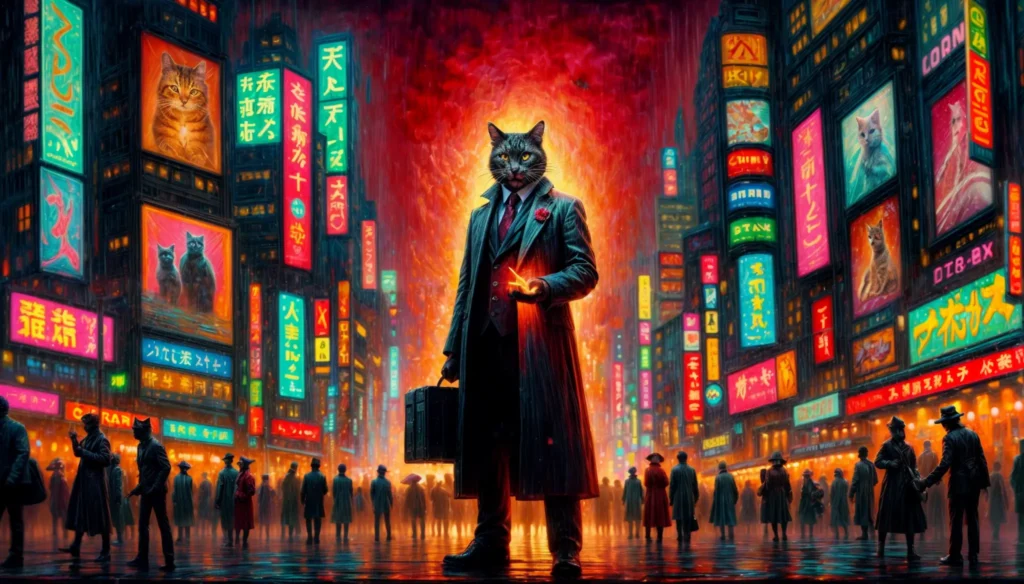
Gnostic Era
The Kenomitian History, as detailed in Volume II, illustrates a cosmos in constant flux, shaped by grand cycles, divine interventions, and the evolving lives of its inhabitants. It provides a rich historical context for understanding the complex realities and ongoing narratives within the Kenomitian Universe.
Watch Video on Youtube
The Kenomitian Universe | Volume II – Kenomitian History and Cosmology: The Wheel of Ages and the Four Realities is available on Amazon, in differents versions: Kindle (available on Kindle Unlimited) and Paperback (standard color). I’ll provide the links.
The Kenomitian Universe | Volume II - Kenomitian History and Cosmology: The Wheel of Ages and the Four Realities